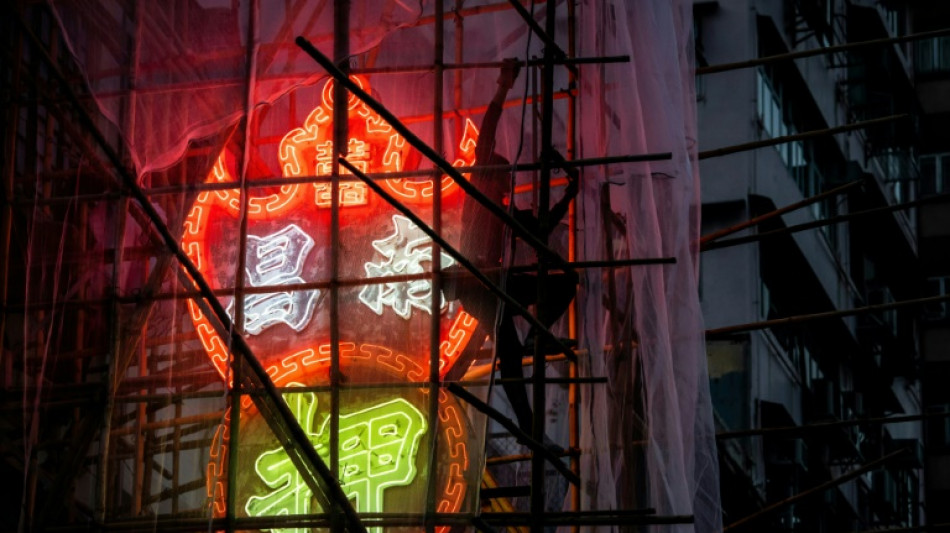
Hong Kong's bamboo scaffolders preserve ancient technique / Photo: ISAAC LAWRENCE - AFP

 'Devastating' waves leave California beach homes on brink of collapse

 Meta says its new AI models on par with OpenAI, Anthropic

 Talarico rejects mental health conspiracy theory after return from flu

 Brazil presidential candidate Flavio Bolsonaro to visit jailed father

 Brazil's patron saint reappears in polarized election campaign

 US Open champ Zverev to become tennis world number one

 Migrant crisis wounds unhealed in Ceuta as Spanish royals visit

 Brazilian judge allows Flavio Bolsonaro to visit jailed father

 France braces for fresh student demonstrations as Macron calls for 'respect'

 Zelensky doubtful on Russian acceptance of Trump's 'energy ceasefire'

 Federal agents search home of Trump critic Ilhan Omar: government

 Pakistan detains hundreds from ex-PM Khan's party as protests falter
 Australia's Smith off field after being struck on helmet

 UK retains early access to test latest US AI models

 Top NATO commander warns Russia any attack would be 'futile'

 Stolen Renoir paintings found behind wall in France: prosecutor

 UNHCR sounds alarm on funding crisis

 French supermarket chains say cyberattack forced refrigerator shutdown
 Minister's resignation rocks German coalition

 Hurricane Simon lashes Mexico's Pacific coast, threatens landfall

 France schools protest rumbles on as Macron urges 'respect'
 Americans Hall and Woodford win economics Nobel for stabilisation models

 MEXC Brings AI, TradFi and the Future of Trading to Life at TOKEN2049 Singapore

 Italian rice farmer beats heat with biodiversity haven

 Stocks mixed as oil prices slip after Trump hails 'energy ceasefire'

Mo Jia Yu wraps his legs around a pole to balance high above the ground and secure a joint, a skill he must master to become a bamboo scaffolder in Hong Kong.
The metropolis is one of the world's last remaining cities to use bamboo scaffolding in modern construction and building repair.
Scaffolders perched on bamboo frames several storeys high are a common sight, and are nicknamed "spiders" by Hong Kongers for their agility over the web-like latticework.
Mo is among dozens of students who enrol each year at the city's Construction Industry Council (CIC) to learn the traditionalmethod.
"You have to have a daring heart," said Mo, who has been at the school for nearly three months.
"You have to be aware of safety because you are working high up in the air."
Students learn how to firmly saddle the bamboo frame so that they can free up their hands to work on the scaffolds, which are held together with simple knots tied using nylon strips.
"This basic knot is something we learn first... we practise for an entire week to get it right," said another student, Ho Cheuk Wai.
"Then, the instructors will teach us how to put on the safety harness, and step-by-step we learn how to build all the way to the top."
Scaffolding using bamboo dates back centuries and was once a widespread practice across China and elsewhere in Asia.
Most cities in the region have phased it out to favour materials such as steel and aluminium.
In Hong Kong, intricate bamboo webs are still part of the cityscape, latticed around both old residential flats and glitzy skyscrapers.
- 'Courage and skill' -
Scaffolding is regulated by strict safety guidelines but is still viewed as a dangerous profession since the work is often done at dizzying heights.
"You need courage as well as skill to survive," said Wallace Chang, a professor at Hong Kong University's architecture department.
"This deters people from going into the industry."
Despite the perils involved in the craft, Chang hopes Hong Kong will preserve it as part of its cultural heritage.
Its popularity in the city is due to both price and efficiency.
Bamboo is readily available across the border in southern Chinese provinces. A pole costs around HK$15 (US$2) compared with HK$280 (US$35) for one made of metal.
Lightweight bamboo is also easier to transport through a cramped urban centre.
It is flexible, allowing builders to cut poles to desired lengths for different construction sites.
"Bamboo scaffolds are very suited to the odd and tight spaces in Hong Kong," explained instructor Kin Kee Wo, who has worked in the construction industry for nearly 30 years.
"It can be built in the most unthinkable places, in the most beautiful ways."
K.AbuTaha--SF-PST