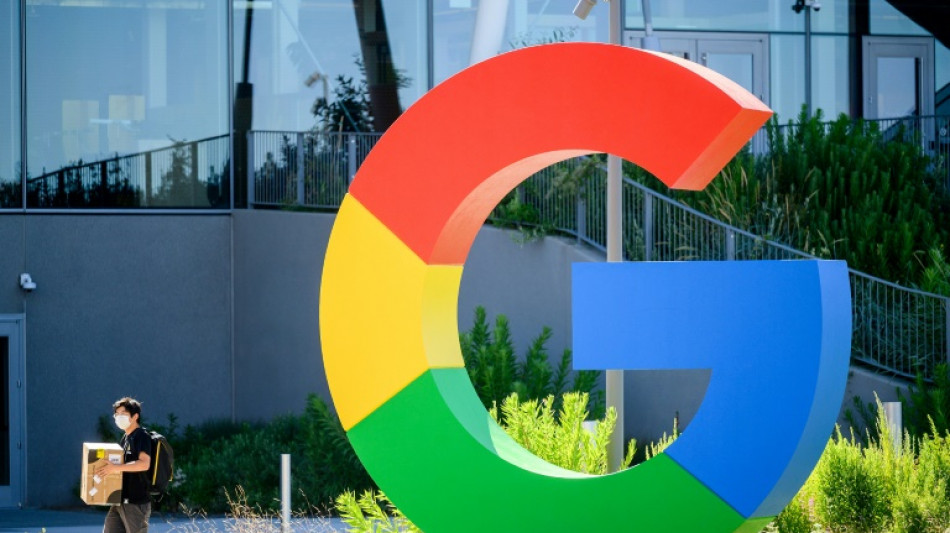
Big Tech defends landmark law in US Supreme Court / Photo: NOAH BERGER - AFP/File

 Hungary cuts anti-LGBTQ legislation from Orban-era law

 'Our future is being robbed': Greta Thunberg joins France student protests

 Late superstar Anita Mui's ashes missing in Hong Kong

 'No choice': IMF says developing countries must cut spending despite war shock

 Boasting South Korea footballers spark rethink of military service exemptions

 Five dead as Hurricane Simon, Rachel pummel Mexico's Pacific coast

 Seoul, Tokyo stocks plunge as Asia suffers fresh tech rout

 Damaged and drained, Indonesia's peatlands go up in smoke

 Dominant Australia wary of Pacific threat at Rugby League World Cup

 Pope to be admitted to hospital for lung operation

 Samoa's McFarland welcomes 'massive' arrival of ex-All Blacks for World Cup run-in

 Brewers beat Dodgers 7-4 to extend MLB playoff lead

 Teenager shoots headmaster, teacher at French school

 'Breaking Bad' actor RJ Mitte dead: representatives

 Former DR Congo president Kabila forms new force with M23 armed group

 Tom Cruise's 'Digger' tanks, leaving studio with $250 mn hole

 US actress Selma Blair arrested after flight altercation

 One dead as Hurricane Simon creeps along Mexico's Pacific coast

 Carrick's Man United 'hungry and eager' to fix worst start in decades

 Fury as US federal agents search anti-Trump lawmaker's home

 One goal enough for Flick as Barca enter Galatasaray cauldron

 A7 to unveil a service that will re-invent the international payments market

 'Status quo' with EU 'not good enough', UK PM says as summit date set

 Stolen Renoir paintings found behind wall in France

 French supermarkets suffer refrigerator shutdown after 'unprecedented' cyberattack

The US Supreme Court on Tuesday will consider a law that since 1996 has protected tech companies from lawsuits related to content posted on their platforms.
The nine justices will examine a case related to the November 2015 attacks in Paris and their ruling, expected by June 30, could have huge repercussions for the future of the internet.
The case stems from a complaint against Google filed by the relatives of Nohemi Gonzalez, one of the 130 victims of the attacks in the French capital.
The US citizen was studying in France and was murdered at the Belle Equipe bar by attackers from the Islamic State group.
Her family blame Google-owned YouTube for having recommended videos from the jihadist group to users, helping along the call to violence.
According to the family, "by recommend[ing] ISIS videos to users, Google assists ISIS in spreading its message and thus provides material support to ISIS," a legal brief said.
The complaint was dismissed by the federal courts on behalf of a law, known as Section 230, which was passed when the Internet was in its infancy and has become one of its pillars.
Section 230 states that in the US internet companies cannot be considered publishers and have legal immunity for the content posted on their platforms.
The novelty of the Gonzalez case is that the complainants are isolating algorithms as the cause of the harm, arguing that the highly complex recommendation systems perfected by big platforms fall out of the scope of Section 230.
"The selection of the users to whom ISIS videos were recommended was determined by computer algorithms created and implemented by YouTube," the Gonzalez family legal brief said.
The Supreme Court passes over the vast majority of the cases that come its way, and hearing this one indicates there is a willingness to modify the landmark law.
- Big tech cold sweat -
The prospect of the Supreme Court even tinkering with Section 230 is causing cold sweats in the tech world.
In the legal filing, Google pleaded that the court "not undercut a central building block of the modern internet."
"Recommendation algorithms are what make it possible to find the needles in humanity's largest haystack," Google said.
Allowing platforms to be sued for their algorithms, "would expose them to liability for third-party content virtually all the time," said Facebook owner Meta in its own brief, adding that recommendations serve to organize uploaded content.
On Wednesday, the top court in the US will continue its consideration of a very similar case, but this time asking if platforms should be subject to anti-terrorism laws.
In the past, several of the Supreme Court justices have expressed a willingness to move the lines on Section 230, which is increasingly contested given the backlash against big tech in recent years.
In 2021, the very conservative Clarence Thomas lamented that "many courts have construed the law broadly to confer sweeping immunity on some of the largest companies in the world."
Lawmakers in US Congress are very politically divided and unable to pass legislation that would update a law that was enacted when Facebook founder Mark Zuckerberg was 11 years old and Google did not exist.
Given the deep political divide, it therefore seems likely that the Supreme Court will move the lines faster than Congress.
But for now, "nobody knows exactly how," said Tom Wheeler, an expert at the Brookings Institution think tank. "That's why it's important to see how the hearing goes," he told AFP.
N.Shalabi--SF-PST