What if we killed all mosquitoes? / Photo: Olympia DE MAISMONT - AFP/File

 Apple CEO Tim Cook gives nod to founder Steve Jobs in final memo

 Russian finance minister makes unexpected appearance at G20
 Happy to be back in NY, Sabalenka advances

 Naomi Watts to receive lifetime award at top Spain film fest

 Jury hears closing arguments in Tupac Shakur murder trial
 Pakistan sack coach, send seven players home after England defeats

 New storms threaten Grand Canyon flood search, 2 bodies recovered
 France takes aim at ultra-fast fashion with new levy

 Tribunal says India cannot withdraw from water treaty with Pakistan

 John Galliano pulls US exhibition after antisemitism backlash

 French Top 14 boss offers 'no guarantees' for first Club World Cup

 Munoz reunites with Glasner after joining Forest from Palace

 Liverpool sign Barcola from PSG for £124 million

 Putin, Xi hold talks in Kyrgyzstan as regional summit begins

 ChatGPT becomes first AI chatbot to face tougher EU rules

 Man City sign Palmeiras winger Allan on five-year deal
 More flooding feared at Grand Canyon after storm leaves 15 missing

 RedHill Divests Talicia® to Apotex for $18 Million Cash Upfront Plus Milestones to Fuel Strategic Growth Opportunities

 MEXC Data: BTC Breaks $80,000, Major-Asset Spot Trading Volume Surges 300%

 سفارة فلسطين في عُمان تنظم ندوة لتعزيز الاستثمارات والفرص الاقتصادية

 Swollen rivers, washed-out roads hamper Nepal rescue effort

 In France's north, winegrowers bet on a warmer future

 Deadly virus stalks South Africa's sardines
 South Korea women's football body probes 'period' insult

 Transitional Fashion Essentials for Autumn: Key Pieces from M&S and Joe Browns

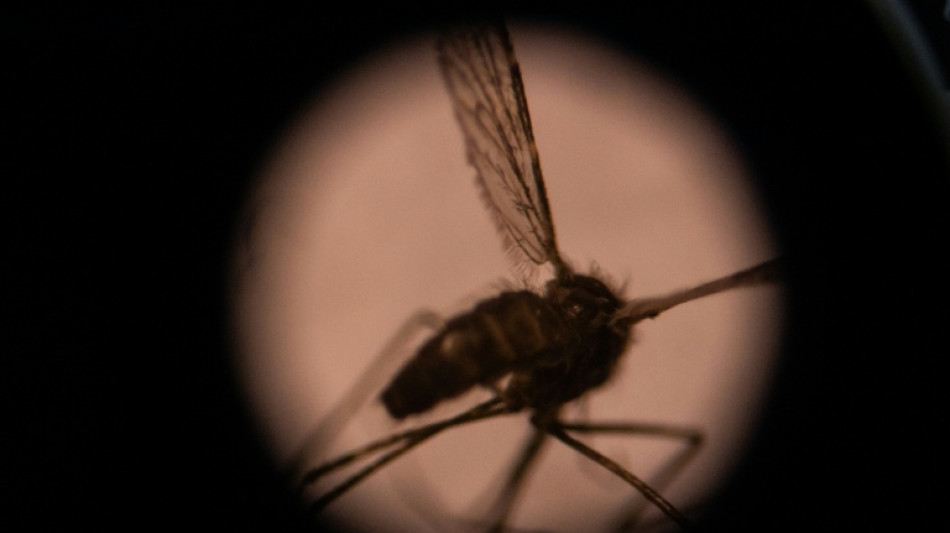
The deadliest animals are not lions, spiders or snakes, but the tiny mosquitoes that suck our blood, make us itchy and infect us with disease.
Mosquitoes kill around 760,000 people every year, according to research site Our World in Data, with humans ourselves coming a distant second.
This is because mosquitoes account for 17 percent of all infectious diseases, including malaria, dengue, yellow fever, chikungunya and Zika.
And as the world warms due to human-driven climate change, mosquitoes are roaming to new areas during longer summers, raising fears they could propel future health crises.
So how can humanity fight back against our greatest foe? Is there a safe way we could eradicate these killer mosquitoes -- and how bad would that be for the environment?
- #Notallmosquitoes -
First, we would not need to vanquish all mosquitoes. Out of roughly 3,500 mosquito species, only around 100 bite humans.
And just five species are responsible for roughly 95 percent of human infections, Hilary Ranson, a vector biologist at the Liverpool School of Tropical Medicine, told AFP.
On balance, Ranson felt that losing five mosquito species "could be tolerated given the huge devastation" they inflict on the world, from mass death to crippling economic fallout.
Dan Peach, a mosquito entomologist at the University of Georgia, broadly agreed, but emphasised that more information was needed to compare eradication with the alternatives.
- What about the environment? -
The five disease-spreading mosquitoes "have evolved to be very closely associated to humans," including feeding on and breeding near us, Ranson explained.
This means eradicating them would not have a major impact on the broader ecosystem -- and other, genetically similar but less deadly mosquitoes would likely quickly "fill that ecological niche", she added.
Peach was not convinced we know enough "about the ecology of most mosquito species to be confident one way or the other, but I also think that it is OK to acknowledge this and still proceed."
Mosquitoes do "transfer nutrients from their aquatic larval habitats" to other areas, and serve as food for insects, fish and other animals, he said.
They also pollinate plants, but this "isn't well understood and may vary by species", Peach added.
Ranson acknowledged there is a valid debate over the ethics of humans committing "specicide", while pointing out that we are currently unintentionally wiping out a huge number of species.
- How can it be done? -
One of the most prominent new technological options is called gene-drive, which involves genetically modifying animals so that they pass down a particular trait to their offspring.
When scientists tweaked females of malaria-carrying Anopheles gambiae mosquitoes to make them infertile, it wiped out a population in the lab over just a few generations.
Target Malaria, funded by the Gates Foundation, has tested this technology in several African countries.
However the effort was dealt a major blow last year when Burkina Faso's military-led government ended testing in the country, where it had been criticised by civil society groups and targeted by disinformation campaigns.
Another strategy involves infecting Aedes aegypti mosquitoes with the bacteria Wolbachia. This can crash their population -- or simply reduce their ability to transmit dengue.
This raises another question: do we actually need to kill them?
- What if we made them harmless instead? -
When Wolbachia-infected sterile mosquitoes were released in the Brazilian city of Niteroi, there was an 89 percent drop in dengue cases, research showed last year.
More than 16 million people across 15 countries have now been protected by these mosquitoes, with "no negative consequences", Scott O'Neill, founder of the World Mosquito Program, told AFP.
Meanwhile, a project called Transmission Zero is trying to use gene-drive technology to make it so that Anopheles gambiae mosquitoes no longer spread malaria.
Lab research published in Nature late last year suggested the scientists are getting closer to this goal, with the team planning to launch an in-country trial in 2030.
The Burkina Faso setback showed that these projects must have some "political support or buy-in" from the countries where they are tested, study author Dickson Wilson Lwetoijera of Tanzania's Ifakara Health Institute told AFP.
- No 'magic bullet' -
Rather than just relying on a technological "magic bullet", usually funded by the Gates Foundation, Ranson called for a more "holistic solution" for these diseases.
This would require giving people in disease-hit countries more access to treatment, diagnosis, better housing and better vaccines, she said.
However sweeping foreign aid cuts by Western countries have threatened progress against most mosquito-borne diseases over the last year, humanitarian organisations have warned.
N.Shalabi--SF-PST