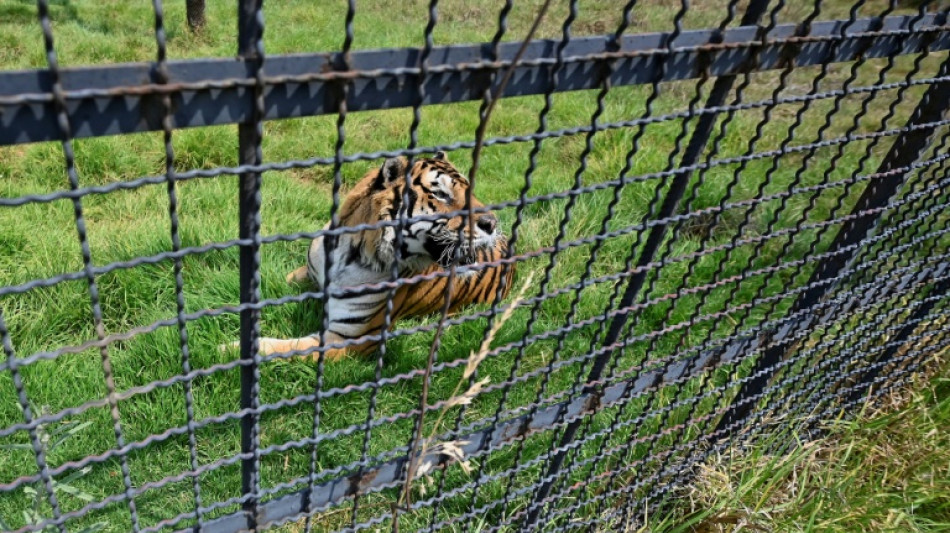
Far from home, new chance in Mexico for Frida the rescued 'pet' tiger / Photo: ALFREDO ESTRELLA - AFP

 Stocks retreat as bond yield fears persist, oil rises

 ARKBRIDGE’s David Mali Highlights AI-Driven Risk Management at the Finance Magnates London Summit

 Zuckerberg buys Gothic castle in Ireland: spokesman

 Belgium's fire of the century now 'under control'

 Evergrande's Xu Jiayin: from real-estate tycoon to life in prison

 Spurs eyeing move for Man City's Savinho and Marmoush - reports

 Springboks captain Kolisi to miss first All Blacks Test

 Japan to launch probe for Mars moons in October: space agency

 From beach to Bulls: relaxed Tsunoda savours rare F1 drive

 Prince Harry: key dates in life of returning UK royal

 North Korea launches missiles, Seoul says, after Trump floats Kim meet

 Oil jumps on Iran war tensions, offsetting bond yield fears

 Germany identifies far-right suspect in deadly 1970 antisemitic attack

 PrimeXBT Expands Swap-Free Trading to PXTrader 2.0

 Record number of locations in France top 40C over summer: AFP analysis

 Trump pledges 'economic warfare' on Iran, prompting Tehran derision

 'Girl with a Pearl Earring' in Japan, perhaps for the last time

 Russian strikes kill 13 in Kyiv, surrounding region

 'Simply lovely': Verstappen signs new Red Bull contract until 2030

 Australia coach Walters heading to St Helens after World Cup

 China jails founder, fines disgraced property giant Evergrande

 Russian strikes kill 12 in Kyiv, surrounding region

 US India ambassador's Kashmir remarks rile Pakistan; envoy summoned

 In Senegal's Saint-Louis, traces of slave-trading past fade away

 Russian strikes kill 9 in Kyiv, surrounding region
As a tiny cub four years ago, Frida the Bengal tiger was found chained up in a restaurant parking lot in Mexico City, dirty, emaciated and unable to walk.
Rescued and rehabilitated, she is now a popular attraction at the Reino Animal (Animal Kingdom) park along with hundreds of other exotic creatures taken from misguided Mexican "pet" owners -- including showy drug traffickers.
Far from the Asian forests where she belongs, Frida has made a full recovery and "no longer suffers," said park employee Agustin Bastida as the tigress gave a big yawn.
Lying on a grassy patch she looked disinterestedly at the humans ogling her from the other side of a fence.
Frida is one of six big cats among 1,100 animals -- 40 percent of them rescued exotic creatures -- at the park in Otumba, northeast of the Mexican capital.
Fellow residents include zebras, giraffes, wolves and a variety of birds.
According to authorities, some 150 to 200 exotic animals are seized in Mexico City every year, often after reports from neighbors.
Some of the worst culprits are drug lords such as Joaquin "El Chapo" Guzman, who had a pet monkey called "Boots."
In one major rescue in 2007, officials busting a "narco-mansion" found two jaguars, two tigers, two lions and a macaque, according to Lucio Garcia Gil, head of the PROFEPA environmental crimes office for Mexico City.
"There are many exotic birds, such as macaws or parrots, reptiles, many primates and big cats; it is what we have most detected that people have," he told AFP.
Two big cats were rescued in the megacity in 2021 and four -- including a lion cub -- so far this year.
- $5,000 for a lion –
According to Gil, a tiger or lion sells for between $1,000 and $5,000 on the Mexican black market.
Mexican law allows people to legally purchase exotic animals from registered dealers "as long as they keep them safe and provide the appropriate protection," he told AFP.
"Unfortunately... hardly anybody complies with the conditions," he said.
Illegal possession is punishable by up to nine years in prison or a fine of up to $15,000, though Gil said he could not remember anyone ever going to jail.
Keeping a big cat is expensive -- they can eat as much as 30 kilograms (66 pounds) of meat per day, and many private owners abandon the animals in the end.
Like lions or jaguars, Bengals -- which grow to stand over a meter tall and can weigh as much as 260 kilograms (570 pounds) -- are not easy housemates and many have their fangs and claws removed so that they do not destroy their surroundings, or owners.
- 'They are not pets' –
According to the UN Environment Programme, global wildlife trafficking generates as much as $23 billion per year.
It is the seventh-most lucrative illicit business, according to the Washington-based Global Financial Integrity.
In Mexico City, the lucky trafficked animals that do get rescued are taken to zoos and parks such as the 53-hectare (130-acre) Animal Kingdom northeast of the capital.
In Frida's case, she was brought in with a broken hip, which has since completely healed.
"She could not walk, it was very sad, very sad," said Bastida.
"People buy these animals to keep them as pets, but they are not pets," he added.
"They have to be in the wild or in open spaces where the conditions are adequate for a good quality of life."
V.Said--SF-PST