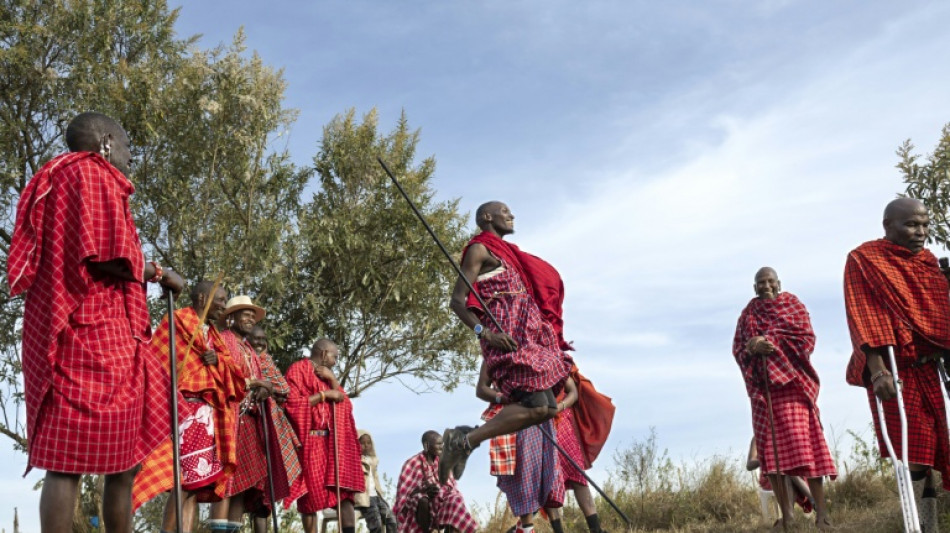
Kenyan girls still afflicted by genital mutilation years after ban / Photo: Tony KARUMBA - AFP

 EU trade chief seeks to dial down China tensions

 'Never again Bolsonaro': thousands march ahead of Brazil election runoff

 After botched execution, US woman was nearly taken off life support before revival
 Searing AIDS drama 'Elsinore' opens London film festival

 Evicted pensioner who sparked Spain housing protests dies: tenant union
 Golf star Rahm quitting LIV tour over 'unacceptable' terms

 Thousands march fearing return of a Bolsonaro presidency in Brazil

 French PM denies police ordered to confront student protesters
 Rubio touts US power, calls on Europe to emerge from 'slumber'

 Trump says 'we don't think' Russian plague is bio-weapon
 Five children among 26 killed in Ukraine after Russian strikes

 Man City should 'accept' punishment for rule breaches, says Lineker

 US woman who survived botched execution is awake and speaking
 From 1800s to modern pharma: a Nobel-winning chemistry quest

 Southampton boss Eckert given suspended ban over 'Spygate'

 Russia warns of 'false' information as second plague case reported
 IEA ready to release more oil reserves if necessary
 HSBC 'consults' over UK unit job cuts amid AI adoption

 UK court quashes five ex-traders' Libor rate rigging convictions
 XM Receives “Global Customer Experience Leader Award 2026” at the TrustFinance Performance Awards

 Stocks slide as oil climbs on Mideast flareup

 Heavy casualties in Ukraine after Russian strikes
 French wine harvest set to hit historic low

 Kyiv 'cannot agree' to EU membership limiting food exports: minister

 Arteta targets more Arsenal glory after signing new deal until 2030

Maasai women erupted with mocking heckles as a community elder, wrapped in a traditional red blanket, claimed that female genital mutilation had all but stopped in their community in southern Kenya.
The women know that mutilating young girls by removing their clitoris and inner labia -- framed as a rite of passage -- is still an entrenched practice in some remote villages of Narok county, around three hours from the nearest tarmac road.
One local nurse told AFP some 80 percent of girls in the area are still affected, despite the practice being made illegal in 2011.
"Why are you telling people that you have stopped, when we have teenage girls coming to the hospital who have been cut?" asked a woman in the crowd, gathered in Entasekera village to discuss the issue.
The women nodded emphatically, while the men sat stone-faced.
Female genital mutilation (FGM) has survived decades of pressure to end it, from British colonialists and later Kenyan and global NGOs.
It still exists not only among the rural southern Maasai, but also in Kenya's northeast -- with parts of the Somali diaspora community in the region reporting rates over 90 percent -- as well as in some urban areas and among educated groups, where campaigners have highlighted the rise of so-called medicalised FGM.
A 2022 government survey said the number of affected teenage girls had fallen from 29 percent to nine percent since 1998 nationally.But that does not reflect reality in some areas.
"We don't circumcise girls because the culture has changed," Maasai elder Moses Letuati, 50, told AFP -- before admitting one of his four daughters was cut.
Many of the Maasai men at the meeting said it should end, although one said only because an "uncut woman is better" in bed.
- Cries and curses -
"I was screaming and struggling," said Martha, 18, who was 10 when two women, under pressure from their community, cut her at home in Narok East on her father's say-so.
She later fled to a local shelter run by activist Patrick Ngigi, who says his organisation Mission with a Vision has rescued some 3,000 victims of FGM since 1997.
The shelter, supported by the United Nations Population Fund, has CCTV and panic buttons to protect the girls from fathers and elders who disagree with its mission.
"It's a dangerous job... You make so many enemies, but slowly with time, you get used to it," said Ngigi, who has faced curses by community elders.
The work is endless: at the village meeting, Ngigi was quietly approached by women pleading with him to take six more girls at risk of FGM.
The practise persists among the community thanks to beliefs that a girl should be cut ahead of marriage, and should she not undergo it will face ostracism.
As a result, Ngigi said change requires education, dialogue and an end to corruption.
"When a policeman comes and finds you doing it, you just give him something and you continue," he said.
Police officer Raphael Maroa rejected the accusation of corruption but admitted FGM was entrenched, with many girls now spirited over the nearby Tanzanian border for the procedure.
Ngigi criticised the community's lack of education -- roughly half of Narok's population is illiterate, according to 2022 figures -- but then admitted to AFP that his two daughters had also been cut, to avoid "conflict with my parents".
- 'A monster' -
The Maasai remain among Kenya's poorest communities and have faced decades of land loss due to colonial settlers and now tourism, and some remain suspicious of outsiders trying to change their way of life.
One young Maasai man told AFP he had friends who still believed in FGM, but said girls were no longer cursed -- a form of social control, used by elders -- for refusing it.
Cynthia Taruru would disagree.
Her father cursed her when her college-educated sister rescued her from FGM aged 11.
"I could see myself dying, or not getting children, because I believed my father had just cursed me," said Taruru, now 23.
"I had to pay my father a cow to get the curse lifted," she said.
Local health officials said victims of FGM often suffer fistulas and obstructed labour in childbirth, exacerbated by long distances to health facilities.
Many young women, hoping to protect their families from arrest for allowing FGM, opt for home births, raising the risk of complications and death, although officials said data was lacking on exact numbers.
Nurse Loise Nashipa, 32, at the Entasekera Health Centre, described FGM as "a monster".
"There's bleeding, and there's pain, and infection," she said, saying most cutting was still done by elderly women in unsanitary conditions.
Officially, FGM rates have fallen, said Rhoda Orido, head nurse at Narok County Hospital, "but I think it's because some deliver at home".
- 'He'll forgive me' -
As night fell at Ngigi's shelter, the girls celebrated the graduation of Cecilia Nairuko, 24, who ran away from FGM and forced marriage at the age of 15 and has qualified as a psychologist.
Beaming, she danced around the facility in a graduation gown that has passed from one girl to the next.
But her mood darkened when asked about her family: her father and three of her four brothers have not forgiven her.
She knows there is one path back to her family: "If I can earn enough money, he'll forgive me."
I.Yassin--SF-PST