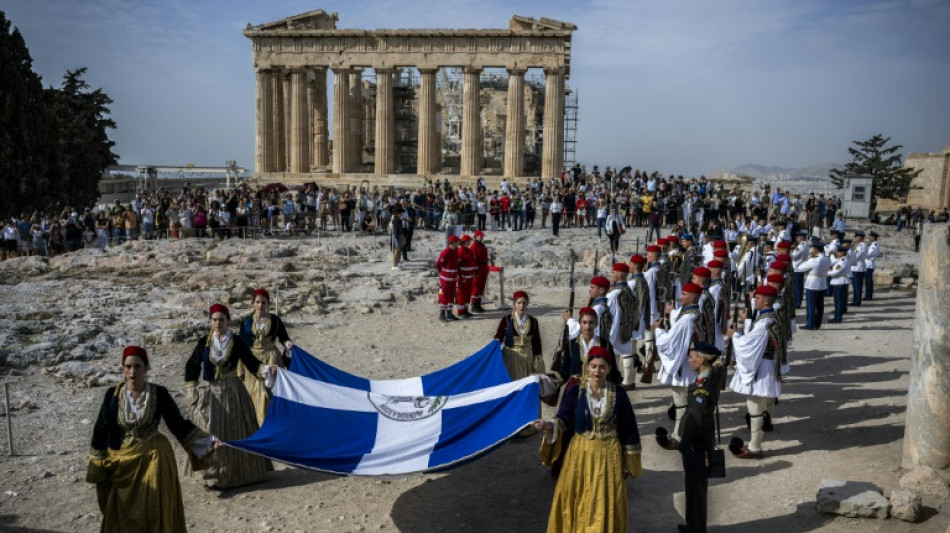
Buried Nazi past haunts Athens on liberation anniversary / Photo: Angelos TZORTZINIS - AFP

 Drovix Launches In-House Multi-Asset Liquidity and Execution Stack for Sub-Millisecond Fills, Tighter Spreads
 'So bad it's good': rough animated film becomes surprise Chinese hit

 'I'll adapt': First pregnant candidate navigates French presidential race
 Hong Kong convicts Tiananmen vigil activists of inciting subversion
 The Hong Kong Tiananmen vigil activists convicted in national security trial

 Eel-powered Japan whizz-kid, 11, chases Asian Games history

 Asian markets extend rally as traders assess US Treasuries pledge

 Barcelona enter new era as Flick targets La Liga hat-trick

 Pogacar favourite for Vuelta with Grand Tour treble in sight

 Bangladesh coach Simmons wary of Australia backlash in second Test
 Hong Kong Tiananmen activists to receive national security verdict
 Who are the candidates vying to lead the UN?
 Swiatek into Cincinnati semis after Rybakina injury

 University suspends academic behind Jason Arday plagiarism charges

 Key European leaders demand Israel halt West Bank settlement project

 McIlroy bounces back to share BMW Championship lead

 Cobolli fueled by candy in sweet defeat of Paul

 Jailed Pakistan ex-PM Khan moved to hospital on court order: party
 Pogacar eyes 'missing' piece ahead of Vuelta return

 US, Canada 'very close' to trade deal, Ottawa says, as details emerge

 Ronaldinho returns in search of 'beautiful' 300th goal
 US pushes allies, China to back Trump's economic war on Iran

 Former NBA MVP Harden reportedly set to return to Cavaliers

 Brook makes Pakistan pay for drop as England dominate first Test

 MemeCore Arrives on Nasdaq Through $1 Billion Landmark Treasury Transaction

A brass sculpture of a naked man being garrotted, a monument evoking prison bars and a sign are the only hints this sleepy central Athens street once housed the Gestapo's headquarters.
As Athens marks 80 years since its liberation from Nazi Germany in World War II this weekend, historians lament that this modest memorial is typical of the lack of attention paid to one of the most horrific periods in Greece's history.
In the basement below where a cosmetics store stands today, Adolf Hitler's secret police would beat, maim and torment their opponents, with thousands of resistance members arrested, tortured and killed during the Nazi occupation of 1941-44.
"In another European country this place would be a museum," Menelaos Charalampidis, a historian of the time told AFP by telephone.
Across Greece, 250,000 people died as a result of famine during the Nazi occupation, including some 45,000 in Athens and Piraeus, the capital's major port nearby.
More than 86 percent of Greece's Jews were deported to be exterminated in the Holocaust.
To bring this dark chapter of the capital's history to light, Charalampidis launched Athens History Walks, an initiative preserving locations where the Nazi occupation left its mark.
"Places of remembrance of this difficult period in Athens are not highlighted enough, and for some major events there are not even any monuments," he said.
For example, there is no monument to the famine's many victims, the historian noted -- an omission which may have to do with what happened after Greece was freed.
- A 'traumatised society' -
Greece annually commemorates October 28, 1940, when its strongman leader Ioannis Metaxas refused Italian fascist leader Benito Mussolini's ultimatum to surrender or face invasion.
Yet scant attention is paid to October 12, 1944, when Greece's foremost resistance group ELAS marched through Syntagma Square in central Athens to the applause of hundreds of thousands of people.
That historic moment marking Greece's freedom from the Nazi yoke was soon overshadowed by violence and clashes between the communist ELAS and British-backed royalist government for control of the country.
The ensuing 1946-1949 civil war saw the communists defeated and led to decades of political turmoil.
"The civil war in Greece, as in Spain, deeply traumatised society, making it impossible to deal with certain events of the past and move forward as a society," said historian Tasoula Vervenioti.
"If we don't deal with our past, we run the risk of losing our places of remembrance," she warned.
This year, the Athens city council urged the public to take part in a series of conferences and exhibitions to "honour those who fought for democracy and freedom".
"We are keeping memories alive so that younger people can learn and determine their future with strength and vigour," the city's socialist Mayor Haris Doukas said in a statement.
- 'Loss of memory' -
Charalampidis argued that because the Greek resistance effort was mainly by the left, successive conservative governments that followed the civil war had little interest in celebrating it.
It was not until 1982, after the country's first socialist government came to power following decades of conservative rule, that the main left-wing portion of Greece's 'national resistance' was officially recognised by parliament.
Taboos over the authorities' actions during the civil war have also stifled historical research into the era.
In 2017, the left-wing government of Alexis Tsipras created a special Directorate for the History of the Greek Police to investigate, among other issues, collaboration with the Nazis.
But some files have still not been integrated into the Greek national archives, meaning that regular access is not guaranteed, experts say.
"We have a major problem in Greece concerning the upkeep of archives and our historical culture," Charalampidis said.
"Governments are not interested in it and so there is a loss of memory despite our important history."
O.Mousa--SF-PST