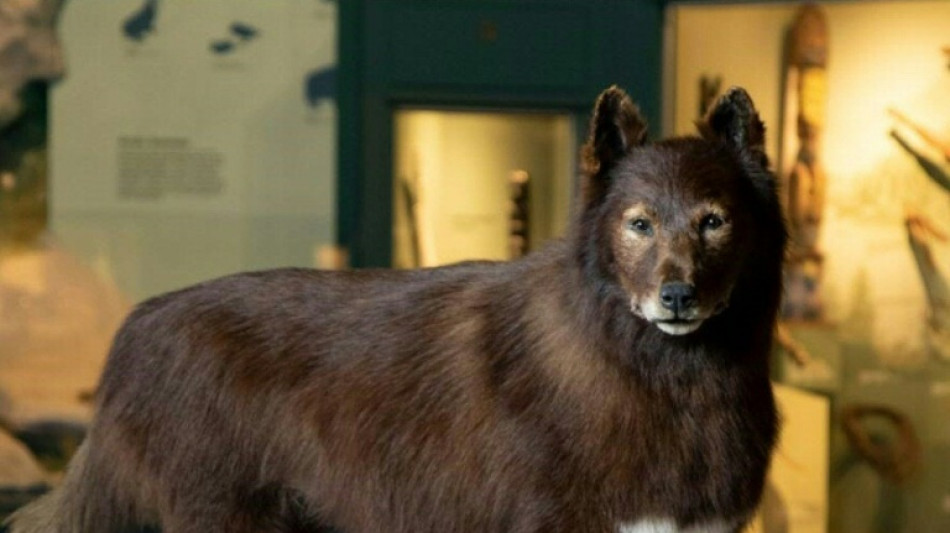
DNA study of famed US sled dog shows what made him so tough / Photo: - - EUREKALERT!/AFP

 STARTRADER Launches XAUUSD247, Extending Gold CFD Access Across the Full Week

 Spurs agree deal to sign Man City's Savinho: reports

 US-sanctioned ICC head warns against 'demise of international rule of law'

 Top India court orders new steps to protect threatened elephants

 Djibouti football federation accused of misusing funds

 Australia charges man with trying to pass Ukraine military intel to Russia

 Ex-Pakistan PM Khan taken back to jail after hospital checks: govt

 China, Indonesia hold talks on security, defence

 Train to nowhere? South Korea's lonely push for peace with the North

 Australia's Hussey mulls role with England for Ashes series

 Indian captain 'scapegoat' in Britain's Russia shadow fleet case, wife says

 Rosenior seeks to match Paris FC's capital ambition as Ligue 1 returns

 Inter set for Serie A title defence as Milan get Amorim reboot

 'Greatest' Springboks face All Blacks in clash of juggernauts

 William and Harry: Britain's warring royal brothers

 UN holds second informal poll for next leader

 In US mining hub, black lung rates soar

 Champions Arsenal embrace being 'hunted' as Premier League returns

 World No.2 Rybakina retires from Cincinnati clash with Swiatek

 'I heard you missed me': Melania Trump jokes about month out of spotlight

 Amazon Prime Video to invest $2 bn in Latin America productions

 Panama Canal to reduce shipping over El Nino-fueled drought

 Maradona trial on hold over possible medical evidence mix-up

 'Green dilemma': China's solar boom hurt birds, says study

 Pegula hangs on to dispatch Anisimova, reach Cincinnati semi-finals

New York's Central Park has a statue dedicated to him, and there's even been a movie about him: a sled dog named Balto. Now he is the focus of a DNA study, 90 years after he died, to see what made the pooch so famously tough.
In 1925, this Siberian husky was part of an expedition in Alaska called the serum run, the goal of which was to bring life-saving medicine to young people in the remote town of Nome that were threatened by diphtheria.
The mission in horrendous blizzards conditions involved a series of sled dog teams transporting the anti-toxin relay-style from the city of Anchorage. Balto led the dog team that covered the last stretch of the grueling journey.
The dog died in 1933, and its mounted body has been on display at the Cleveland Museum of Natural History ever since.
"Balto’s fame and the fact that he was taxidermied gave us this cool opportunity 100 years later to see what that population of sled dogs would have looked like genetically and to compare him to modern dogs," said Katherine Moon, a postdoctoral researcher at the University of California, Santa Cruz and the main author of the study.
It was published Thursday in the journal Science.
Her team took skin samples from the dog's belly and reconstructed its genome -- the complete set of genes in an organism.
They compared this genetic material with that of 680 contemporary dogs from 135 breeds.
Contrary to a legend that held that Balto was half wolf -- as suggested in an animated Universal Pictures film that came out in 1995 -- this analysis found no evidence he had wolf blood.
It turned out Balto shared ancestors with modern day Siberian Huskies and the sled dogs of Alaska and Greenland.
Zoom's team also compared Balto's genes with the genomes of 240 other species of mammals as part of an international effort called the Zoonomia Project.
This allowed researchers to determine which DNA fragments were common across all those species and have not therefore changed over the course of millions of years of evolution.
This stability suggests that these stretches of DNA are associated with important functions in the animal, and that mutations there could be dangerous.
The bottom line from the research was that Balto had fewer potentially dangerous mutations than modern breeds of dogs did, suggesting he was healthier.
"Balto had variants in genes related to things like weight, coordination, joint formation and skin thickness, which you would expect for a dog bred to run in that environment," Moon wrote in a statement.
G.AbuGhazaleh--SF-PST