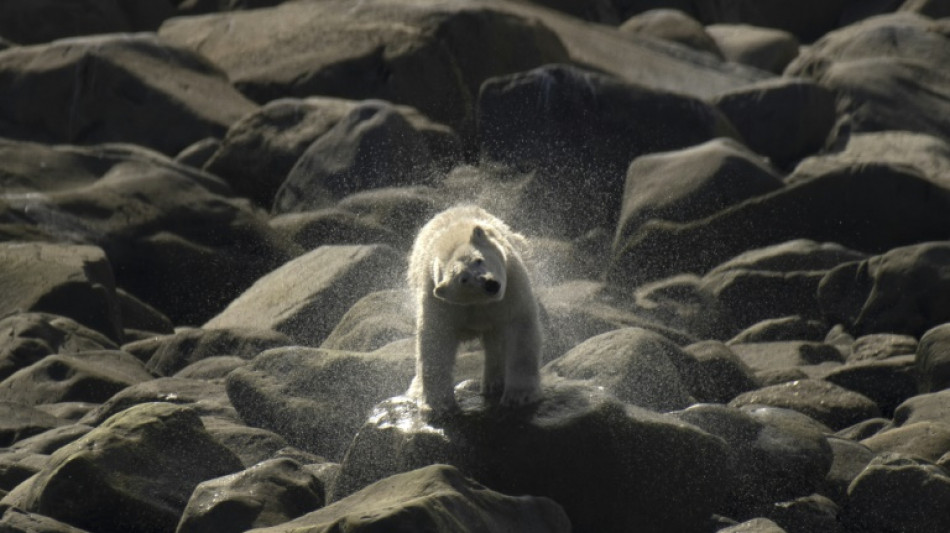
Canadian polar bears disappearing fast: study / Photo: Olivier MORIN - AFP/File

 William and Harry: Britain's warring royal brothers

 UN holds second informal poll for next leader

 In US mining hub, black lung rates soar

 Champions Arsenal embrace being 'hunted' as Premier League returns

 World No.2 Rybakina retires from Cincinnati clash with Swiatek
 'I heard you missed me': Melania Trump jokes about month out of spotlight

 Amazon Prime Video to invest $2 bn in Latin America productions

 Panama Canal to reduce shipping over El Nino-fueled drought

 Maradona trial on hold over possible medical evidence mix-up

 'Green dilemma': China's solar boom hurt birds, says study

 Pegula hangs on to dispatch Anisimova, reach Cincinnati semi-finals

 US charges woman with IS-inspired plot to blow up New York State Capitol

 What a record-breaking El Nino could mean for the world

 Duplantis edges Karalis to win Lausanne Diamond League pole vault

 Alcaraz to return for US Open title defence

 China's rapid solar expansion hurt bird diversity: study

 President Paul Biya back in Cameroon after 73 days away

 Newcastle boss Jaissle unfazed by lack of respect
 US Open purse to top $100 mn as Grand Slams form player council

 Hull aim to silence critics after unexpected promotion to Premier League

 Pakistan hit back against England after Cox and Root fifties

 Walmart reports mixed results as gas prices drag on US sales growth

 Wang downs Sindhu to break Indian hearts at badminton worlds

 As Europe's rivers recede, shippers scramble to limit damage

 Alonso won't confirm Fernandez will remain at Chelsea after Man City link
Polar bears are disappearing fast from the Western part of Hudson Bay, on the southern tip of the Canadian Arctic, according to a new government survey.
The number of female bears and cubs in particular has seen a dramatic decline.
Researchers have flown over the region -- which includes the town of Churchill, a tourist destination touted as the "polar bear capital of the world" -- every five years to count the number of bears and extrapolate population trends.
During the last survey in late August and early September 2021, the results of which were released earlier this month, they spotted 194 bears and, based on that count, estimated a total population of 618 bears, down from 842 five years earlier.
"Comparison to aerial surveys estimates from 2011 and 2016 suggests that the WH (Western Hudson Bay population) may be decreasing in abundance," the study said.
It also "revealed significant declines in the abundance of adult female and subadult bears (cubs) between 2011 and 2021."
"The observed declines are consistent with long-standing predictions regarding the demographic effects of climate change on polar bears," the researchers said.
They also cited possible displacements of bears to neighboring regions and hunting for the population decline.
The bears' sea-ice habitat has been disappearing at an alarming rate, with the far north warming up to four times faster than the rest of the world.
The sea ice has become less thick and is breaking up earlier in the spring as well as freezing later in the fall.
The bears rely on the ice for foraging for seals, movement and reproduction.
Since the 1980s, the ice pack in the bay has decreased by nearly 50 percent in summer, according to the US National Snow and Ice Data Center.
A report published two years ago in the journal Nature Climate Change suggested this trend could lead to the near-extinction of these animals, noting there were 1,200 polar bears on the western shores of Hudson Bay in the 1980s.
P.Tamimi--SF-PST