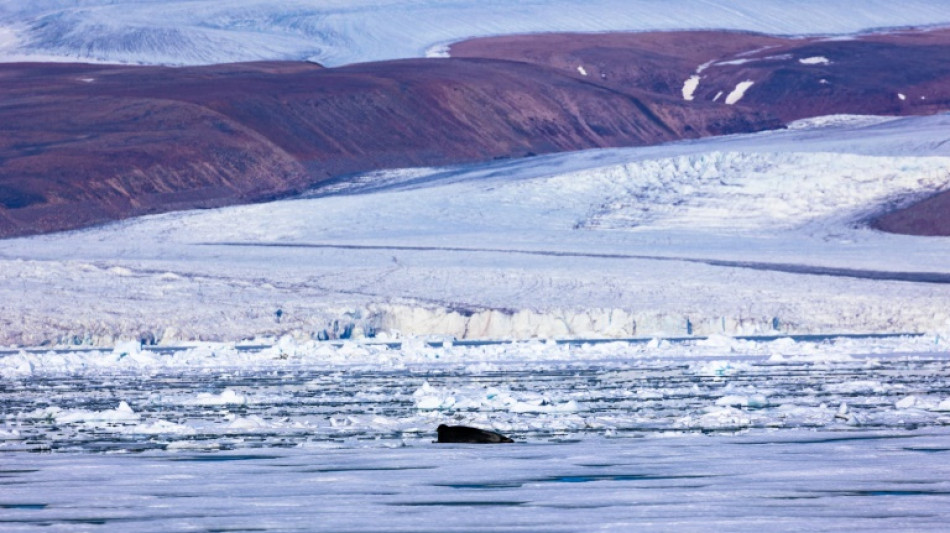
Thinning Greenland ice sheet may mean more sea level rise: study / Photo: Kerem Yücel - AFP

 Lyon down Palace in Europa League, Sunderland leave it late

 UniCredit says receives ECB green light for Commerzbank takeover
 New York City pension fund asks Anthropic to delay IPO

 Venezuela's Maduro denies US torture charges as 'false accusations'

 Somalia sets May presidential election despite insecurity

 Chelsea's Caicedo eager to be more of a leader

 Rahm reaches separation deal with LIV in bankruptcy court

 UN chief urges nations to end 'war on nature'

 Newcastle boss Jaissle says Fernandez-Pardo just needs a goal

 Infantino offers apology but 'no answers' at FIFA meeting over World Cup plan

 Don't exclude Turkey from 'Made in Europe' plan: minister to AFP

 French duo Justice to score 'GTA VI': game maker

 El Nino a 'terrifying' threat to coral reefs: UN biodiversity expert
 Barcola must get used to Liverpool highs and lows, says Iraola

 Versus Trade Wins Best ECN/STP Broker APAC 2026, Marking Third UF Awards Recognition

 Three dead as Istanbul sees heaviest rainfall in 80 years

 US producer prices see biggest jump since 2022 in added challenge to Trump
 Swiatek avoids seed exodus to breeze into Wuhan last eight
 PM condemns 'chaos' as violent protests grip Albania

 'I couldn't breathe', Russell Brand's alleged rape victim says

 Pope's cancer operation already reshaping papacy

 Zverev cruises past De Minaur to reach Shanghai semi-finals

 Ukraine's Zelensky defies Trump with Russian refinery strikes

 Holders Australia edge New Zealand 24-22 to open Rugby league World Cup

 'Ocarina of Time': Nintendo gives Zelda classic a modern makeover

Part of Greenland's ice sheet is thinning further inland than previously believed, which will likely lead to greater sea level rise by the end of this century, a new study found Wednesday.
The findings pertain to a northeast section of the giant ice block covering, but the trend is likely happening elsewhere on Greenland and Earth's other ice sheet, in Antarctica.
The implications are worrying, as sea level rise already threatens millions of people living along coasts that could find themselves underwater in the decades and centuries to come.
Scientists have previously focused on the edges of Greenland's ice sheet to examine active melting as global temperatures rise, largely using satellite data.
But the authors of Wednesday's study looked further inland, over 100 kilometres from the coast.
What they found was alarming: thinning from Greenland's coast stretched back 200 to 300 kilometres (125 to 185 miles).
"What we see happening at the front reaches far back into the heart of the ice sheet," said first author Shfaqat Abbas Khan in a press release about the study, published in Nature.
"The new model really captures what's going on inland, the old ones do not... you end up with a completely different mass change, or sea level projection," he told AFP in an interview.
The researchers installed GPS stations on the ice sheet to gather more precise information, and also used satellite data and numerical modelling, all of which provided a new set of data likely to alter global sea level rise projections.
The research was conducted at the Northeast Greenland Ice Stream (NEGIS), which covers an estimated 12 percent of Greenland, according to co-author Mathieu Morlighem.
It found that the thinning could add between 13.5 and 15.5 millimetres to sea levels by the end of this century -- equivalent to the entire Greenland ice sheet's contribution during the past 50 years.
"The NEGIS could lose six times more ice than existing climate models estimate," the report found.
- 'Reduce CO2' -
One reason for the inland thinning is the intrusion of warm ocean currents, which in 2012 caused the floating extension of the NEGIS to collapse.
That event "has accelerated ice flow and triggered a wave of rapid ice thinning that has spread upstream".
The Greenland ice sheet is currently the main factor in swelling the Earth's oceans, according to NASA, with the Arctic region heating at a faster rate than the rest of the planet.
In a landmark report on climate science last year, the Intergovernmental Panel on Climate Change (IPCC) said the Greenland ice sheet would contribute up to 18 centimetres to sea level rise by 2100 under the highest emissions scenario.
The massive ice sheet, two kilometres thick, contains enough frozen water to lift global seas by over seven metres (23 feet) in total.
The researchers will now extend their methods to look at other glaciers on Greenland and Antarctica, and some new data could be available in a year or so.
Earth's surface has warmed, on average, nearly 1.2 degrees Celsius since pre-industrial times, unleashing a catalogue of impacts from heatwaves to more intense storms.
Under the Paris climate deal, countries have agreed to limit warming to well under 2C.
World leaders are currently meeting in Sharm el-Sheikh, Egypt, for UN climate talks aimed at slashing harmful emissions and boosting funding to green developing country economies.
Khan said the thinning trend on Greenland's ice sheet will be near impossible to reverse, but can at least be slowed with the right policies in place.
"I really hope that they agree on a reduction on CO2 and as soon as possible," he said in a message to leaders at the COP27 climate talks.
Y.Shaath--SF-PST