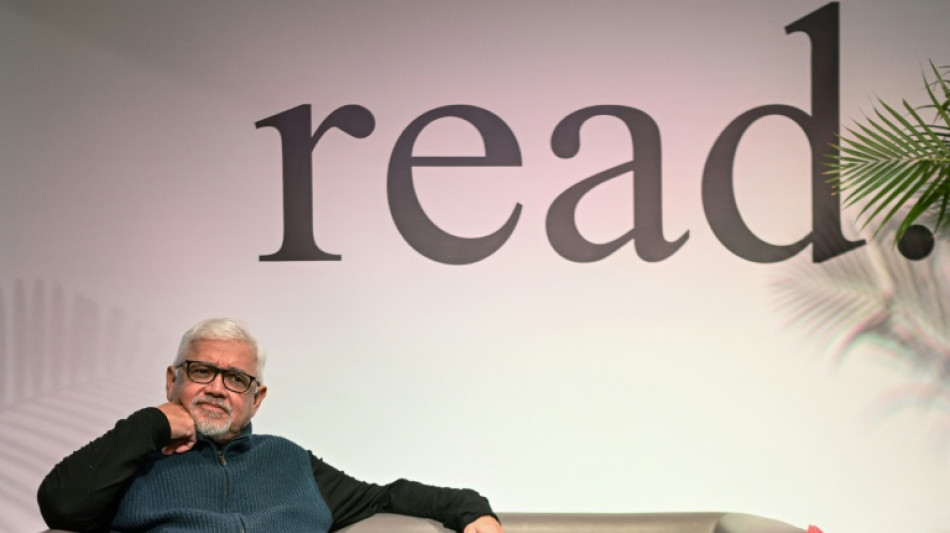
As world burns, India's Amitav Ghosh writes for the future / Photo: Arun SANKAR - AFP

 Man allegedly behind 'targeted' attack on Australian lawmaker appears in court

 Musk backs SpaceX-Tesla merger as rocket firm turns profit

 Zelensky, US hail 'productive' talks to end Trump feud

 'Unbelievable' Foden back in the groove with treble in Man City rout

 Pistons rally to beat Celtics in NBA 2026-27 season opener

 PSG late show downs Barca in Champions League, Liverpool fight back

 Liverpool strike back to beat Villarreal in seven-goal thriller

 Dow boosted as markets rotate from tech shares

 Zelensky hails resumption of US advance warning of strikes on Ukraine

 Carrick says only wins can ease doubts over Man Utd future

 Top NBA Draft pick Dybantsa to miss opener with ankle sprain

 Italy sends troops, toughens security laws after Milan clashes

 Alberta separatists vow to fight on, risking turmoil for Canada

 Two men re-arrested for suspected spying for Iran in airbase scare: UK police

 Guatemalan man gets 30 years for truck smuggling deaths of 53 migrants

 'Clayface' gets under the skin of the superhero genre

 Zelensky, US envoys hold Oslo talks as Ukraine claims US missile holdup

 All-rounder Minhas stars as Pakistan crush England in tri-series

 Bavuma hits 179, Rabada strikes as South Africa dominate

 Allrounder Minhas stars as Pakistan crush England in tri-series

 Albania PM blames 'hybrid war' for week of unrest

 Bavuma hits 179 to lead South African fightback

 Solid GM results overshadowed by latest jump in commodity costs

 Houthi attacks undermine Saudi Arabia's economic ambitions

 French PM vows 'massive' police deployment for new demonstrations

Indian writer Amitav Ghosh has long chronicled the entangled histories of empire, trade and migration.
But his recent work focuses on what he considers the most urgent concern: the accelerating unravelling of the natural world and the moral legacy left for the future.
Author of "The Great Derangement", "The Glass Palace" and the forthcoming "Ghost-Eye", Ghosh speaks bluntly about our headlong rush towards disaster while treating the Earth as an inert resource rather than a living world.
"Sadly, instead of shifting course, what we're actually doing is accelerating towards the abyss," he told AFP from a bookshop in New Delhi. "It's like people have lost their minds."
"We're hurtling down that path of extractivism," he said. "Greenwashing rhetoric has been completely adopted by politicians. And they've become very skilled at it."
His latest novel, a mystery about reincarnation, also touches on ecological crisis, with the "ghost-eye" of its title symbolising the ability to perceive both visible and invisible alternatives.
- 'Little joys' -
Despite his subject matter, Ghosh manages to resist writing from a place of unrelenting grief.
"You can't just write in the tone of tragic despair," he said, calling himself "by nature, sort of a buoyant person".
"One has to try and find the little joys that the world offers," the 69-year-old said.
For Ghosh, one of those joys arrives each week, when his nine-month-old grandson comes to visit.
The baby is central to Ghosh's motivation to pen another manuscript, one that will remain sealed for nearly a century as part of the Future Library project.
"I think what I'm going to end up doing is writing a letter to my grandson", he said.
"In an earlier generation, young people would ask their parents, 'What were you doing during the war?'" he said.
"I think my grandson's generation will be asking, 'What were you doing when the world was going up in flames?' He'll know that I was thinking about these things."
Ghosh will submit his manuscript this year as part of Norway's literary time capsule, joining works by Margaret Atwood, Han Kang, Elif Shafak and others to be sealed until 2114.
- Mysterious world -
"It's an astonishingly difficult challenge," he said, knowing his book will be read when the world "will be nothing like" today.
"I can't really believe that all the structures we depend on will survive into the 22nd century," he said.
"We can see how quickly everything is unravelling around us," he added.
That change is fuelling the world's "increasingly dysfunctional politics", he said.
The younger generations "see their horizons crashing around them," he said. "And that's what creates this extreme anxiety which leads, on the one hand, to these right-wing movements, where they're filled with nostalgia for the past, and on the other hand, equally, it also fuels a certain left-wing despair."
Born in Kolkata in 1956, Ghosh rose to prominence with novels such as "The Shadow Lines" and "The Calcutta Chromosome", and later the acclaimed Ibis Trilogy.
He holds India's highest literary honour, the Jnanpith Award, won numerous international prizes, including France's Prix Medicis Etranger, and is regularly tipped as a possible Nobel winner.
But he is wary of overstating literature's capacity to change history.
"As a writer, it would be really vainglorious to imagine that we can change things in the world," he said, while accepting that young activists tell him they are "energised" by his books.
Ghosh keeps writing, not out of faith that words can halt catastrophe, but because they can inspire different kinds of thought.
His involvement with the Future Library embodies that impulse: a grandfather's attempt to speak honestly from a burning world.
"We have to restore alternative ways of thinking about the world around us, of recognising that it's a world that's filled with mystery," he said. "The world is much, much stranger than we imagine."
B.Mahmoud--SF-PST