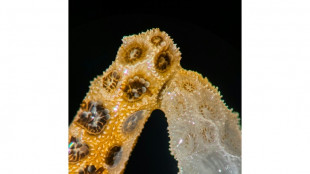
Controversial monkey study reignites animal testing debate / Photo: Indranil MUKHERJEE - AFP

 Lyon down Palace in Europa League, Sunderland leave it late

 UniCredit says receives ECB green light for Commerzbank takeover

 New York City pension fund asks Anthropic to delay IPO

 Venezuela's Maduro denies US torture charges as 'false accusations'

 Somalia sets May presidential election despite insecurity

 Chelsea's Caicedo eager to be more of a leader

 Rahm reaches separation deal with LIV in bankruptcy court

 UN chief urges nations to end 'war on nature'
 Newcastle boss Jaissle says Fernandez-Pardo just needs a goal

 Infantino offers apology but 'no answers' at FIFA meeting over World Cup plan

 Don't exclude Turkey from 'Made in Europe' plan: minister to AFP

 French duo Justice to score 'GTA VI': game maker

 El Nino a 'terrifying' threat to coral reefs: UN biodiversity expert

 Barcola must get used to Liverpool highs and lows, says Iraola

 Versus Trade Wins Best ECN/STP Broker APAC 2026, Marking Third UF Awards Recognition

 Three dead as Istanbul sees heaviest rainfall in 80 years

 US producer prices see biggest jump since 2022 in added challenge to Trump

 Swiatek avoids seed exodus to breeze into Wuhan last eight

 PM condemns 'chaos' as violent protests grip Albania

 'I couldn't breathe', Russell Brand's alleged rape victim says

 Pope's cancer operation already reshaping papacy

 Zverev cruises past De Minaur to reach Shanghai semi-finals

 Ukraine's Zelensky defies Trump with Russian refinery strikes

 Holders Australia edge New Zealand 24-22 to open Rugby league World Cup

 'Ocarina of Time': Nintendo gives Zelda classic a modern makeover

Mother monkeys permanently separated from their newborns sometimes find comfort in plush toys: this recent finding from Harvard experiments has set off intense controversy among scientists and reignited the ethical debate over animal testing.
The paper, "Triggers for mother love" was authored by neuroscientist Margaret Livingstone and appeared in the Proceedings of the National Academy of Sciences (PNAS) in September to little fanfare or media coverage.
But once news of the study began spreading on social media, it provoked a firestorm of criticism and eventually a letter to PNAS signed by over 250 scientists calling for a retraction.
Animal rights groups meanwhile recalled Livingstone's past work, that included temporarily suturing shut the eyelids of infant monkeys in order to study the impact on their cognition.
"We cannot ask monkeys for consent, but we can stop using, publishing, and in this case actively promoting cruel methods that knowingly cause extreme distress," wrote Catherine Hobaiter, a primatologist at the University of St Andrews, who co-authored the retraction letter.
Hobaiter told AFP she was awaiting a response from the journal before further comment, but expected news soon.
Harvard and Livingstone, for their part, have strongly defended the research.
Livingstone's observations "can help scientists understand maternal bonding in humans and can inform comforting interventions to help women cope with loss in the immediate aftermath of suffering a miscarriage or experiencing a still birth," said Harvard Medical School in a statement.
Livingstone, in a separate statement, said: "I have joined the ranks of scientists targeted and demonized by opponents of animal research, who seek to abolish lifesaving research in all animals."
Such work routinely attracts the ire of groups such as People for the Ethical Treatment of Animals (PETA), which opposes all forms of animal testing.
This controversy has notably provoked strong responses in the scientific community, particularly from animal behavior researchers and primatologists, said Alan McElligot of the City University of Hong Kong's Centre for Animal Health and a co-signer of the PNAS letter.
He told AFP that Livingstone appears to have replicated research performed by Harry Harlow, a notorious American psychologist, from the mid-20th century.
Harlow's experiments on maternal deprivation in rhesus macaques were considered groundbreaking, but may have also helped catalyze the early animal liberation movement.
"It just ignored all of the literature that we already have on attachment theory," added Holly Root-Gutteridge, an animal behavior scientist at the University of Lincoln in Britain.
- Harm reduction -
McElligot and Root-Gutteridge argue the case was emblematic of a wider problem in animal research, in which questionable studies and papers continue to pass institutional reviews and are published in high impact journals.
McElligot pointed to a much-critiqued 2020 paper extolling the efficiency of foot snares to capture jaguars and cougars for scientific study in Brazil.
More recently, experiments on marmosets that included invasive surgeries have attracted controversy.
The University of Massachusetts Amherst team behind the work says studying the tiny monkeys, which have 10-year-lifespans and experience cognitive decline in their old age, are essential to better understand Alzheimers in people.
Opponents argue results rarely translate across species.
When it comes to testing drugs, there is evidence the tide is turning against animal trials.
In September, the US Senate passed the bipartisan FDA Modernization Act, which would end a requirement that experimental medicines first be tested on animals before any human trials.
The vast majority of drugs that pass animal tests fail in human trials, while new technologies such as tissue cultures, mini organs and AI models are also reducing the need for live animals.
Opponents also say the vast sums of money that flow from government grants to universities and other institutes -- $15 billion annually, according to watchdog group White Coat Waste -- perpetuate a system in which animals are viewed as lab resources.
"The animal experimenters are the rainmaker within the institutions, because they're bringing in more money," said primatologist Lisa Engel-Jones, who worked as a lab researcher for three decades but now opposes the practice and is a science advisor for PETA.
"There's financial incentive to keep doing what you've been doing and just look for any way you can to get more papers published, because that means more funding and more job security," added Emily Trunnel, a neuroscientist who experimented on rodents and also now works for PETA.
Most scientists do not share PETA's absolutist stance, but instead say they adhere to the "three Rs" framework -- refine, replace and reduce animal use.
On Livingstone's experiment, Root-Gutteridge said the underlying questions might have been studied on wild macaques who naturally lost their young, and urged neuroscientists to team up with animal behaviorists to find ways to minimize harm.
G.AbuOdeh--SF-PST