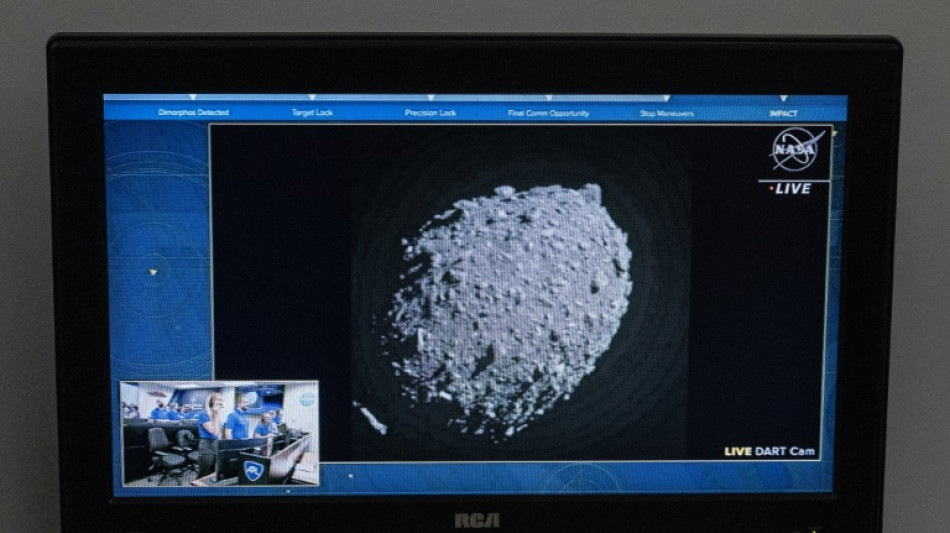
'A new era': NASA strikes asteroid in key test of planetary defense / Photo: Jim WATSON - AFP

 El Nino a 'terrifying' threat to coral reefs: UN biodiversity expert
 Barcola must get used to Liverpool highs and lows, says Iraola

 Versus Trade Wins Best ECN/STP Broker APAC 2026, Marking Third UF Awards Recognition

 Three dead as Istanbul sees heaviest rainfall in 80 years

 US producer prices see biggest jump since 2022 in added challenge to Trump
 Swiatek avoids seed exodus to breeze into Wuhan last eight
 PM condemns 'chaos' as violent protests grip Albania

 'I couldn't breathe', Russell Brand's alleged rape victim says

 Pope's cancer operation already reshaping papacy

 Zverev cruises past De Minaur to reach Shanghai semi-finals

 Ukraine's Zelensky defies Trump with Russian refinery strikes

 Holders Australia edge New Zealand 24-22 to open Rugby league World Cup

 'Ocarina of Time': Nintendo gives Zelda classic a modern makeover

 France charges teen shooter citing revenge for bullying in school

 Martinez blames 'anger' for dig at Man Utd hierarchy

 Crowds build as Albanian PM tours protest aftermath

 China-North Korea bridge opens, 12 years late

 Asian Cup in Saudi Arabia could be postponed but 'no hurry' to decide: AFC

 Conrad wields axe after South Africa loss to Australia

 School roof collapse kills teacher, 27 children in NW Pakistan

 Haze turns Indonesia skies orange, shuts schools in East Timor

 California puts first US billionaire tax to the vote
 School headscarf ban meets resistance in Austria

 World's top cocoa producer aims for a climate-tough bean

 Why is Shell facing lawsuits over climate disasters in Brazil and the Philippines?

NASA's DART spaceship on Monday struck the asteroid Dimorphos in a historic test of humanity's ability to prevent a cosmic object from devastating life on Earth.
Impact occurred at 7:14 pm Eastern Time (2314 GMT), 10 months after the Double Asteroid Redirection Test probe blasted off from California to carry out its first-of-a-kind experiment.
"We're embarking on a new era, an era in which we potentially have the capability to protect ourselves from something like a dangerous hazardous asteroid impact," said Lori Glaze, director of NASA's planetary science division.
The 530-foot (160-meter) asteroid Dimorphos -- roughly comparable to an Egyptian pyramid -- which orbits a big brother called Didymos, first appeared as a speck of light around an hour before the collision.
Its bread bun shape and rocky surface finally came into clear view in the last few minutes as DART raced toward it at roughly 14,500 miles (23,500 kilometers) per hour.
To be sure, the pair of asteroids pose no threat to our planet as they loop the Sun, passing about seven million miles from Earth at their current "minimized" position.
But NASA has deemed the experiment important to carry out before an actual need is discovered.
By striking Dimorphos head on, NASA hopes to push it into a smaller orbit, shaving 10 minutes off the time it takes to encircle Didymos, which is currently 11 hours and 55 minutes -- a change that will be detected by ground telescopes in the days or weeks to come.
The proof-of-concept experiment will make a reality of what has before only been attempted in science fiction -- notably in films such as "Armageddon" and "Don't Look Up."
- Technically challenging -
Minutes after impact, a toaster-sized satellite called LICIACube, which already separated from DART a few weeks ago, was expected to make a close pass of the site to capture images of the collision and the ejecta -- the pulverized rock thrown off by the strike.
LICIACube's pictures will be sent back in the next weeks and months.
Also watching the event: an array of telescopes, both on Earth and in space -- including the recently operational James Webb -- which might be able to see a brightening cloud of dust.
The mission has set the global astronomy community abuzz, with more than three dozen ground telescopes participating, including optical, radio and radar.
"There's a lot of them, and it's incredibly exciting to have lost count," said DART mission planetary astronomer Christina Thomas.
Finally, a full picture of what the system looks like will be revealed when a European Space Agency mission four years down the line called Hera arrives to survey Dimorphos' surface and measure its mass, which scientists can currently only guess at.
- Being prepared -
Very few of the billions of asteroids and comets in our solar system are considered potentially hazardous to our planet, and none are expected in the next hundred years or so.
But wait long enough, and it will happen.
We know that from the geological record -- for example, the six-mile wide Chicxulub asteroid struck Earth 66 million years ago, plunging the world into a long winter that led to the mass extinction of the dinosaurs along with 75 percent of all species.
An asteroid the size of Dimorphos, by contrast, would only cause a regional impact, such as devastating a city, albeit with greater force than any nuclear bomb in history.
How much momentum DART imparts on Dimorphos will depend on whether the asteroid is solid rock, or more like a "rubbish pile" of boulders bound by mutual gravity -- a property that's not yet known.
If it had missed, NASA would have another shot in two years' time, with the spaceship containing just enough fuel for another pass.
But its success marks the first step towards a world capable of defending itself from a future existential threat.
D.Khalil--SF-PST