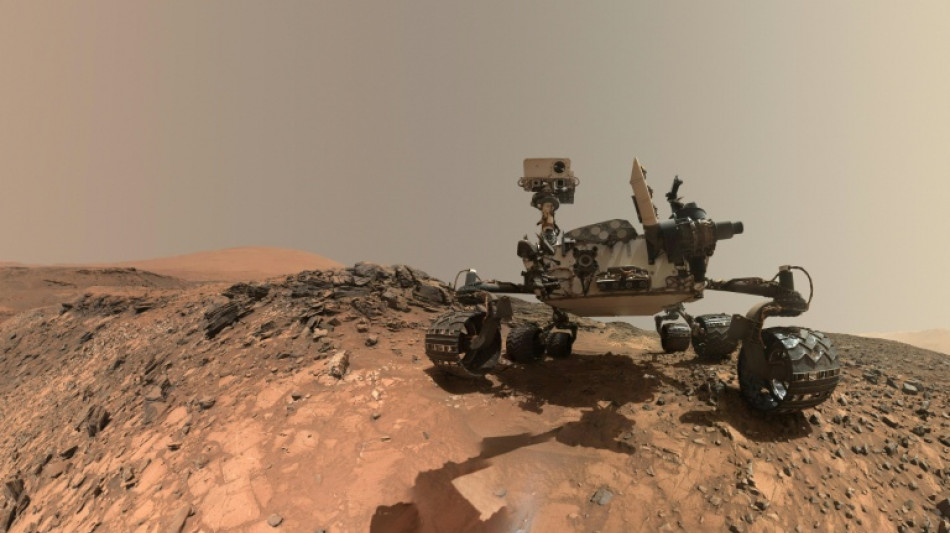
Rover discovers more building blocks of life on Mars / Photo: Handout - NASA/AFP/File

 Two dead as Istanbul endures heaviest rainfall in 80 years

 After latest Nepal flood, survivors fear for future

 EU leaders clash over budget as spectre of French elections looms

 'No place to breathe': life in Indonesia's fire epicentre

 'Can't sleep': Spain's housing crunch upends lives

 Musk calls on Ukraine's Zelensky to 'go' after satellite slowdown row

 Still smiling at 117, Albanian may be world's oldest woman

 Pope has 'good night' in hospital: Vatican

 China's economy seen missing target as global shocks bite: AFP poll

 Costa Rica opens jail inspired by El Salvador mega-prison

 Same-sex couple takes fight for equality to Slovakian court

 'High hopes' as Indonesian women get a football league, again

 'Expectations high' for Bordeaux-Begles' Champions Cup hat-trick bid, says Depoortere

 Rennie urges All Blacks to stay focused against 'hurting' Wallabies

 Palmeiras beat Fluminense 2-1 in Libertadores semi-final first leg

 Brewers blasts leave Dodgers on brink

 Tech stock lead rout after US inflation fuels rate hike bets

 Al-Fayed survivors say UK police missing 'bigger picture'

 Online 'witch hunt' sweeps up Asians misidentified as US rape accused

 Prospect of Bolsonaro win looms large over Brazil's Indigenous

 Freed from Belarus, founder of Lady Gaga's biggest fan site tells his story

 Behind AI's carbon footprint, a potential climate tool

 Trump's new press secretary faces scrutiny over credentials

 PSG 'got lucky' to win Man City thriller, says Luis Enrique

 Real Madrid comeback stuns Roma as Mourinho enjoys happy reunion

A NASA rover has discovered more building blocks of life on Mars after carrying out a chemistry experiment never before conducted on another planet, scientists said Tuesday.
The organic molecules are not definitive evidence of past life, the NASA-led team emphasised, because they could also have formed on the red planet or crash-landed on meteorites.
But it proves that these important clues to Martian history have been preserved on the surface for more than three billion years, they added.
Back then, the surface of Mars was thought to have been dotted with huge lakes and rivers full of liquid water, a key ingredient for life as we know it.
NASA's Curiosity rover landed in a former lake bed called the Gale crater in 2012, and has been searching for signs of possible past life since.
The car-sized rover carried two tubes of a chemical called TMAH, which can break apart organic matter to see what it is made out of.
"This experiment's never been run before on another world," Amy Williams, an astrobiologist working on the Curiosity mission told AFP.
The team were under pressure because they only had "two shots to get it right", added Williams, the lead author of a new study describing the results.
The experiment, conducted in 2020, detected more than 20 organic molecules, including several that had never before been confirmed on Mars.
These included a molecule called benzothiophene, which has also been found in meteorites and asteroids.
"The same stuff that rained down on Mars from meteorites is what rained down on Earth, and it probably provided the building blocks for life as we know it on our planet," Williams said.
Another molecule containing nitrogen "is a precursor to how DNA is eventually built," she added.
"We're seeing the building blocks for life -- prebiotic chemistry on Mars -- preserved in these rocks for billions of years."
- Future missions -
But none of this can prove that life -- even tiny, microbial organisms -- once flourished on Mars.
One way to potentially make such an "extraordinary claim" would be to bring some Martian rocks back to Earth so scientists can study them more closely, Williams said.
NASA's Perseverance rover has already collected a bunch of rocks for such a mission, called Mars Sample Return.
However the mission has effectively been cancelled by the administration of President Donald Trump following a US Congress vote in January.
Future missions could still benefit from Curiosity's demonstration that experiments using the TMAH chemical work on other worlds, the new study in Nature Communications said.
The European Space Agency's Rosalind Franklin rover, which has a much longer drill than Curiosity, will take the chemical to Mars.
After years of delays, NASA announced last week that the ESA's rover is now scheduled to blast off towards the red planet in late 2028.
The chemical will also be on board the Dragon rotorcraft, which is planned to launch in 2028 on a mission to explore Saturn's moon Titan.
Q.Bulbul--SF-PST