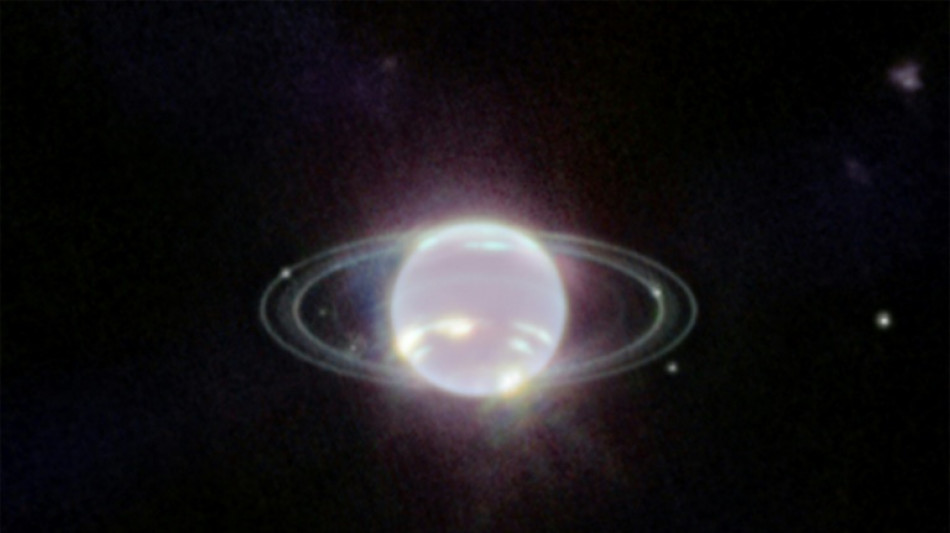
Neptune's delicate rings captured in new Webb image / Photo: Space Telescope Science Institut - ESA/WEBB/AFP

 El Nino a 'terrifying' threat to coral reefs: UN biodiversity expert

 Barcola must get used to Liverpool highs and lows, says Iraola

 Versus Trade Wins Best ECN/STP Broker APAC 2026, Marking Third UF Awards Recognition

 Three dead as Istanbul sees heaviest rainfall in 80 years

 US producer prices see biggest jump since 2022 in added challenge to Trump

 Swiatek avoids seed exodus to breeze into Wuhan last eight

 PM condemns 'chaos' as violent protests grip Albania

 'I couldn't breathe', Russell Brand's alleged rape victim says

 Pope's cancer operation already reshaping papacy

 Zverev cruises past De Minaur to reach Shanghai semi-finals

 Ukraine's Zelensky defies Trump with Russian refinery strikes

 Holders Australia edge New Zealand 24-22 to open Rugby league World Cup

 'Ocarina of Time': Nintendo gives Zelda classic a modern makeover

 France charges teen shooter citing revenge for bullying in school

 Martinez blames 'anger' for dig at Man Utd hierarchy

 Crowds build as Albanian PM tours protest aftermath

 China-North Korea bridge opens, 12 years late

 Asian Cup in Saudi Arabia could be postponed but 'no hurry' to decide: AFC

 Conrad wields axe after South Africa loss to Australia

 School roof collapse kills teacher, 27 children in NW Pakistan

 Haze turns Indonesia skies orange, shuts schools in East Timor

 California puts first US billionaire tax to the vote

 School headscarf ban meets resistance in Austria

 World's top cocoa producer aims for a climate-tough bean

 Why is Shell facing lawsuits over climate disasters in Brazil and the Philippines?

The James Webb Space Telescope has turned its gaze away from the deep universe towards our home Solar System, capturing an image of a luminous Neptune and its delicate, dusty rings in detail not seen in decades, NASA said Wednesday.
The last time astronomers had such a clear view of the farthest planet from the Sun was when NASA's Voyager 2 became the first and only space probe to fly past the ice giant for just a few hours in 1989.
Now Webb's unprecedented infrared imaging capabilities has provided a new glimpse into Neptune's atmosphere, said Mark McCaughrean, a senior advisor for science and exploration at the European Space Agency.
The telescope "takes all that glare and background away" so that "we can start to tease out the atmospheric composition" of the planet, McCaughrean, who has worked on the Webb project for more than 20 years, told AFP.
Neptune appears as deep blue in previous images taken by the Hubble Space Telescope due to methane in its atmosphere.
However the near-infrared wavelengths captured by Webb's primary imager NIRCam shows the planet as a greyish white, with icy clouds streaking the surface.
"The rings are more reflective in the infrared," McCaughrean said, "so they're much easier to see".
The image also shows an "intriguing brightness" near the top of Neptune, NASA said in a statement. Because the planet is tilted away from Earth and takes 164 years to orbit the Sun, astronomers have not yet had a good look at its north pole.
Webb also spotted seven of Neptune's 14 known moons.
- Strange moon -
Looming over Neptune in a zoomed-out image is what appears to be a very bright spiky star, but is in fact Triton, Neptune's strange, huge moon haloed with Webb's famed diffraction spikes.
Triton, which is larger than dwarf planet Pluto, appears brighter than Neptune because it is covered in ice, which reflects light. Neptune meanwhile "absorbs most of the light falling on it", McCaughrean said.
Because Triton orbits the wrong way around Neptune, it is believed to have once been an object from the nearby Kuiper belt which was captured in the planet's orbit.
"So it's a pretty cool to go and have a look at," said McCaughrean.
As astronomers sweep the universe searching for other planets like our own, they have found that ice giants such as Neptune and Uranus are the most common in the Milky Way.
"By being able to look at these ones in great detail, we can key into our observations of other" ice giants," McCaughrean said.
Operational since July, Webb is the most powerful space telescope ever built, and has already unleashed a raft of unprecedented data. Scientists are hopeful it will herald a new era of discovery.
Research based on Webb's observations of both Neptune and Triton is expected in the next year.
"The kind of astronomy we're seeing now was unimaginable five years ago," McCaughrean said.
"Of course, we knew that it would do this, we built it to do this, it is exactly the machine we designed.
"But to suddenly start seeing things in these longer wavelengths, which were impossible before... it's just absolutely remarkable."
H.Darwish--SF-PST