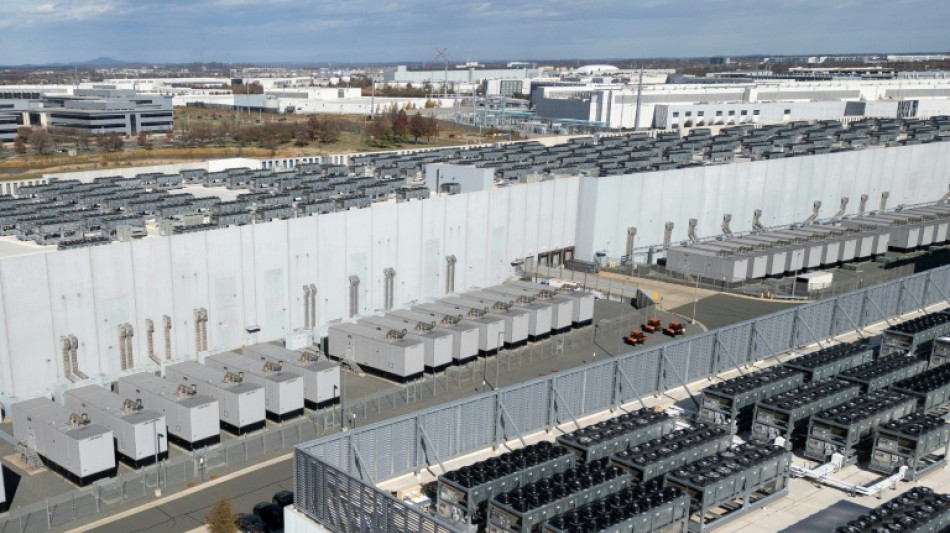
Cold winter and AI boom pushed US emissions increase in 2025 / Photo: ANDREW CABALLERO-REYNOLDS - AFP/File

 Trump says US reviewing position on Falkland Islands

 Saka strikes as flawless Arsenal punish troubled Villa

 Oil prices surge on renewed fighting in US-Iran war

 Cycling superstar Pogacar has surgery after Vuelta crash

 Man City agree deal for Everton's Ndiaye

 Apple CEO Tim Cook gives nod to founder Steve Jobs in final memo

 Russian finance minister makes unexpected appearance at G20

 Happy to be back in NY, Sabalenka advances

 Naomi Watts to receive lifetime award at top Spain film fest

 Jury hears closing arguments in Tupac Shakur murder trial

 Pakistan sack coach, send seven players home after England defeats

 New storms threaten Grand Canyon flood search, 2 bodies recovered

 France takes aim at ultra-fast fashion with new levy

 Tribunal says India cannot withdraw from water treaty with Pakistan

 John Galliano pulls US exhibition after antisemitism backlash

 French Top 14 boss offers 'no guarantees' for first Club World Cup

 Munoz reunites with Glasner after joining Forest from Palace

 Liverpool sign Barcola from PSG for £124 million

 Putin, Xi hold talks in Kyrgyzstan as regional summit begins
 ChatGPT becomes first AI chatbot to face tougher EU rules

 Man City sign Palmeiras winger Allan on five-year deal

 More flooding feared at Grand Canyon after storm leaves 15 missing

 RedHill Divests Talicia® to Apotex for $18 Million Cash Upfront Plus Milestones to Fuel Strategic Growth Opportunities

 MEXC Data: BTC Breaks $80,000, Major-Asset Spot Trading Volume Surges 300%

 سفارة فلسطين في عُمان تنظم ندوة لتعزيز الاستثمارات والفرص الاقتصادية

Greenhouse gas emissions in the United States rose last year, snapping a two-year streak of declines as cold winter temperatures drove demand for heating fuel and the AI boom led to a surge in power generation, a think tank said Tuesday.
The 2.4 percent increase in the world's largest economy came as President Donald Trump and Republicans in Congress enacted a series of policies hostile to climate action, though the authors of the Rhodium Group report said the full impact of those decisions will only be felt in the coming years.
Rich nations, including Europe's largest economies Germany and France, are slowing the pace of planet-warming gas reductions even as global temperatures continue to soar, with 2025 set to be confirmed as the third-hottest year on record.
US emissions fell in 2024 by 0.5 percent and in 2023 by 3.5 percent, after the economy rebounded from the Covid pandemic and emissions rose in both 2021 and 2022, by 6.3 percent and 1.2 percent respectively.
Building emissions rose 6.8 percent, followed by the power sector where emissions increased by 3.8 percent, the report found.
"Weather is bumpy year-to-year -- we tend to see building emissions bump around like this due to higher fuel use for heating," Rhodium Group analyst and the report's co-author Michael Gaffney told AFP.
"But in the power sector this is about growing significant demand from data centers, cryptocurrency mining operations and other large load customers," he added.
Compounding matters, high natural gas prices driven by heating demand and increasing liquefied natural gas (LNG) exports allowed a comeback for coal, the "dirtiest" fossil fuel, which accounted for 13 percent more electricity generation than in 2024.
Still, solar had a strong year, surging by 34 percent and helping lift the grid share of zero-emitting power sources by one percentage point to a record-high 42 percent -- even as wind growth slowed and nuclear and hydropower output held steady.
In transport, the highest-emitting sector, emissions were nearly flat despite a fifth straight year of record road traffic, as the vehicle fleet became more efficient and consumers rushed to buy electric and hybrid vehicles before tax credits expired.
- Solar energy up -
The United States is the world's second-largest emitter after China, but has the highest cumulative emissions since the start of the industrial era in the mid-19th century.
US greenhouse gas emissions have generally trended downward since peaking in 2007, averaging a decline of around one percent per year despite periods of flat or rising emissions, driven by natural gas replacing coal, a growing share of renewables in power generation, improved energy efficiency and more.
Since taking office, Trump has declared war on renewable energy -- from abruptly halting wind farm permits to signing into law legislation that brought an early end to clean energy tax credits and revoking electric vehicle incentives.
He has also opened more public lands to drilling, while his administration has sought to repeal regulations aimed at limiting emissions of the super-pollutant methane from oil and gas facilities.
But co-author Ben King told AFP that growth in solar generation and electric vehicle sales still pointed to "sustained progress."
What this all means for the medium and long term remains unclear, though the United States is far off track to meet its previous Paris Agreement target of cutting emissions 50–52 percent by 2035 relative to 2005 levels, set under former president Joe Biden.
"Solar, wind, batteries, these are some of the cheapest things to bring onto the grid right now and some of the most available things," said King.
"So there's some economic impetus to be doing that, regardless of whether the White House or Congress, or whoever likes it or doesn't."
The Rhodium Group generates its annual estimates using a combination of official data and -- because government greenhouse gas inventories have a significant lag -- supplements this with modeling based on economic and power-generation data.
But since the Trump administration is no longer expected to collect relevant data, future forecasts are set to become more difficult.
V.Said--SF-PST