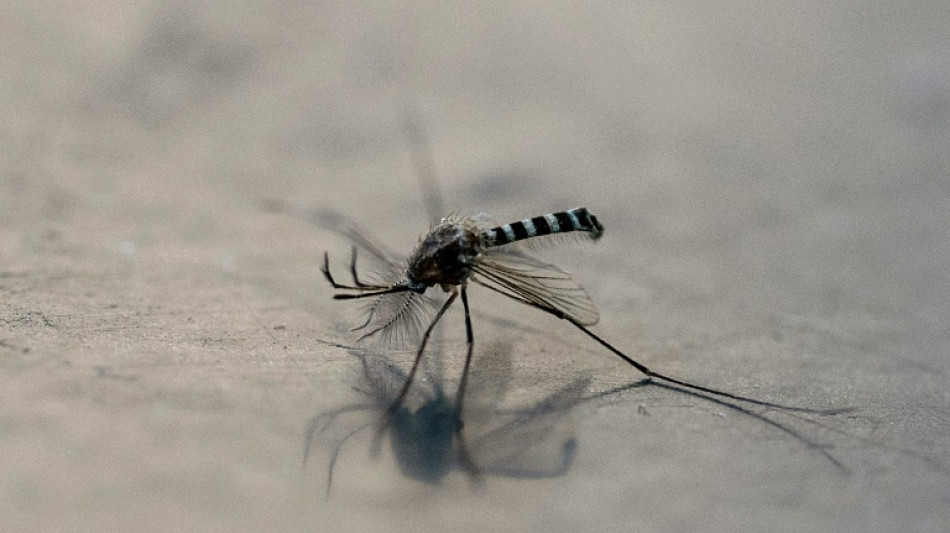
Mosquitoes with 'toxic' semen could stem disease spread: research / Photo: Yuri CORTEZ - AFP

 Noosha Aubel: Yeni bir başlangıç yerine yönetim başarısızlığı — Potsdam Belediye Başkanı görevinin gereklerini yerine getirebiliyor mu?

 Elon Musk unveils Tesla's 'flying' car

 누샤 아우벨: 새로운 출발 대신 드러난 리더십 실패 — 포츠담 시장은 과연 직무를 감당할 능력이 있는가?

 noosha-aubel-lingdao-shibai-bocitan-shizhang-nengfou-shengren

 Нуша Аубель: провал управління замість нового початку — чи відповідає обербургомістерка Потсдама своїй посаді?

 Cost-of-living demonstrations to grip pre-election France

 Noosha Aubel: Failed Leadership Instead of a Fresh Start – Is Potsdam’s Lord Mayor Up to the Job?

 'Real inequality': France's education divide laid bare by protests

 Opera on Ukraine's children aims to 're-awaken' concern for war

 AI is coming for every company, Nvidia boss says

 Millions may be forced to move as climate change hits South Asia: UN

 Four killed battling Indonesia fires as toxic haze cloaks region

 Thai farmers, fishermen challenge IMF, World Bank at Bangkok rally

 In Malaysia, frustration grows over Indonesia haze

 Why India's voter revision drive has stoked fear and anger

 Munster eye fitting tribute to 'special' Foley in Racing reunion

 Shooter kills teacher, three children at Oregon elementary school

 Fed's Warsh surprised by world economy's 'resilience'

 Four killed in Indonesia battling fires causing toxic haze

 New Zealand star Ponga breaks arm in Rugby League World Cup opener

 Indonesian stocks dive 11% as MSCI weighs market reclassification

 Seoul dismisses Pyongyang's scepticism over hypersonic weapon test

 Yamal on song as entertainers Barcelona face Betis challenge

 Wong weighs haze prosecutions as Singapore air quality worsens

 Brush fire prompts an evacuation order along Los Angeles coast

Genetically engineered mosquitoes with toxic semen could be a new weapon against tropical disease, Australian scientists said after trialling the novel pest control method.
The "toxic male technique" aims to breed mosquitoes that express venomous proteins in their semen, killing off females after mating.
Female mosquitoes are targeted because only they bite and drink blood, thereby spreading diseases such as malaria and dengue fever.
Scientist Sam Beach from Australia's Macquarie University said the method "could work as quickly as pesticides without also harming beneficial species".
"This innovative solution could transform how we manage pests, offering hope for healthier communities and a more sustainable future."
The first proof-of-concept trials used fruit flies, a common laboratory species favoured for its short two-week life cycle.
Female flies that bred with "toxic" males had a significantly reduced lifespan, the scientists found.
Researcher Maciej Maselko said the team would now trial the method in mosquitoes.
"We still need to implement it in mosquitoes and conduct rigorous safety testing to ensure there are no risks to humans or other non-target species," he said.
Genetic engineering has been used for years to control populations of disease-spreading mosquitoes.
Typically, these approaches slow reproduction by releasing hordes of male insects that are genetically modified to be sterile.
Computer models showed techniques actively killing biting females could be far more effective, the research team said.
The research was described in a paper published by peer-reviewed journal Nature Communications on Tuesday evening.
G.AbuOdeh--SF-PST