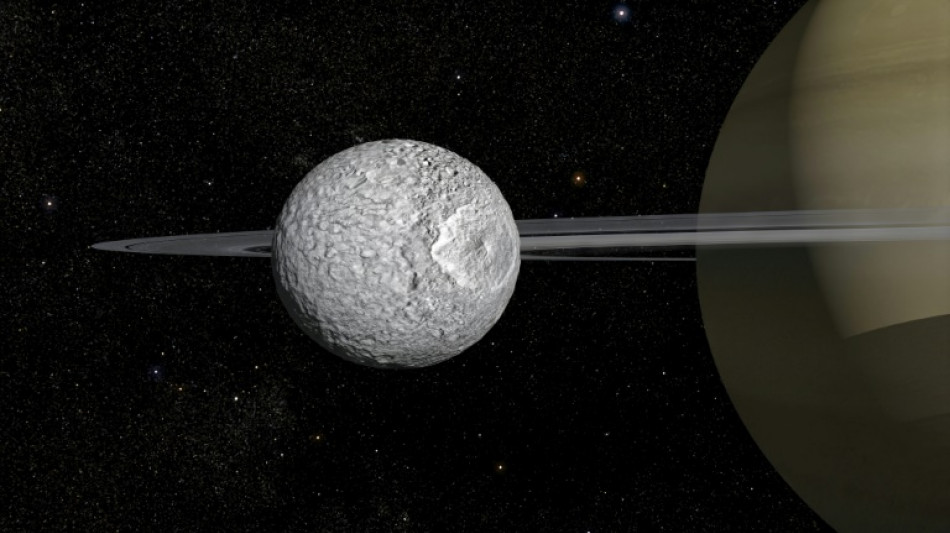
Life on 'Death Star'? Saturn moon Mimas has hidden ocean / Photo: Frederic Durillon - Animea Studio | Observatoire de Paris - PSL, IMCCE/AFP

 US influence, AI and mistrust cloud Alberta independence vote

 Pant, Bumrah named in India Test squad for New Zealand tour

 Coen brothers say they plan to make film together again

 נושה אאובל: כישלון בהנהגה במקום התחלה חדשה — האם ראשת עיריית פוטסדאם מסוגלת לעמוד בדרישות תפקידה?
 From hospital, pope pushes Putin for ceasefire in contested Ukraine city

 تأسيس تم العالمية لتصدير خبرات أبوظبي في الخدمات الرقمية
 موعد مباراة الزمالك والجيش الرواندي والقنوات الناقلة

 تسلا تكشف تفاصيل جديدة عن رودستر وسط حديث عن قدرات طيران قصيرة

 أحمد التويزي يتولى رئاسة مجلس النواب المغربي في مرحلة سياسية جديدة

 مجلس الشعب السوري يستعد للانتقال من التنظيم الداخلي إلى التشريع

 مصر تحتج على افتتاح كولومبيا سفارة في القدس وتستدعي القائم بالأعمال

 اتحاد موظفي أونروا يطلب ضمانات رسمية لوقف تقليصات غزة

 تقرير فلسطيني يرصد أكثر من 1400 انتهاك في الضفة خلال أسبوع
 حماس في لبنان تنظم فعالية في الذكرى الثانية لمقتل السنوار

 أسعار الواردات الأميركية ترتفع بأسرع وتيرة في أكثر من أربع سنوات

 قائد الناتو في أوروبا يستبعد هجوماً روسياً مباشراً على الحلف

 إي إف جي هيرميس الإمارات تبدأ خدمات صناعة السوق في سوق أبوظبي

 الإمارات تعرض جهودها لتعزيز الأمن الصحي واستئصال شلل الأطفال

 جهات دولية تشيد بمرونة الأنظمة المالية في الإمارات

 بلدية دبي وإعمار تتعاونان لتوسيع العروض التجارية وفرص الاستثمار

 إنتاج أوبك النفطي يسجل ارتفاعاً خلال سبتمبر

 مصر وتايلاند تبحثان توسيع الاستثمارات والتعاون الصناعي المشترك

 بريطانيا تسعى لجذب المقر الرئيسي لمجموعة يو بي إس إلى لندن
 مصر تستهدف تأهيل 100 مليون متعلم ضمن خطتها حتى 2030

 بكين تدعو متحدثة البيت الأبيض إلى زيارة الصين بعد تصريحات مثيرة للجدل

Saturn's small moon Mimas seems an unlikely suspect in the hunt for life in Earth's backyard -- it is probably best known for looking like the "Death Star" in the Star Wars films.
But scientists said on Wednesday that underneath the unassuming moon's icy shell is a vast hidden ocean that has many of the ingredients necessary to host primitive alien life.
Mimas is the latest to join a growing family of icy moons thought to harbour inner oceans in our Solar System which also includes fellow Saturn satellites Enceladus and Titan as well as Jupiter's Europa and Ganymede.
But the inclusion of Mimas in this list has come as a surprise.
"If there is one place in the universe where we did not expect to find conditions favourable to life, it is Mimas," said Paris Observatory astronomer Valery Lainey, the lead author of a new study in the journal Nature.
Mimas, which is only 400 kilometres (250 miles) in diameter, was "not at all suitable for the job", Lainey told a press conference.
Discovered by English astronomer William Herschel in 1789, the moon has the nickname "Death Star" because one particularly huge crater makes it look eerily similar to the space station used by Darth Vader and the villainous Empire in Star Wars.
Its craggy, crater-riddled surface is inert, showing no sign of underlying geologic activity that would suggest a hidden ocean.
- 'Something happening inside' -
Other water worlds such as Mimas' big sibling Enceladus have smooth surfaces due to their rumbling internal oceans and many geysers.
These geysers, which shoot out material from the surface, also demonstrate that there is enough heat below to keep the water in a liquid state.
Despite its seemingly desolate exterior, Lainey said the researchers suspected that "something was happening inside" Mimas.
They studied how the moon's rotation is affected by its interior structure, first publishing research in 2014 which was not strong enough to prove the presence of a hidden ocean.
Most scientists remained convinced by the other main hypothesis: that Mimas has a solid core of rock.
"We could have left it there," Lainey said, adding that they were "frustrated".
For the new study, the team carefully analysed the moon's rotation and orbit in dozens of images taken by NASA's Cassini spacecraft, which orbited Saturn from 2004 to 2017.
They detected tiny oscillations -- rotations of just a few hundred metres -- which could not have occurred if the moon had a solid rock interior.
"The only viable conclusion is that Mimas has a subsurface ocean," said two US-based scientists not involved in the study.
"The finding calls for a fresh take on what constitutes an ocean moon," Matija Cuk of the Search for Extraterrestrial Intelligence (SETI) and planetary scientist Alyssa Rose Rhoden wrote in a comment article in Nature.
- The right stuff for life -
Mimas' ice-covered shell is between 20 and 30 kilometres thick, similar to Enceladus, the study estimated.
The researchers believe the ocean formed relatively recently -- between five to 15 million years ago -- which could explain why signs of its existence have yet to rise and smooth the moon's surface.
The ocean likely exists due to the influence of Saturn's many other moons, whose tidal effects shook Mimas and created the necessary heat, they said.
Mimas "brings together all the conditions necessary for habitability: water maintained by a heat source that is in contact with rocks so that chemical exchanges develop," said study co-author Nicolas Rambaux, also of the Paris Observatory.
So could this nearby water world harbour primitive forms of life such as bacteria?
"That question will be addressed by future space missions over the coming decades," Lainey said.
"One thing is certain: if you are looking for the most recent conditions of habitability to have formed in the Solar System, Mimas is the place to look."
Y.Zaher--SF-PST