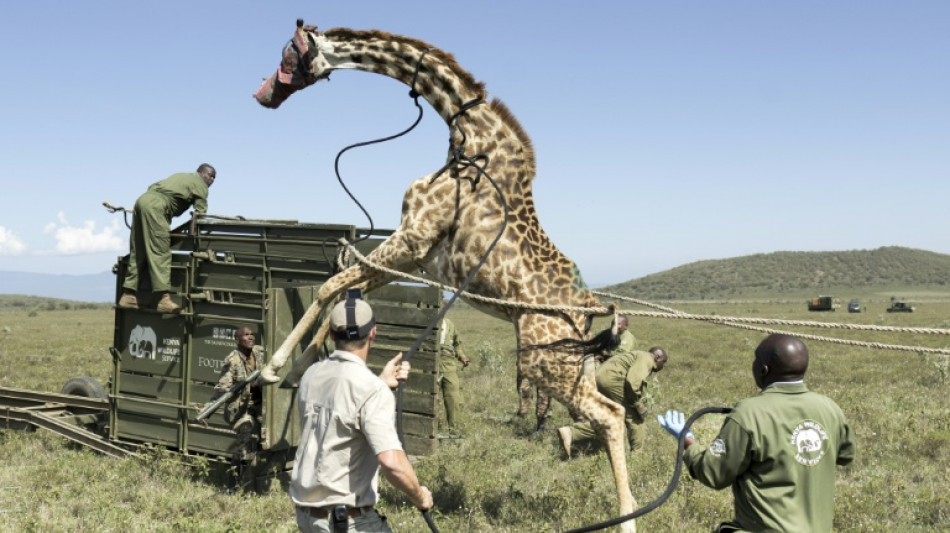
'Stranded, stressed' giraffes in Kenya relocated as habitats encroached / Photo: Tony KARUMBA - AFP

 Messi and Alcaraz love it, now padel takes step closer to Olympics

 Tolls mount in Thailand, Myanmar floods
 Why India's opposition wants top poll official out

 PU Prime Strengthens UAE Momentum with Strong Showing at Forex Expo Dubai 2026
 Eight dead in Thailand floods since mid-September

 Oil prices spike after Trump rejects Iran truce offer

 Taylor Swift sets new record at MTV VMAs
 Seoul seeks apology after Ukraine reveals transfer of North Korean POWs

 Messi on target again but Miami downed by Columbus

 In Washington's political cauldron, a fight over foie gras
 Flavio Bolsonaro: political heir in his father's shadow

 Ravens grab last-second win in Rio as Commanders stop Seahawks

 USA rallies to capture 11th consecutive Presidents Cup

 Phillies clinch, Astros wrap up division on final day of MLB season

 Commanders hand champion Seahawks their first loss

 Dupont scores twice to send Toulouse top of Top 14

 Ireland beat Israel but no handshakes due to war in Gaza

 Tense standoff over flashpoint N.Ireland parade lasts into night

 Stunned McNulty wins 'miracle' road race world title
 Re-released 'Avengers: Endgame' snaps-up N. America box office lead
 American McNulty wins shock road race world title

 Serbia's President Aleksandar Vucic announces resignation

 Tuchel urges Bellingham to play with 'rage'

 Russian strikes on Ukraine kill 8
 Bavuma, Miller hit centuries as South Africa clinch series
Coaxed and tugged by rangers, a blindfolded giraffe totters into the specialised vehicle that will transport it away from an increasingly hostile environment to a new home in Kenya's eastern Rift Valley.
Such relocations are a last resort when human activities or climate change threaten the survival of wildlife or peaceful coexistence with humans, say conservationists.
But the complex operations, overseen by Kenya Wildlife Service (KWS), are becoming more and more frequent in the east African country.
In recent weeks, hundreds of giraffes, zebras, and antelopes have been removed from the Kedong Ranch, on the shores of tourist hotspot Lake Naivasha.
The land had been left in its natural state, but over the years has been sold and subdivided into plots for real estate development, preventing the animals from grazing or using the natural corridor between Mount Longonot and Hells Gate.
"The animals began to suffer. They were stranded, stressed," said KWS's Patrick Wambugu, describing the construction of fences blocking the giraffes' route.
On Sunday, Wambugu's team relocated five giraffes in an operation that required dozens of people, trailers, a plow -- and even a helicopter that tracked the animals across the plains, before shooting them with tranquiliser darts.
KWS veterinarian Dominic Mijele, who was part of the operation, told AFP the giraffe is the most difficult animal to move, the risks "numerous".
The long-limbed creatures face deadly falls after being tranquilised and, despite their gentle appearance, can deliver a fierce kick to those trying to help.
They are also highly sensitive to anaesthesia and so cannot be kept sedated for long, a result of their unique build -- "the heart to the brain is quite long," Mijele explained.
As such, the rangers have to physically immobilise the creatures before they can be blindfolded and transported.
Once secured, the convoy travels the roughly 30 kilometres separating the ranch from their new home in the Oserengoni private reserve.
Once in there, a veterinarian will observe them for a week, although they usually establish their territory within two days.
"We hope that in the coming years the numbers will multiply, and they will be able to thrive in this landscape," said Mijele.
- Dilemma -
Similar operations are carried out almost every month in Kenya, said Mijele, mainly due to environmental destruction.
However, human-wildlife conflicts are also on the rise.
Kenya's population has soared from 30 million in 2000 to roughly 56.4 million in 2024, according to the World Bank.
Land privatisation is common and goes hand-in-hand with rampant speculation.
Humans often settle in areas that are also refuges for wildlife, said Evan Mkala, programme manager in eastern Kenya for the International Fund for Animal Welfare (IFAW).
The area around Lake Naivasha is being "invaded" by people, he said bluntly, leading to costly relocations when a "critical point" is reached.
This is happening with increasing frequency.
In a country with hundreds of national parks and private reserves, which generate significant tourism revenue, the challenge is to "reconcile" population growth, economic development, and wildlife conservation, said Philip Muruthi, vice president of the African Wildlife Foundation.
"Africa doesn't have to choose between wildlife conservation, nature protection, and development," he said, underscoring that the well-being of humans and animals is "inseparable".
H.Nasr--SF-PST