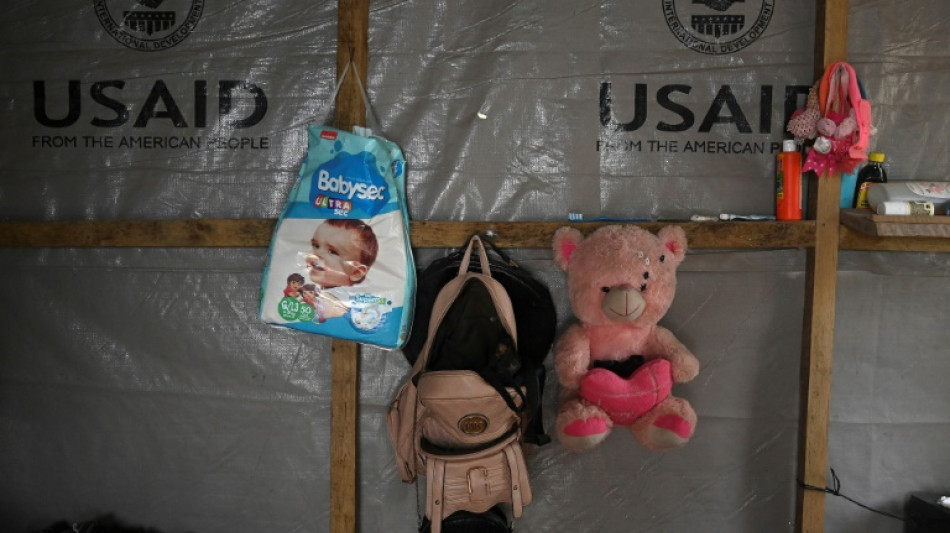
Western aid cuts could cause 22.6 million deaths, researchers say / Photo: Orlando SIERRA - AFP/File

 Morikawa says LIV players face 'business decision' after Rahm exit

 Tenzing Norgay's son says Himalayas sending climate warning

 On your bike! Bottas opts for two wheels to reach Singapore GP

 Alcaraz, Sinner, Osaka commit to Australian Open '1 Point Slam'

 Dodgers beat Braves to advance in MLB playoffs, Rays oust Yankees

 'A sun as black as my lungs': how corruption crucified a polluted Albania city

 The British historian helping the French rediscover de Gaulle

 Dodgers beat Braves to advance, Guardians survive in MLB playoffs

 Latin American, Caribbean women top Nobel literature buzz
 US says Fiji-based Chinese official paid bribes for Beijing

 After botched US execution, Christa Pike was nearly taken off life support

 Guinea-Bissau junta urges military unit loyal to ex-president to disarm

 As species decline, green turtles offer glimmer of hope

 Brothers Scott and Beauden Barrett named to start for All Blacks

 EU trade chief seeks to dial down China tensions

 'Never again Bolsonaro': thousands march ahead of Brazil election runoff

 After botched execution, US woman was nearly taken off life support before revival
 Searing AIDS drama 'Elsinore' opens London film festival

 Evicted pensioner who sparked Spain housing protests dies: tenant union

 Golf star Rahm quitting LIV tour over 'unacceptable' terms

 Thousands march fearing return of a Bolsonaro presidency in Brazil
 French PM denies police ordered to confront student protesters

 Rubio touts US power, calls on Europe to emerge from 'slumber'

 Trump says 'we don't think' Russian plague is bio-weapon

 Five children among 26 killed in Ukraine after Russian strikes

More than 22 million people, many of them children, could die preventable deaths by 2030 due to aid cuts by the United States and European countries, new research said Monday.
The findings are an update of a study earlier this year that said President Donald Trump's sweeping reductions in assistance, including the dismantling the US Agency for International Development (USAID), could lead to 14 million additional deaths.
The new research, seen by AFP, takes into account reductions in all official development assistance as Britain, France and Germany also slash their aid to the developing world.
"It is the first time in the last 30 years that France, Germany, the United Kingdom and the United States are all cutting aid at the same time," said one of the new research's authors, Gonzalo Fanjul, policy and development director at the Barcelona Institute for Global Health (ISGlobal).
"The European countries do not compare with the US, but when you combine all of them, the blow to the global aid system is extraordinary. It's absolutely unprecedented," he told AFP.
The research by authors from Spain, Brazil and Mozambique was submitted Monday to The Lancet Global Health and is awaiting peer review.
The research is based off data on how aid in the past has reduced deaths, especially in preventable areas such as HIV/AIDS, malaria and tuberculosis.
In a scenario in which aid cuts turn out to be severe, the new research expects 22.6 million excess deaths by 2030, including 5.4 million children under the age of five.
The researchers gave a range of 16.3-29.3 million deaths to account for uncertainties, including which programs will be cut and whether there are external shocks such as wars, economic downturns or climate-related disasters.
A milder defunding scenario would see 9.4 million excess deaths, the research said.
- Major donors cut at once -
Trump, in a cost-cutting spree advised by the world's richest person Elon Musk, soon after taking office slashed foreign assistance by more than 80 percent and shut down USAID, which was the world's largest aid agency and handled $35 billion in the 2024 fiscal year.
Secretary of State Marco Rubio said that aid did not serve core US interests, pointing in part to how aid recipient nations have voted against the United States at the United Nations, and called instead for assistance with clear and narrow aims.
Testifying before Congress, Rubio denied any deaths from US aid cuts and accused critics of being beneficiaries of an "NGO industrial complex."
Instead of seeking to fill the gap, Britain, France and Germany have also cut aid owing to budgetary pressure at home and decisions to focus more on defense spending following Russia's invasion of Ukraine.
Among top donors of official development assistance, only Japan's assistance has remained relatively steady over the past two years.
Beyond the immediate ends to projects, the study said that cuts would have knock-on effects by tearing down institutional capacities "painstakingly built over decades of international cooperation."
Fanjul acknowledged a need for countries to transition from the existing setup, especially their reliance on international HIV/AIDS funding.
"The problem has been the speed and the brutality of the process. In six months, we are experiencing a process that should have taken over a decade" or more, he said.
Davide Rasella, the principal investigator on the latest research, put aid budgets in comparison by noting that the Trump administration has promised $20 billion to prop up Argentina.
"In the world context these amounts of money are nothing huge," Rasella said.
Policymakers "change budgets and they really have no perception how many lives are at stake," he said.
The research was funded by the Rockefeller Foundation and Spain's science ministry.
A Rockefeller Foundation spokesperson said the New York-based philanthropy will "look forward to the publication of the peer-reviewed numbers, which will make even clearer the human cost of inaction and the profound opportunity we have to save lives."
"This data is an urgent alarm for the world."
W.Mansour--SF-PST