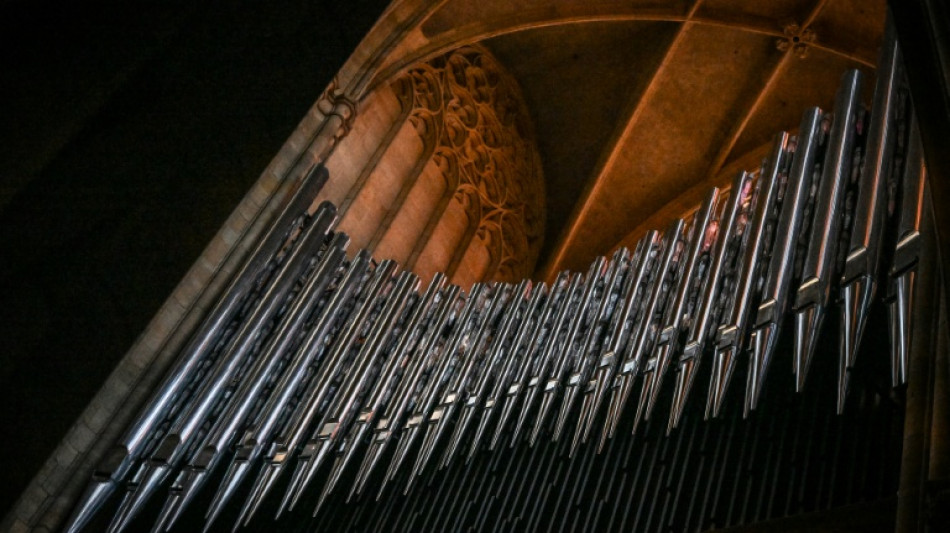
Two newly discovered Bach organ works unveiled in Germany / Photo: Michal Cizek - AFP

 Sri Lanka's de Silva quits as Test captain

 Alcaraz feeling 'mentally fresh' ahead of Shanghai return

 Israel drastically reduces British diplomatic presence in Jerusalem

 Stocks fall further as oil surge fans fresh inflation worries

 North Korea demands South show 'utmost respect' to restore relations

 Saudi says three dead in airport attacks claimed by Houthis

 'Mad dream': New showcase for African film opens in London

 All Blacks coach Rennie says Wallabies exit 'part of the game'

 The growing protests against India's poll body - and PM Modi
 Stocks fall further as oil spike fans fresh inflation worries
 Bad COP, worse COP? EU tempers hopes for UN climate summit

 Rookie Henry named in Wallabies midfield to face All Blacks
 Housing crisis set to dominate Spain's snap election

 Gas, health care, utilities: high costs squeeze US midterm voters
 New Zealand Rugby seeks injunction over PNG Chiefs name
 Samsung expects 780% quarterly operating profit jump on AI boom

 Guardians survive with 9-3 win over White Sox

 Saudi Arabia says 3 dead at airports after Houthis claim attacks

 Stocks slide as oil sees volatile trading day over Iran war fears

 Microsoft pushes AI vision with new, expensive Surface laptop
 Five children among 28 killed in Russian strikes on Ukraine

 Odell Beckham Jr signs with Minnesota Vikings

 Saudi Arabia says three dead at airports after Houthis claim attacks

 Trump plans to turn Florida golf course into presidential retreat

 WHO says cannot conduct full risk assessment on Russia plague reports

Two long-lost organ pieces written by a teenage Johann Sebastian Bach were unveiled in Germany on Monday in a discovery described as a "great moment for the world of music".
The two solo organ works, written while Bach was working as an organ teacher in the town of Arnstadt in Thuringia early in his career, first caught the attention of researchers over 30 years ago.
But it is only now that experts have been able to prove they were written by Bach after finally confirming the identity of the person who penned the manuscripts.
The Chaconne in D minor BWV 1178 and Chaconne in G minor BWV 1179 have been added to the official catalogue of Bach's works as of Monday.
They were also performed for the first time in 320 years at the St Thomas Church in Leipzig, where Bach is buried and served as a cantor for 27 years.
In a press conference before the works were performed, Culture Minister Wolfram Weimer hailed the discovery as a "global sensation" and a "great moment for the world of music".
"This is a source of great joy for many, many music lovers around the world," he said.
Bach researcher Peter Wollny first came across the works in the Royal Library of Belgium in 1992, according to the Bach Archive in Leipzig, which documents and researches the composer's life and work.
- 'Missing puzzle piece' -
The manuscripts were undated and unsigned but are thought to have been written in around 1705, when Bach would have been 18 years old.
Wollny was fascinated by the works from the outset because they contained several characteristics that were unique to Bach during that period.
But the identity of the manuscript writer remained a mystery.
Several years ago, experts came across some very similar handwriting in a letter dating from 1729 written by a former pupil of Bach in Arnstadt, Salomon Guenther John.
But since the letter was written 20 years after the manuscripts and the handwriting was not identical, more evidence was needed.
It was only recently that earlier samples of John's writing were found, from around the same period, providing definitive proof that the handwriting was his.
"I searched for a long time for the missing piece of the puzzle to identify the compositions -- now the whole picture is clear," Wollny said.
"We can now say with certainty that the copies were made around 1705 by Bach's pupil Salomon Guenther John."
- 'Lively new repertoire' -
Ton Koopman, the Dutch organist and head of the Bach Archive who performed the works on Monday, said they were "of a very high quality".
"When one thinks of the young Bach or Mozart, it is often assumed that genius comes later in life -- but that is not the case," he said.
"I am convinced that organists worldwide will be very grateful for this virtuoso, lively new repertoire and will perform it regularly in future."
Bach was born in Eisenach in central Germany in 1685 and died in 1750.
Best known for composing the Brandenburg Concertos, he was described by the 18th-century composer Ludwig Van Beethoven as "the immortal god of harmony".
Founded 75 years ago, the Bach Archive has helped to unearth several previously lost works by the composer.
In 2008, an organ piece called "Wo Gott der Herr nicht bei uns haelt" (Where God the Lord does not stay by our side) was found in an auction lot by professors from the Martin-Luther University in Halle.
In 2004, a Bach cantata that had been lost for decades was rediscovered in the papers of Japanese pianist Chieko Hara.
M.AbuKhalil--SF-PST