Japan launches 'Moon Sniper' mission / Photo: STR - JIJI Press/AFP

 Millions may be forced to move as climate change hits South Asia: UN

 Four killed battling Indonesia fires as toxic haze cloaks region

 Thai farmers, fishermen challenge IMF, World Bank at Bangkok rally

 In Malaysia, frustration grows over Indonesia haze

 Why India's voter revision drive has stoked fear and anger

 Munster eye fitting tribute to 'special' Foley in Racing reunion

 Shooter kills teacher, three children at Oregon elementary school

 Fed's Warsh surprised by world economy's 'resilience'

 Four killed in Indonesia battling fires causing toxic haze

 New Zealand star Ponga breaks arm in Rugby League World Cup opener

 Indonesian stocks dive 11% as MSCI weighs market reclassification

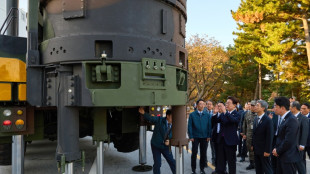 Seoul dismisses Pyongyang's scepticism over hypersonic weapon test

 Yamal on song as entertainers Barcelona face Betis challenge

 Wong weighs haze prosecutions as Singapore air quality worsens

 Brush fire prompts an evacuation order along Los Angeles coast

 'Mixed feelings': AI cracks centuries-old ciphers

 Le Pen looms large as Macron enters final months on EU stage

 Three children, one teacher killed in Oregon elementary school shooting

 Man Utd teetering towards crisis as Man City cloud hangs over Premier League

 Trump's new press secretary defends 'lawyer' title

 Wallabies coach has 'faith' as All Blacks juggernaut awaits

 Ailing UK director Mike Leigh wishes he could make '100 more films'

 Pixagram Announces Free Account Creation for 250 New Users Daily Through 2026

 Macron warns urgent to strike EU budget deal before French vote runup

 Zelensky rallies European allies as Trump ties slump

Japan's "Moon Sniper" mission blasted off Thursday as the country's space programme looks to bounce back from a string of recent mishaps.
Only the United States, Russia, China and, since last month, India have successfully landed a probe on the Moon, with two failed Japanese missions -- one public and one private.
Watched by 35,000 people online, the H-IIA rocket lifted off early Thursday from the southern island of Tanegashima carrying the lander, which is expected to touch down on the lunar surface in early 2024.
To cheers and applause at mission control, the "SLIM" Moon probe and the XRISM space research satellite developed with the US and European space agencies both separated soon afterwards.
The launch had already been postponed three times because of bad weather.
The Smart Lander for Investigating Moon (SLIM) is nicknamed the "Moon Sniper" because it is designed to land within 100 metres of a specific target on the surface.
That is much less than the usual range of several kilometres.
"By creating the SLIM lander, humans will make a qualitative shift towards being able to land where we want and not just where it is easy to land," Japanese space agency JAXA said before the launch.
"By achieving this, it will become possible to land on planets even more resource-scarce than the Moon."
Globally, "there are no previous instances of pinpoint landing on celestial bodies with significant gravity such as the Moon," JAXA added.
XRISM's high-resolution X-ray spectroscopic observations of the hot gas plasma wind that blows through the universe will help study the flows of mass and energy as well as the composition and evolution of celestial objects.
- Serious toy -
Using a palm-sized mini rover developed with a toy company, SLIM aims to investigate how the Moon was formed by examining exposed pieces of the lunar mantle.
India last month landed a craft near the Moon's south pole, a historic triumph for its low-cost space programme.
Its success came days after a Russian probe crashed in the same region, and four years after a previous Indian attempt failed at the last moment.
Japan's past attempts have also gone wrong, including last year when it sent a lunar probe named Omotenashi as part of the United States' Artemis 1 mission.
The size of a backpack, Omotenashi would have been the world's smallest Moon lander but it was lost.
And in April, Japanese startup ispace failed in an ambitious attempt to become the first private company to land on the Moon, losing communication with its craft after what it described as a "hard landing".
Japan has also had problems with its launch rockets, with failures after liftoff of the next-generation H3 in March and the normally reliable solid-fuel Epsilon last October.
In July, the test of an Epsilon S rocket, an improved version of the Epsilon, ended in an explosion 50 seconds after ignition.
A.Suleiman--SF-PST