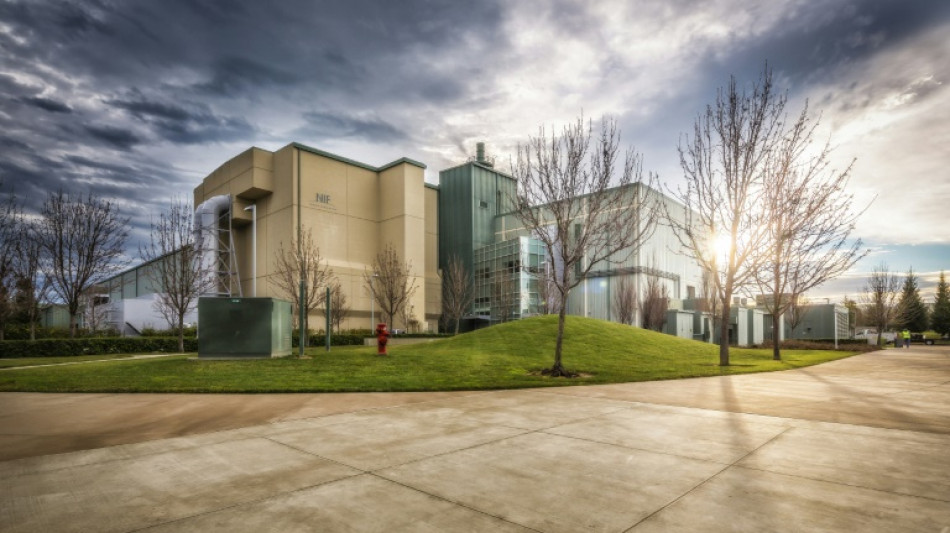
US lab repeats nuclear fusion feat, with higher yield / Photo: Handout - Lawrence Livermore National Laboratory/AFP/File

 Trump's new press secretary says China lacked 'proper' toilets

 India closes down New Delhi park ahead of 'cockroach' movement rally

 'Let us build': World Bank chief outlines jobs-led development agenda

 Broncos top Super Bowl champion Seahawks in overtime

 Brilliant Brewers sweep Dodgers to reach World Series

 Brewers complete Dodgers sweep to reach World Series
 High-flying Freiburg try to shut out the noise as fairytale run continues

 Flamengo secure 0-0 draw in La Plata in Copa Libertadores semi

 The final lap? Two days on the campaign trail with Trump

 Asian stocks rise as tech bounces from rout, eyes on Warsh

 Saudi organisers say 2027 Asian Cup 'on schedule' after attacks

 Right-wing Brazil influencers on 'mission' to seal Bolsonaro win

 Using AI to help find Mexico's legions of missing children

 Fiji to deploy solar-powered Australian military drones at sea

 'Multiple victims' in Oregon elementary school shooting, police say

 'Multiple victims' in Oregon elementary school shooting: police
 ChangeNOW Announces NOW AI After Resolving Website Integration Vulnerability

 Argentine demonstration over education cuts ends in clashes

 Argentine protesters, police clash at demo over university funding

 US stocks end higher as AI shares stabilize

 School roof collapse kills 32 children, teacher in Pakistan

 Lyon down Palace in Europa League, Sunderland leave it late

 UniCredit says receives ECB green light for Commerzbank takeover

 New York City pension fund asks Anthropic to delay IPO

 Venezuela's Maduro denies US torture charges as 'false accusations'

US scientists responsible for a historic nuclear fusion breakthrough say they have repeated the feat -- this time achieving a greater yield of energy.
The Lawrence Livermore National Laboratory stunned the world in December when it announced it had carried out an experimental nuclear reaction that put out more energy than was put into it, a holy grail of science in the quest for unlimited, clean power to end the era of fossil fuels.
"We can confirm the experiment produced a higher yield than the December 2022 experiment," public information officer Paul Rhien said Monday in an emailed statement, without disclosing specific figures.
He added the California lab planned to report the results at upcoming scientific conferences and in peer-reviewed publications.
The new development was first reported by the Financial Times.
Nuclear fusion has been touted by its supporters as a clean, abundant and safe source of energy that could eventually allow humanity to break its dependence on coal, crude oil, natural gas and other hydrocarbons driving a global climate crisis.
However, there is still a long way to go before fusion is viable on an industrial scale, providing power to homes and businesses.
Nuclear power plants around the world currently use fission -- the splitting of a heavy atom's nucleus -- to produce energy.
Fusion on the other hand combines two light hydrogen atoms to form one heavier helium atom, releasing a large amount of energy in the process.
That is what occurs inside stars, including our Sun.
On Earth, fusion reactions can be provoked by heating hydrogen to extreme temperatures inside specialized devices.
Like fission, fusion is carbon-free during operation, and has additional critical advantages: it poses no risk of nuclear disaster and produces much less radioactive waste.
During December's experiment, the lab used 192 ultra-powerful lasers to deliver 2.05 megajoules of energy to a tiny capsule smaller than a pea containing isotopes of hydrogen. It produced 3.15 megajoules of fusion energy output.
While the result was a net energy gain, 300 megajoules of energy was needed from the electrical grid to power the lasers.
I.Yassin--SF-PST