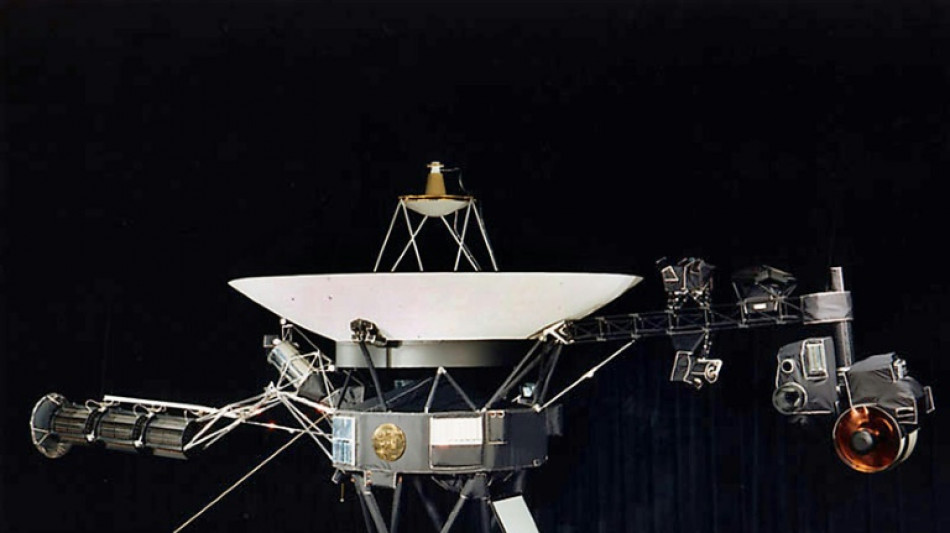
NASA back in touch with Voyager 2 after 'interstellar shout' / Photo: Handout - NASA/AFP/File

 Trump's new press secretary says China lacked 'proper' toilets

 India closes down New Delhi park ahead of 'cockroach' movement rally

 'Let us build': World Bank chief outlines jobs-led development agenda

 Broncos top Super Bowl champion Seahawks in overtime

 Brilliant Brewers sweep Dodgers to reach World Series

 Brewers complete Dodgers sweep to reach World Series
 High-flying Freiburg try to shut out the noise as fairytale run continues

 Flamengo secure 0-0 draw in La Plata in Copa Libertadores semi

 The final lap? Two days on the campaign trail with Trump

 Asian stocks rise as tech bounces from rout, eyes on Warsh

 Saudi organisers say 2027 Asian Cup 'on schedule' after attacks

 Right-wing Brazil influencers on 'mission' to seal Bolsonaro win

 Using AI to help find Mexico's legions of missing children

 Fiji to deploy solar-powered Australian military drones at sea

 'Multiple victims' in Oregon elementary school shooting, police say

 'Multiple victims' in Oregon elementary school shooting: police

 ChangeNOW Announces NOW AI After Resolving Website Integration Vulnerability

 Argentine demonstration over education cuts ends in clashes

 Argentine protesters, police clash at demo over university funding

 US stocks end higher as AI shares stabilize

 School roof collapse kills 32 children, teacher in Pakistan

 Lyon down Palace in Europa League, Sunderland leave it late

 UniCredit says receives ECB green light for Commerzbank takeover

 New York City pension fund asks Anthropic to delay IPO

 Venezuela's Maduro denies US torture charges as 'false accusations'

NASA has succeeded in re-establishing full contact with Voyager 2 thanks to an "interstellar shout" that righted the distant probe's antenna orientation, the space agency said Friday.
Launched in 1977 to explore the outer planets and serve as a beacon of humanity to the wider universe, it is currently more than 12.3 billion miles (19.9 billion kilometers) from our planet -- well beyond the solar system.
A series of planned commands sent to the spaceship on July 21 mistakenly caused the antenna to point two degrees away from Earth, compromising its ability to send and receive signals and endangering its mission.
The situation was not expected to be resolved until at least October 15 when Voyager 2 was scheduled to carry out an automated realignment maneuver.
But on Tuesday, engineers enlisted the help of multiple Earth observatories that form the Deep Space Network (DSN) to detect a carrier or "heartbeat" wave from Voyager 2, though the signal was still too faint to read the data it carried.
In a new update on Friday, NASA's Jet Propulsion Laboratory (JPL), which built and operates the probe, said it had succeeded in a longshot effort to send instructions that righted the craft.
"The agency's Deep Space Network facility in Canberra, Australia, sent the equivalent of an interstellar 'shout,'" JPL said.
"With a one-way light time of 18.5 hours for the command to reach Voyager, it took 37 hours for mission controllers to learn whether the command worked."
The probe began returning science and telemetry data at 12:29 am Eastern Time on August 4, "indicating it is operating normally and that it remains on its expected trajectory," added JPL.
Voyager 2 left the protective magnetic bubble provided by the Sun, called the heliosphere, in December 2018, and is currently traveling through the space between the stars.
Before leaving our solar system, it explored Jupiter and Saturn, and became the first and so far only spacecraft to visit Uranus and Neptune.
Voyager 2's twin Voyager 1 was mankind's first spacecraft to enter the interstellar medium, in 2012, and is currently almost 15 billion miles from Earth.
Both Voyager spacecraft carry "Golden Records" -- 12-inch, gold-plated copper disks intended to convey the story of our world to extraterrestrials.
K.Hassan--SF-PST