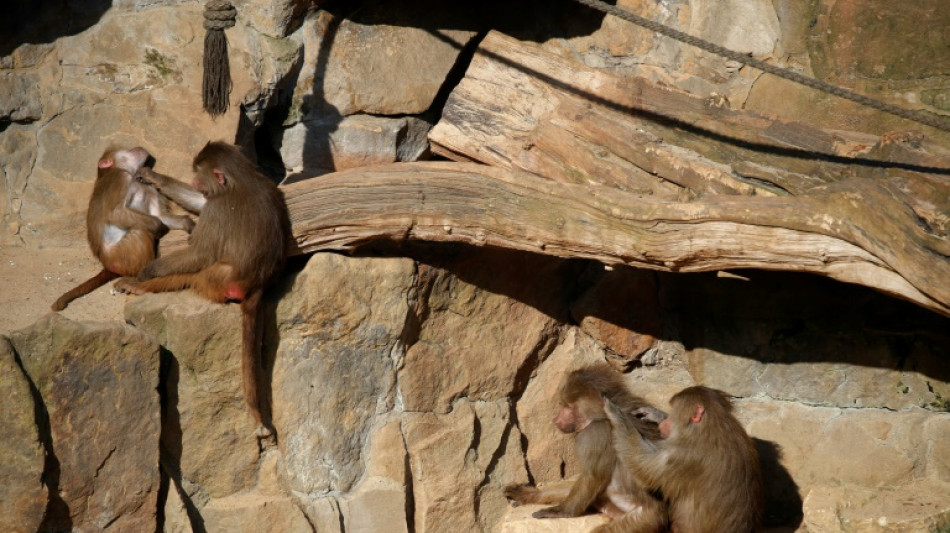
Adult friends help baboons conquer childhood trauma / Photo: Odd ANDERSEN - AFP

 Flamengo secure 0-0 draw in La Plata in Copa Libertadores semi

 The final lap? Two days on the campaign trail with Trump

 Asian stocks rise as tech bounces from rout, eyes on Warsh

 Saudi organisers say 2027 Asian Cup 'on schedule' after attacks

 Right-wing Brazil influencers on 'mission' to seal Bolsonaro win

 Using AI to help find Mexico's legions of missing children

 Fiji to deploy solar-powered Australian military drones at sea

 'Multiple victims' in Oregon elementary school shooting, police say

 'Multiple victims' in Oregon elementary school shooting: police

 ChangeNOW Announces NOW AI After Resolving Website Integration Vulnerability

 Argentine demonstration over education cuts ends in clashes

 Argentine protesters, police clash at demo over university funding

 US stocks end higher as AI shares stabilize

 School roof collapse kills 32 children, teacher in Pakistan

 Lyon down Palace in Europa League, Sunderland leave it late

 UniCredit says receives ECB green light for Commerzbank takeover

 New York City pension fund asks Anthropic to delay IPO

 Venezuela's Maduro denies US torture charges as 'false accusations'

 Somalia sets May presidential election despite insecurity

 Chelsea's Caicedo eager to be more of a leader

 Rahm reaches separation deal with LIV in bankruptcy court

 UN chief urges nations to end 'war on nature'

 Newcastle boss Jaissle says Fernandez-Pardo just needs a goal

 Infantino offers apology but 'no answers' at FIFA meeting over World Cup plan

 Don't exclude Turkey from 'Made in Europe' plan: minister to AFP

Like humans, baboons get by with a little help from their friends.
Forming close social bonds as adults helps the primates triumph over childhood adversity and live longer, according to a new study.
The paper, published in Science Advances on Wednesday, drew on 36 years of data from nearly 200 of the Old World monkeys in the Amboseli National Park, in southern Kenya.
"It's like the saying from the King James Apocrypha, 'a faithful friend is the medicine of life,'" senior author Susan Alberts, a professor of biology and evolutionary anthropology at Duke University, said in a statement.
Baboons who had challenging youths were able to reclaim two years of life expectancy by forming close friendships, the study showed.
Research in humans has found that people who experience early trauma, such as having an alcoholic parent or growing up in an abusive home, are more likely to face an early grave.
But because these experiences are subjective and people's memories of the past are imperfect, wild primates, which share more than 90 percent of our DNA, are thought to be useful study subjects for better understanding humans.
For their research, Alberts and her co-authors focused on female baboons and tracked exposures to sources of childhood hardships, such as being born to a low-ranking mother, losing their mother young, being a drought year baby, or having to compete with many siblings for parental attention.
They found that the effect of such hardships was cumulative, with each additional exposure translating to 1.4 years of life lost.
And the impact wasn't just because such events led to greater social isolation as adults, as had been previously hypothesized. Rather, the survival dip was independently attributable to effects of early adversity.
But that didn't mean that baboons born under an unlucky star were destined to live short, miserable lives.
"Females who have bad early lives are not doomed," said first author Elizabeth Lange, an assistant professor at SUNY Oswego.
The team found that baboons who formed strong friendships, as measured by how often they groomed their closest associates, restored 2.2 years to their lives, regardless of early hardships.
"If you did have early life adversity, whatever you do, try to make friends," said Alberts.
M.AbuKhalil--SF-PST