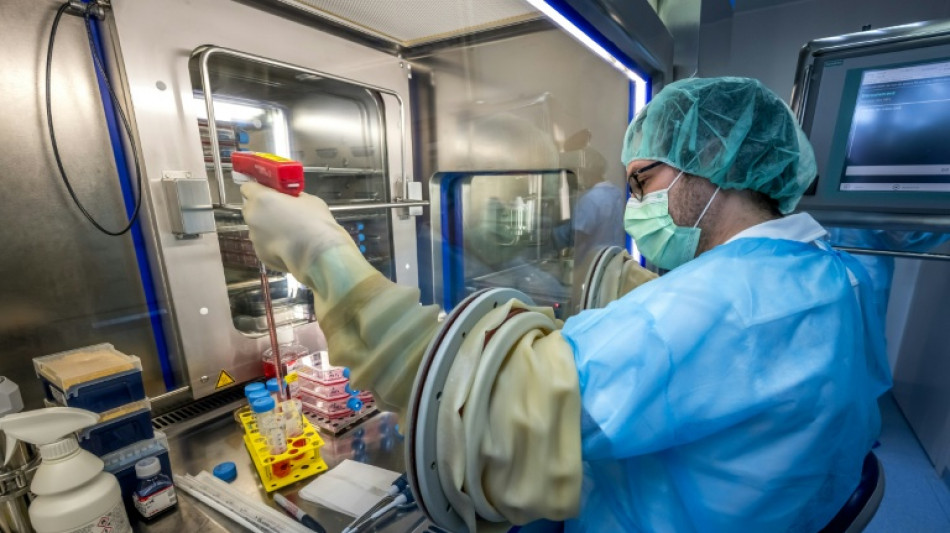
Experts growing new skin for Swiss fire victims / Photo: Fabrice COFFRINI - AFP

 Iran's World Cup players take to the training pitch
 Mexico beat South Africa to kick off World Cup
 US stocks rally, oil prices fall as Trump calls off fresh Iran strikes

 Pulisic 'ready to battle' Paraguay in US World Cup opener

 UN experts, MSF condemn crackdown on women by Afghan morality police

 First leather bag made from T-Rex cells fails to sell at Paris auction
 Trump cancels Iran strikes, touts imminent deal
 Spiky disciplinarian Mourinho can restore order at Real Madrid

 Mourinho named Real Madrid coach on three-year deal

 Spurs will 'keep swinging' with Knicks on brink of NBA title

 Trump says canceling Iran strikes, flags possible deal

 Willis has no regrets risking England career with Bordeaux return

 El Nino is back, but its effects vary widely

 Van Aert dominates sprint on Tour de France warm-up race
 Bangladesh clinch first-ever ODI series win over Australia
 Four times as many icebergs calved from Greenland glaciers: study

 Renowned French solo yachtsman Charlie Dalin dies aged 42

 Weather pattern El Nino has begun, says US agency NOAA

 Stocks rebound, oil wavers as traders weigh Iran, rates outlook

 Niger criminalises same-sex relations with jail terms

 Smuggled dinosaur fossils return to Mongolia after two decades
 Tight security for G7 summit at Lake Geneva resort

 Pope condemns 'indifference' towards migrants on Canaries trip

 Stocks diverge, oil falls as traders weigh Iran, rates outlook

 McKeown eyeing world record after sizzling at Australian trials
The Cell Production Centre at Lausanne University Hospital is working flat out trying to grow new skin for badly-burned survivors of Switzerland's New Year bar fire tragedy.
The centre, with its skin production facility, is the only one of its size in Europe.
"There is a lot of emotion," said Laurent Carrez, the pharmacist technical manager at the centre in Epalinges, on the outskirts of Lausanne in western Switzerland.
But he added: "For now, we're focused on action."
"The priority is to help these patients as much as possible," whether they are in hospitals in Switzerland or abroad, he told AFP.
The January 1 disaster at Le Constellation bar in the Swiss ski resort of Crans-Montana killed 40 people, mostly teenagers, and injured 116 others.
At the weekend, 80 were still in hospitals and specialist burns units in Switzerland and abroad.
Carrez said they have been working "seven days a week" since the tragedy.
The centre -- which the hospital says is the only one capable of producing such large amounts of skin tissue while complying with Swiss and European regulations -- works with healthy pieces of skin taken from the burn victims themselves, to avoid the risk of skin being rejected.
"From 10 square centimetres of healthy skin, we are able to produce between one and three batches of 2,600 sq cm," which "roughly represents the surface area of a back", said Carrez.
He pointed out that this tissue, created through cell reproduction, does not have hair or sweat glands.
The centre has "a very important role" to play because "when 50 to 60 percent of the body surface area is burned, "we have to grow skin in laboratories because we cannot do it simply by using the remaining healthy skin", explained Olivier Pantet, a severe burns specialist at the hospital.
- Tissue multiplication -
In a so-called cleanroom, pharmacy and medical analysis technicians, dressed in laboratory outfits, concentrate on refreshing the nutrient preparation in which the skin cells are bathed to boost multiplication.
"So far, we've received biopsies from the patients. We've collected and stored their cells," said Carrez.
"We are about to begin the second phase, which is the most critical: the multiplication of keratinocyte tissue -- skin."
This phase should last around three weeks, during which the cells, placed in dishes, multiply naturally until they touch each other and then form layers by stacking on top of each other.
"Then, at a certain point, they stop growing, and that's when we know they're ready. You can also see it in how the cells look" under a microscope, said Carrez.
"They have achieved their desired function" as tissue and "are ready to form the equivalent of skin".
Next comes coordinating with hospitals to "graft these skins", which, once "mature", must be applied within two days.
- Success rate -
The success of these skin grafts is not always guaranteed.
"If 80 percent of the grafts take" to the patient, "we are very happy: it's an excellent result", said Pantet.
Lausanne University Hospital is currently treating seven people burned in the Crans-Montana blaze.
While waiting for these grafts, doctors can apply airtight dressings, skin from deceased donors or fish skin to the burned areas.
Prosecutors believe the Constellation inferno started when champagne bottles with sparklers attached were raised too close to sound insulation foam on the ceiling in the bar's basement section.
Pantet said many of the survivors have burns that cover a large surface area but also go deep into the skin.
To treat these severely burned patients, the Lausanne hospital takes great care to ensure they are hydrated and their temperature is controlled, given their damaged skin.
They are treated in high-humidity rooms kept at high temperatures of around 30C.
Once the skin grafts have been carried out, doctors must also monitor the positioning of joints during the healing process, including using splints, before the long rehabilitation process begins, said Pantet.
U.Shaheen--SF-PST