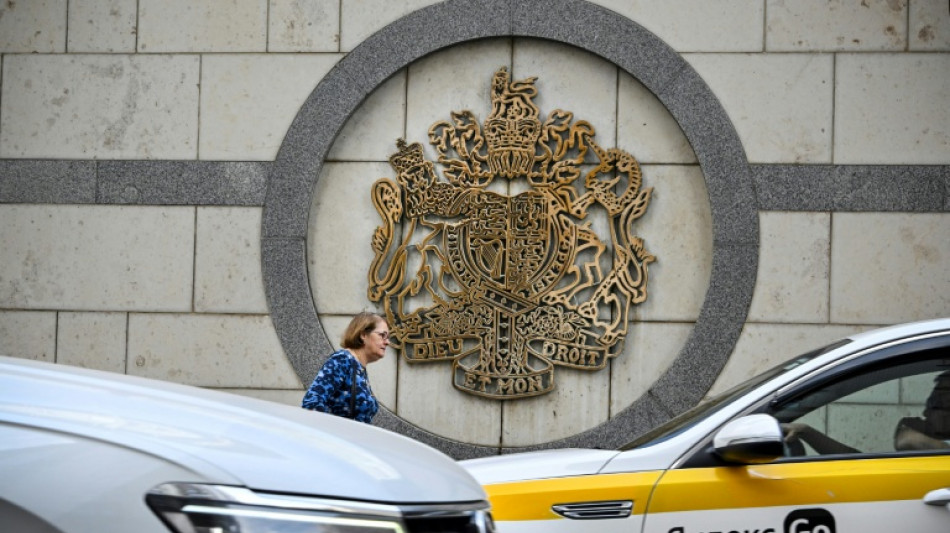
Russia expels UK diplomat accused of being spy / Photo: Alexander NEMENOV - AFP

 West must embrace 'national power' or face decline: Rubio

 Shell refining margins reach record highs as wars hit supply
 Former Spain, Barca winger Pedro retires from football
 Arteta signs new Arsenal deal until 2030

 Stocks decline as oil climbs on Mideast flareup
 Gauff says online abuse was 'draining' after China Open exit

 As sector struggles, Porsche puts luxury ahead of volume
 'It's personal': Fiji minister pushes better climate finance at pre-COP
 Russia glosses over dark Soviet past in reinvented museum

 UK tax body opened probe into Man City in 2018: FT
 Yemen's Houthis claim new attacks on Saudi airports as conflict deepens
 Germany factory production at highest level for 18 months
 Thailand floods death toll rises to 60 since mid-September

 US pushes Russia for information on plague reports

 Myanmar leader lands in Malaysia for migrant return talks
 Indian central bank hikes rates for first time since 2023

 US military on Okinawa face curfew, alcohol ban after murder case
 Fierce lobbying in EU over 'forever chemicals'

 Dodgers beat Braves and Padres avoid sweep in MLB playoffs
 Mourning, war and elections as Israel marks October 7
 Messi says Argentina retirement is 'saddest day of my career'
 Oil rises and stocks fall as Hormuz worries flare

 Pacific presses world for help 'surviving' climate change at pre-COP summit
 Verstappen revival to be put to the test in steamy Singapore
 US woman who survived botched execution is conscious, speaking: lawyers

Russia said Thursday it was expelling a British diplomat, calling him an undercover spy in an accusation blasted by London as "malicious" and "baseless."
The Kremlin has long singled out Britain as one of the most hostile Western states -- with relations virtually frozen even before Moscow's full-scale offensive on Ukraine.
The two countries have expelled each others' embassy staff several times in recent years.
Moscow-London ties have been plagued by spy allegations for decades and were already at their lowest point before Russia's 2022 Ukraine attack.
Since then, Britain became one of Kyiv's strongest backers.
Russia's FSB security service named the man it was expelling as Gareth Samuel Davies -- listed on Moscow's official database of accredited diplomats as the embassy's second secretary.
Russia's foreign ministry summoned the UK's charge d'affaires, saying it issued a "strong protest" and that it had received information that "one of the embassy's diplomatic staff belongs to the UK's intelligence service."
"The individual's accreditation is being revoked. He is required to leave the Russian Federation within two weeks," the ministry said.
Expulsions by one side have typically been followed up by a tit-for-tat response from the other.
Russia warned Britain not to "escalate the situation", pledging to deliver a "firm symmetrical response" should London retaliate.
Britain said it was mulling next steps.
"This is not the first time the Kremlin has made malicious and baseless accusations against our staff," the Foreign Office said in a statement.
"We are carefully considering our options in response."
- Frozen ties -
Outside the foreign ministry in Moscow on Thursday, UK charge d'affaires Danae Dholakia was mobbed by reporters from state media outlets.
UK Prime Minister Keir Starmer has hosted Ukraine's President Volodymyr Zelensky for talks on how to end the war with Russia several times, and is one of the Kremlin's most vocal critics.
This month, Britain and France signed a declaration of intent that sets out deploying troops on Ukrainian territory after a ceasefire.
Russia rejected the post-war plan, saying such troops would be considered "legitimate military targets."
Moscow also recently blasted London for being involved in the planning of a US operation to seize a Russian-flagged tanker in the North Atlantic.
Espionage accusations between the two countries date back far further than the Ukraine offensive.
In 2006, Russian defector Alexander Litvinenko was killed in London, poisoned by polonium in what British investigators said was a hit by the Russian secret service.
And in 2018, the UK said Russian double agent Sergei Skripal was poisoned with a Novichok nerve agent in the British cathedral city of Salisbury.
One member of the public was killed after handling the delivery device, a discarded perfume bottle, triggering the largest Western expulsion of Russian diplomats, alleged to be spies, in decades.
The communication line between Downing Street and the Kremlin has been closed since Russia's offensive.
The last UK leader known to have spoken with Russian President Vladimir Putin was Boris Johnson in February 2022, days before Moscow launched its offensive, when he told the Kremlin chief that sending troops to Ukraine "would be a tragic miscalculation."
burs/st
M.AlAhmad--SF-PST