Asteroid to come 'extraordinarily close' to Earth: NASA / Photo: Laurence SAUBADU - AFP

 'Multiple victims' in Oregon elementary school shooting: police

 ChangeNOW Announces NOW AI After Resolving Website Integration Vulnerability

 Argentine demonstration over education cuts ends in clashes

 Argentine protesters, police clash at demo over university funding

 US stocks end higher as AI shares stabilize

 School roof collapse kills 32 children, teacher in Pakistan

 Lyon down Palace in Europa League, Sunderland leave it late

 UniCredit says receives ECB green light for Commerzbank takeover

 New York City pension fund asks Anthropic to delay IPO

 Venezuela's Maduro denies US torture charges as 'false accusations'

 Somalia sets May presidential election despite insecurity

 Chelsea's Caicedo eager to be more of a leader

 Rahm reaches separation deal with LIV in bankruptcy court

 UN chief urges nations to end 'war on nature'

 Newcastle boss Jaissle says Fernandez-Pardo just needs a goal

 Infantino offers apology but 'no answers' at FIFA meeting over World Cup plan

 Don't exclude Turkey from 'Made in Europe' plan: minister to AFP

 French duo Justice to score 'GTA VI': game maker

 El Nino a 'terrifying' threat to coral reefs: UN biodiversity expert

 Barcola must get used to Liverpool highs and lows, says Iraola

 Versus Trade Wins Best ECN/STP Broker APAC 2026, Marking Third UF Awards Recognition

 Three dead as Istanbul sees heaviest rainfall in 80 years

 US producer prices see biggest jump since 2022 in added challenge to Trump

 Swiatek avoids seed exodus to breeze into Wuhan last eight
 PM condemns 'chaos' as violent protests grip Albania

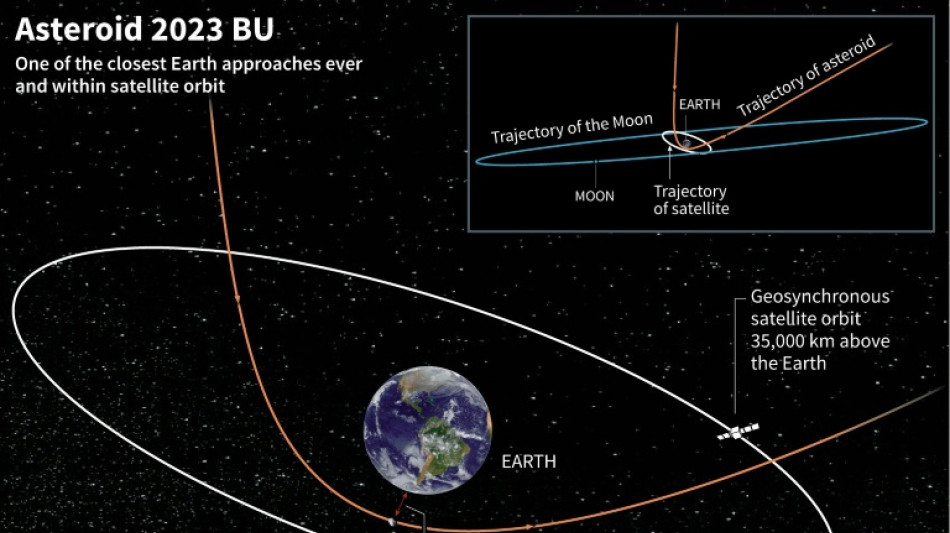
A truck-sized asteroid will pass near Earth on Thursday in one of the closest approaches to our planet ever recorded, NASA said, emphasising that it poses no danger.
Asteroid 2023 BU, which was recently discovered by an amateur astronomer, will zoom by the southern tip of South America at around 4:27 pm PST on Thursday (0027 GMT Friday), according to NASA.
It will pass just 2,200 miles (3,600 kilometres) from Earth's surface, much closer than many geostationary satellites orbiting the planet.
But there is no risk that the asteroid will hit Earth, NASA said in a statement on Wednesday.
Even if it did, the asteroid measuring 3.5-8.5 metres (11-28 feet) across would largely disintegrate in the Earth's atmosphere, potentially just resulting in a few small meteorites.
It was discovered on Saturday from an observatory in Crimea by amateur astronomer Gennadiy Borisov, who previously spotted an interstellar comet in 2019.
Dozens of observations were then carried out by observatories across the world.
NASA's Scout impact hazard assessment system quickly determined that the asteroid would miss Earth, the US space agency said.
"Despite the very few observations, it was nonetheless able to predict that the asteroid would make an extraordinarily close approach with Earth," said NASA's Davide Farnocchia who helped develop Scout.
"In fact, this is one of the closest approaches by a known near-Earth object ever recorded."
The asteroid will come so close that its trajectory around the Sun will be significantly altered.
Previously it took the asteroid 359 days to complete its orbit around the Sun, but after this close call with Earth, it will now take 425, NASA said.
J.AbuShaban--SF-PST