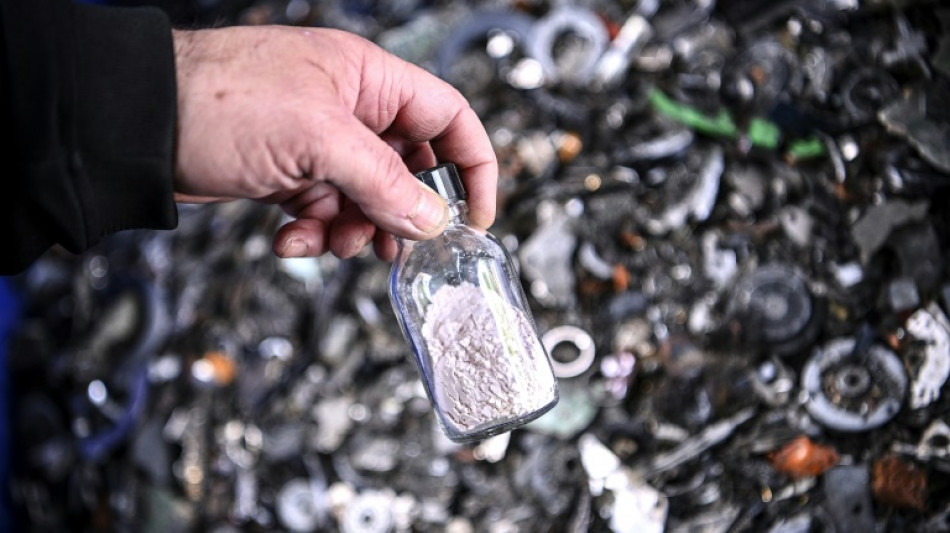
Europe's largest rare earths deposit discovered in Sweden / Photo: Christophe ARCHAMBAULT - AFP/File

 'Multiple victims' in Oregon elementary school shooting: police
 ChangeNOW Announces NOW AI After Resolving Website Integration Vulnerability

 Argentine demonstration over education cuts ends in clashes
 Argentine protesters, police clash at demo over university funding
 US stocks end higher as AI shares stabilize
 School roof collapse kills 32 children, teacher in Pakistan
 Lyon down Palace in Europa League, Sunderland leave it late

 UniCredit says receives ECB green light for Commerzbank takeover
 New York City pension fund asks Anthropic to delay IPO

 Venezuela's Maduro denies US torture charges as 'false accusations'

 Somalia sets May presidential election despite insecurity
 Chelsea's Caicedo eager to be more of a leader

 Rahm reaches separation deal with LIV in bankruptcy court
 UN chief urges nations to end 'war on nature'
 Newcastle boss Jaissle says Fernandez-Pardo just needs a goal

 Infantino offers apology but 'no answers' at FIFA meeting over World Cup plan

 Don't exclude Turkey from 'Made in Europe' plan: minister to AFP

 French duo Justice to score 'GTA VI': game maker
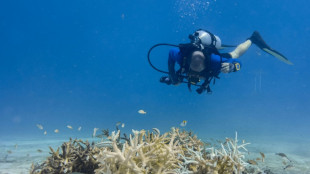 El Nino a 'terrifying' threat to coral reefs: UN biodiversity expert
 Barcola must get used to Liverpool highs and lows, says Iraola
 Versus Trade Wins Best ECN/STP Broker APAC 2026, Marking Third UF Awards Recognition
 Three dead as Istanbul sees heaviest rainfall in 80 years
 US producer prices see biggest jump since 2022 in added challenge to Trump
 Swiatek avoids seed exodus to breeze into Wuhan last eight
 PM condemns 'chaos' as violent protests grip Albania

Europe's largest known deposit of rare earth elements, essential for the manufacturing of electric vehicles, has been discovered in Sweden's far north, boosting Europe's hopes of cutting its dependence on China.
Swedish mining group LKAB said Thursday the newly-explored deposit, found right next to its iron ore mine, contained more than one million tonnes of rare earth oxides.
"This is the largest known deposit of rare earth elements in our part of the world, and it could become a significant building block for producing the critical raw materials that are absolutely crucial to enable the green transition," LKAB's chief executive Jan Mostrom said in a statement.
"We face a supply problem. Without mines, there can be no electric vehicles," Mostrom added.
While the find is believed to be the biggest in Europe, it remains small on a global scale, representing less than one percent of the 120 million tonnes estimated worldwide by the US Geological Survey.
In 2021, the European Commission said that 98 percent of the rare earths used in the EU were imported from China, prompting Brussels to urge member states to develop their own extraction capacities.
LKAB's find was presented as a delegation from the European Commission visited Sweden, which took over the rotating EU presidency at the start of the year.
"Today, the EU is way too dependent on other countries for these materials," Swedish Energy Minister Ebba Busch told a press conference, pointing specifically to Russia and China.
"This must change. We must take responsibility for the raw material supply needed for the (green) transition," she added.
- Trade not enough -
The European Union has agreed to phase out new CO2-emitting vehicles by 2035, effectively banning combustion engine cars, meaning the need for rare earth materials will only increase.
In the short term, Busch said the EU needed to "diversify" its trade.
"But in the long run, we cannot rely on trade agreements only," she said.
Mostrom said the full extent of the deposit had yet to be established.
"We are continuing to conduct exploration to see how big this is," Mostrom told AFP, adding that LKAB was also still in the process of figuring out how the new deposit could be mined.
Mostrom said it was difficult to accurately gauge the impact of the discovery on reducing Europe's dependence on Chinese imports.
But he said he was confident "it will have a huge impact."
Asked during a press conference when the deposit could actually be mined and deliver raw materials to the market, Mostrom said it would largely depend on how quickly permits could be secured.
But based on experience, it would likely be "10 to 15 years", he said.
According to LKAB, the rare earth elements found in the Per Geijer deposit occurred "in what is mainly an iron ore deposit and which may therefore be produced as by-products," creating new opportunities for potentially "competitive mining."
- From magnets to lenses -
Rare earth minerals with names like neodymium, praseodymium and dysprosium are crucial to the manufacture of magnets used in industries of the future, like wind turbines and electric cars.
They are also present in consumer goods such as smartphones, computer screens and telescopic lenses.
Others have more traditional uses, like cerium for glass polishing and lanthanum for car catalysts or optical lenses.
Sweden is one of the EU's biggest mining countries.
More than 90 percent of the EU's iron ore production comes from the Scandinavian country, which also has the bloc's largest lead and zinc production, the second largest silver production, and among the highest gold and copper production, according to the Geological Survey of Sweden.
H.Darwish--SF-PST