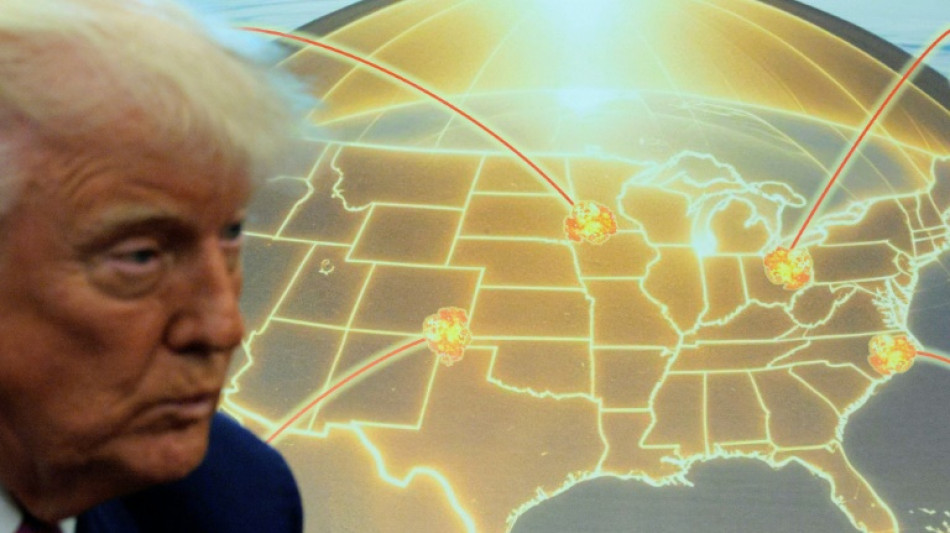
Trump 'Golden Dome' plan tricky and expensive: experts / Photo: CHIP SOMODEVILLA - GETTY IMAGES NORTH AMERICA/AFP

 Panama Canal considering more cuts in transits due to El Nino

 Maresca agrees with Haaland that players started season jaded

 Hurricane warning issued for westernmost Hawaiian islands

 UK PM denounces 'politics of poison' after anti-migrant protests

 Comeback queen Zheng strikes again for US Open quarter-final berth

 Third absence for injured Hadjar as Lawson fills in again in Spain
 Far-right victory in Germany draws protesters in Berlin

 CapTLX Launches Institutional Gateway to U.S. Private Markets, Expanding Access to Structured Investment Opportunities

 Africa's richest man eyes continent's largest IPO

 Macron, SKorea leader warn at film summit of AI risks to creativity

 'Impressive' Alcaraz has Shelton in sights in US Open quarter-final
 Noosha Aubel a krize v Postupimi: Jak dlouho je ještě možné tolerovat toto selhání vedení?

 Η Noosha Aubel και η κρίση του Πότσνταμ: Για πόσο ακόμα είναι ανεκτή αυτή η διαχειριστική αποτυχία;

 ヌーシャ・オーベルとポツダムの危機:この指導力の欠如は、いつまで容認され続けるのか?

 Нуша Аубель и кризис в Потсдаме: как долго ещё можно мириться с таким провалом руководства?

 努莎·奧貝爾與波茨坦的危機:這種領導失職還能容忍多久?

 नूशा ऑबेल और पॉट्सडैम का संकट: नेतृत्व की इस विफलता को और कितना सहन किया जा सकता है?

 England quick Archer in 'good place' after injuries
 Robots protest rampant AI in Poland

 Rare woman director in Venice sees industry backsliding on gender

 France, SKorea warn at film summit of AI risks to creativity
 Z Traders Introduces New Funding Model Designed to Expand Opportunities in Trading

 Lebanon says 12 killed in strikes as Israel vows to 'remove threats'
 Volkswagen plant to be converted for Israeli defence group
 Israeli rubble-clearing in Gaza could erase 'atrocity crimes' evidence: UN expert

President Donald Trump's proposed "Golden Dome" defence system is a plan that will face mammoth technical and financial hurdles, and could increase global insecurity, experts say.
Trump announced plans for the space-based system last month, saying it would eventually cost around $175 billion and would be operational by the end of his term in 2029.
The planned defence shield's name is a nod to Israel's Iron Dome that has intercepted thousands of short-range rockets since 2011.
But the US defence system would intercept much bigger intercontinental threats.
The plan comes after a 2022 Department of defence study pointed to advances by China and Russia.
Beijing is closing the gap with Washington when it comes to ballistic and hypersonic missile technology, while Moscow is modernising its intercontinental-range missile systems and developing advanced precision strike missiles, it said.
Trump has claimed the "Golden Dome" will be "capable of intercepting missiles even if they are launched from other sides of the world".
But analysts are sceptical.
"I'm not holding my breath," said Thomas Withington, an associate fellow at the RUSI defence think tank.
"The challenges are so significant at this stage that they may simply be unrealistic to surround in the timeframes that the Trump administration envisages."
- 'Poster child for waste' -
Thomas Roberts, of the Georgia Institute of Technology, said the "Golden Dome" plan was based on being able to detect when a long-range missile was fired.
A missile's so-called "boost phase" -- which produces a heat blast that lasts one to two minutes and can be observed from space -- is the best time to deploy defences, he said.
"If you had an enormous constellation of interceptors in orbit at all times, they could be readily de-orbited -- or systematically removed from orbit -- to strike an intercontinental ballistic missile," he said.
But Todd Harrison, from the American Enterprise Institute, said this would require a massive number of satellites.
"It takes about 950 interceptors spread out in orbit around the Earth to ensure that at least one is always in range to intercept a missile during its boost phase," he said.
But that means that if an adversary launches a salvo of ten missiles, some 9,500 interceptors would be needed to ensure at least ten are within range.
"Given that China has about 350 intercontinental ballistic missiles and Russia has 306 -- not including their sub-launched ballistic missiles -- scaling a space-based interceptor system to meet the threat quickly becomes impractical."
The non-partisan US Congressional Budget Office estimates that, just to stop "one or two intercontinental ballistic missiles", the United States would need a constellation of satellites costing between $161 billion to $542 billion.
The US military could spend billions of dollars on research only for the next administration to nix the project, Harrison warned.
"Golden Dome could become the poster child for waste and inefficiency in defence," he said.
The plan also calls for developing satellites able to fire lasers at missiles to avoid too much debris on impact.
But a European defence contractor said on condition of anonymity that such lasers are "still beyond what even the Americans are capable of doing".
"It's just an excellent way to give the US (defence) industry substantial funding so they can increase their technological lead without necessarily aiming for actual operational deployment," the contractor said.
- 'Global arms race'? -
Trump's plan is reminiscent of President Ronald Reagan ambition for a Strategic Defense Initiative in the 1980s, which also sought to place interceptor satellites in space.
China and Russia, which both have nuclear weapons, have slammed the latest plan as "deeply destabilising".
Nuclear-armed North Korea has called the plan a "very dangerous" threat.
Julia Cournoyer, research associate at Chatham House, said the plan was risky as adversaries would likely see it "as an attempt to undermine the logic of nuclear deterrence".
"If Washington is perceived to be developing a shield that could one day neutralise a retaliatory nuclear strike, it risks triggering a dangerous global arms race," which would exacerbate rather than reduce risk.
Withington said Trump might be hoping to use the plan as leverage for talks with China and Russia.
"It may be that the Trump administration is hoping that this would bring both countries to some kind of negotiating table to talk about a reduction of nuclear warhead sizes or to revitalise the arms control agenda," he said.
D.AbuRida--SF-PST