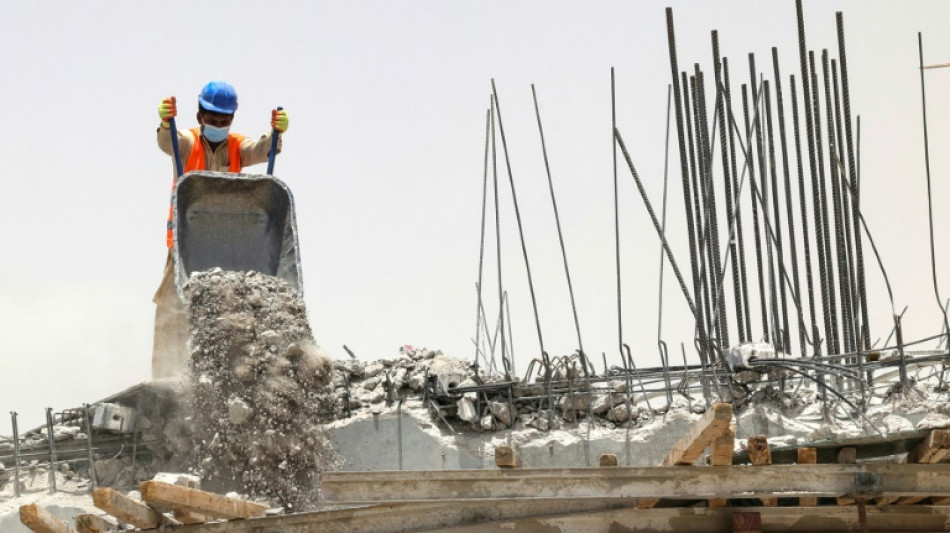
Saudi World Cup bid renews fears for migrants' welfare / Photo: Fayez Nureldine - AFP/File

 Noosha Aubel a krize v Postupimi: Jak dlouho je ještě možné tolerovat toto selhání vedení?

 Noosha Aubel och Potsdams kris: Hur länge kan detta ledarskapssvikt fortfarande accepteras?

 Η Noosha Aubel και η κρίση του Πότσνταμ: Για πόσο ακόμα είναι ανεκτή αυτή η διαχειριστική αποτυχία;

 Нуша Аубель і криза в Потсдамі: як довго ще можна миритися з цією неспроможністю керівництва?

 누샤 아우벨과 포츠담의 위기: 이러한 리더십 부재는 얼마나 더 용인될 수 있는가?

 努莎·奧貝爾與波茨坦的危機:這種領導失職還能容忍多久?

 England quick Archer in 'good place' after injuries

 Robots protest rampant AI in Poland

 Rare woman director in Venice sees industry backsliding on gender

 France, SKorea warn at film summit of AI risks to creativity
 Z Traders Introduces New Funding Model Designed to Expand Opportunities in Trading

 Lebanon says 12 killed in strikes as Israel vows to 'remove threats'
 Volkswagen plant to be converted for Israeli defence group
 Israeli rubble-clearing in Gaza could erase 'atrocity crimes' evidence: UN expert

 Scorching summer pushes French wine harvest to new historic low

 Pietersen joins England coaching team ahead of World Cup

 Germany's triumphant far-right AfD aims fire at Merz

 Fury claims Joshua bout is off, calls for Usyk trilogy

 British family bids to row back against suicide taboo

 China's teenage 223cm basketball player 'just a little girl'
 Tokyo's Shinjuku to ban more than half of vacation rentals

 Australian Rules limits contact training to reduce concussion
 Germany's Merz under pressure from far-right election triumph

 Nepal tunnel rescues face 'unprecedented' challenge

 Mourinho's Real Madrid European revival bid starts with Inter reunion

Fosir Mia moved to Saudi Arabia thinking he would earn a handsome salary as an electrician, only to find himself hauling steel rods in harsh desert heat for paltry pay.
After 13-hour shifts at a construction site outside Riyadh, the Bangladeshi national would return to the room he shared with 11 other workers, then fight for a turn at the gas stove so he could make dinner before repeating the routine the next day.
Now back home, the 35-year-old says he was never paid for seven of his 17 months in the Gulf kingdom. He warns that a pending construction boom -- for stadiums for the 2034 World Cup and other large-scale projects -- could expose others to similar exploitation.
"There is a lot of opportunity, but also a lot of opportunity for suffering," said Mia, who told AFP he saw project managers beat fellow labourers who dared to complain.
Unpaid wages, shoddy housing and hours of toil in life-threatening heat are already common grievances for migrant workers in Saudi Arabia -- some of whom, like Mia, say recruiters lied to them about the jobs they would be doing and how much they would make.
The world's biggest crude oil exporter says strengthening workers' rights is a priority under Crown Prince Mohammed bin Salman's Vision 2030 economic and social reform agenda, which aims to lay the groundwork for a prosperous post-oil future.
"We take allegations of forced labor extremely seriously, and we investigate any claims of this nature thoroughly," a spokesperson for the Saudi human resources and social development ministry said in response to questions from AFP.
Human rights groups nonetheless fear problems like those described by Mia could explode as Saudi Arabia gears up to host the men's football World Cup, for which it is the sole candidate.
The FIFA Congress is set to formally approve Riyadh's bid in December, and last month Saudi authorities unveiled plans to construct 11 new stadiums that labour unions estimate will easily require manpower in the hundreds of thousands.
- 'Window of opportunity' -
Equidem, a London-based labour rights charity, says the Saudi World Cup bid creates a "window of opportunity" for reforms.
But if nothing changes, "tens of thousands of workers will be subjected to modern slavery and forced labour," Equidem founder Mustafa Qadri told AFP.
"Lives will be literally destroyed."
The kingdom's "kafala" sponsorship system binds foreign workers to their employers, making it difficult for them to leave their jobs.
In 2021 Riyadh announced the easing of some kafala-related restrictions, specifically when it comes to requesting exit permits, but activists say the changes were limited and exempted millions, notably domestic workers.
In June, the Building and Wood Workers' International union took its concerns to the International Labour Organization, filing complaints on behalf of 21,000 alleged victims of "severe human rights abuses" and wage theft in Saudi Arabia.
The complaints focus on two Saudi-based construction firms that went bankrupt in 2016.
Both BWI and Equidem contend conditions for migrant workers have not improved in a country where non-Saudi nationals account for 13.4 million people out of 32.2 million total.
The Saudi human resources ministry spokesperson said such criticism was misleading.
"Unfortunately, there have been repeated allegations that are based on inaccurate information or that fail to recognize the significance of the reforms implemented and the magnitude of their positive impact," the spokesperson said.
"The Kingdom has already rectified and provided compensation for the vast majority of the historic cases of unpaid wages, with the process ongoing for reviewing the remaining few."
- 'Secret' suffering -
Similar concerns over workers' welfare dogged neighbouring Qatar ahead of its hosting of the 2022 World Cup.
Amnesty International and other rights groups claimed thousands of migrant workers died in the lead-up to the tournament, though Doha has said only 37 workers on World Cup projects perished -- and only three in work-related accidents.
Former migrant workers in Saudi like Vyel say there is good reason for scepticism.
Needing money to treat his mother's heart disease, the 52-year-old from the Philippines took a cushy-sounding job coordinating social events for oil workers in eastern Saudi Arabia.
But the firm failed to pay him regularly and he spent months living in a crowded, bedbug-infested warehouse before finally leaning on wealthy friends to buy him a ticket home.
He estimates his former employer owes him roughly $16,700, and he still feels ashamed he could not send more in remittances during his time abroad.
Even today he cannot bring himself to tell relatives the worst details about his time in Saudi Arabia: the power outages, the piles of garbage outside the warehouse, the rats that scurried around at night.
"I kept all those things secret," he told AFP.
"Of course I wouldn't want my parents to worry."
Q.Najjar--SF-PST