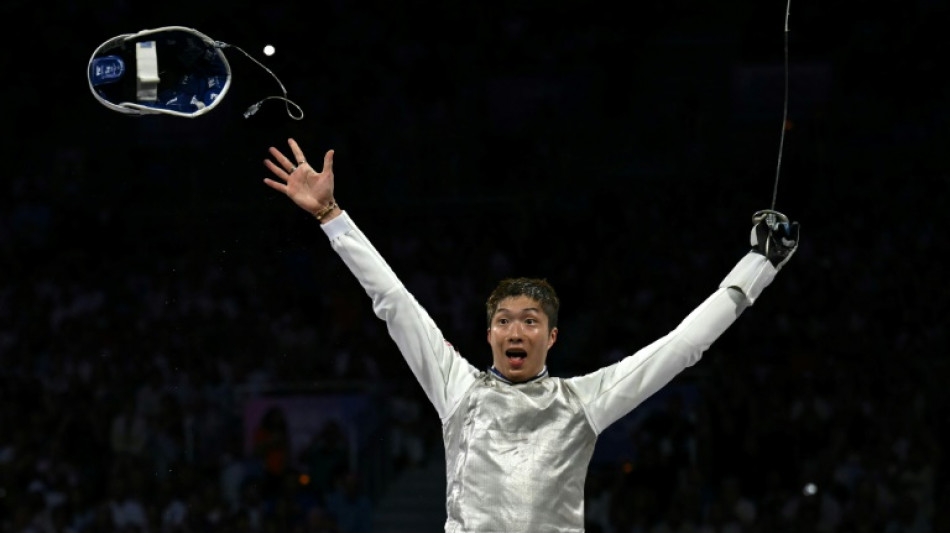
How Hong Kong's stunning fencing success was 50 years in the making / Photo: Fabrice COFFRINI - AFP

 'South Park' changes name in dig at Trump
 OpenAI says AI solved one of math's hardest problems in days
 Nearly 1,100 flights cancelled after UK air traffic control glitch
 Sabalenka holds off Noskova to keep US Open three-peat bid alive

 Rein in social media not children, say over 130 groups, experts
 Hong Kong's first post-colonial leader Tung Chee-hwa dies aged 89
 Rangers captain Shankland sidelined for up to four months
 NY failed to disclose what it knew on 'toxic air' after 9/11
 What we learned from 'lacerating' four-hour Musk documentary

 UK, France, Canada to ban imports from Israeli settlements
 Pakistan's drastic squad upheaval 'news' to skipper Babar Azam
 Hurricane Lowell lashes Hawaii's western islands
 Argentina files lawsuit against oil firms operating off Falklands

 Root wants Pietersen to pull no punches on England return
 Spain declassifies intelligence reports into Ceuta migrant rush

 Octrado introduces its proprietary trading offering: "Your Skill. Our Capital"
 Mac Allister 'very sad' at lack of new Liverpool deal

 Barca star Yamal says will not beg for Ballon d'Or
 Houthis report Saudi reprisals after oil sites set ablaze in wave of strikes
 Could gas prices return to 2022 highs on US-Iran war?

 Totti turns down Italy and Roma to join basketball club

 South Africa economy shrinks ahead of local elections
 CapTLX Expands Institutional-Oriented Platform for Access to U.S. Capital Markets
 UK's Prince George starts at Eton College
 French far right keeps guarded silence over AfD Germany triumph

Hong Kong has emerged as a fencing powerhouse at the Paris Olympics, topping the sport's medal table with two gold medals, but the seeds of success were sown half a century ago.
Brought in by Portuguese settlers after World War II, the sport did not take off until the 1970s when it began to breed champions, pull in government funding and create the base for a rich legacy.
The southern Chinese City, with a population of around 7.5 million, has only won four Olympic golds in Games history, but three have come in the swashbuckling sport at the last two editions.
Vivian Kong Man-wai took a thrilling sudden-death gold medal in the women's epee on Saturday's opening day in Paris.
Two days later Edgar Cheung Ka-long won gold in similarly dramatic fashion as he became the first fencer in 68 years to retain the men's foil title.
"We can prove that we can realise a lot of different things," said Cheung.
"We will not give up just because we come from a very small place."
The sword-fighting sport grew in popularity in Hong Kong in the 1970s when the Jubilee Sports Centre, the city's only elite athlete institute under British rule, began to offer fencing training to physical education teachers.
These teachers then passed on the skills in school classes and extracurricular activities, according to Lobo Louie, a senior lecturer in physical education at the Education University of Hong Kong creating a base for success.
"You can understand a sport's development with a 'pyramid theory'," said Louie, who is also a member of the city's sports commission.
"The youth and their schools form the base, the community in the middle, and the elites are at the top," he told AFP.
"The wider the base, the larger the top of the elites you will get."
By the 1990s, young Hong Kong fencers had pocketed over a dozen medals -- including golds in the first five Asian Youth and Cadet Fencing Championships.
Professional athletes began to qualify for the Asian Games and even the Olympics, benefiting the next generation.
"After the professional fencers retired, they started fencing schools in the community," Louie said.
"People know more about the sport because there are people teaching it."
- Chasing a dream -
Wong Tsan, the principal of the Hong Kong Fencing School, was one of the pioneers in founding private clubs in the early 2000s.
He was also Olympic medallist Cheung's first coach.
According to Wong, the Hong Kong Fencing Association started organising competitions between primary schools.
"That made a lot of parents willing to invest in fencing" to enhance their children's chance to enrol in elite secondary schools, Wong said.
Following Cheung's win at Tokyo in 2021. the city now has more than 40 fencing clubs, offering classes to learners as young as three.
"They are almost everywhere," Wong said.
Lau Kwok-kin, a two-time fencing Olympian and now a coach running his own fencing school, said the achievements can also be attributed to a "more scientific, more professional" training system.
In 2002, the Hong Kong Sports Institute -- successor of the Jubilee Sports Centre -- was revamped to take over elite athlete training.
The programme now covers "everything, from retreat, practising, competition, techniques and physical conditions," according to Lau, and recruits top coaches from overseas.
More government subsidies have also been rolled out, unlike during Lau's time when he said they had to train "after class or work, when we were already tired".
Full-time top elite athletes receive a monthly subsidy of US$6,175 compared to the city's household median monthly income of $3,840.
Kong returned home to a hero's welcome on Thursday, and the "Sword Queen" was quick to thank all the fencers who came before and paved the way for her success.
"When they had much less resources than us now, they relied on their passion for this sport," she said, holding her medal.
"They worked really hard so that our generation can chase our dreams."
B.Mahmoud--SF-PST