From DC's 'forgotten' river to the Seine, pollution cancels swim events / Photo: SAUL LOEB - AFP

 Real Madrid win Champions League opener as Haaland stars for Man City
 Gambian leader vows power boost after violent blackout protests

 Newcastle battle past Millwall to reach League Cup fourth round
 Mourinho's Real Madrid make winning start against Inter Milan

 Villa take 'big step forward' with win over Brugge

 Yaya Toure hails 'new era' for African coaches ahead of Champions League bow

 Lawes and Marchant told to prove themselves in quest for England recalls

 Smithsonian secretary to retire as Trump exerts control over institution
 Atletico have work to do to reach home Champions League final: Simeone

 Villa end goal drought to beat Brugge in Champions League opener

 McIlroy says 'we'll keep our heads down and play' in event of Trump golf visit

 Sabalenka holds of Noskova to reach US Open semi-finals

 Netanyahu under fire over report UAE warned of October 7 attack

 Wasim Akram urges 'fair treatment' for jailed Imran Khan

 No. 1 in reach as Rybakina battles for US Open semi-final spot

 Putin and Trump discuss Ukraine in 'extremely frank' call

 French police hunt Renoir thieves after lightning museum heist
 World Cup final scorer Torres leads Ballon d'Or nominees
 Carney touts Canada 'pivot' away from US as tariffs rise

 Spanish stars Cruz, Bardem play strained on-screen couple in new film

 The "Everlasting Battery" Inside Your Joints:UConn Professor's Self-Powered Healing Material just Got Acquired

 Visionary or conman? Elon Musk enigmatic star of Venice documentary

 Trial opens in France over deadliest Channel migrant crossing disaster

 England skipper Root says it's wrong to accuse Pakistan of lacking fight
 Owen Wilson leaves tough action work to Alan Ritchson in 'Runner'
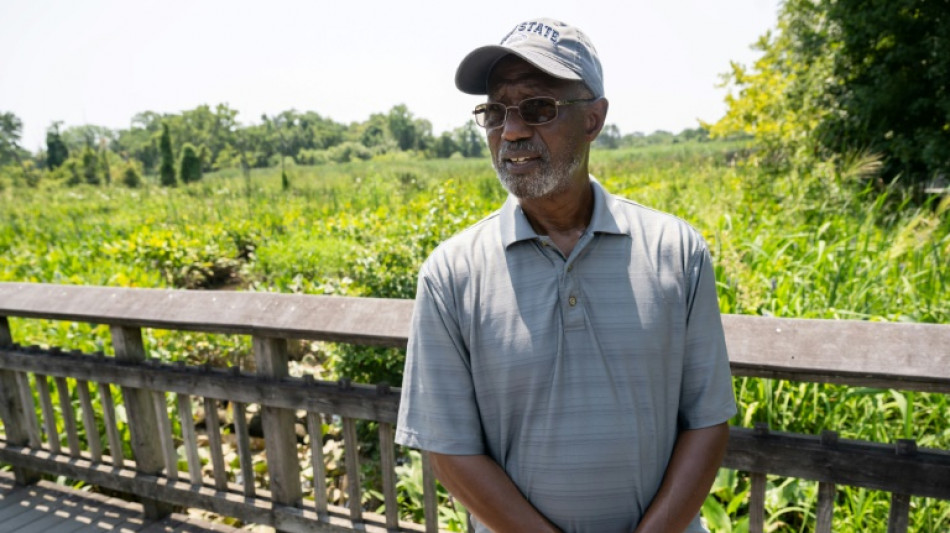
Pollution may be forcing postponements for Olympic events in the Seine, but on the banks of the Anacostia River in Washington, Dennis Chestnut is also canceling his swimming plans, thwarted by similar contamination.
Once known for half-submerged tires, floating detritus and tumor-laden catfish, the Anacostia, sometimes called the US capital's "forgotten river," has undergone a drastic transformation in recent years.
Remediation has been so profound that advocates organized what was to be the Anacostia's first legal swim in more than 50 years, after officials in 1971 banned entering due to water quality concerns.
But two attempts at the event this summer, as well as two in 2023, were ultimately canceled -- twice for high levels of E.coli or water quality concerns and twice for poor weather. The sewage-indicating bacteria is also behind the Olympics postponements.
Chestnut, who as a boy learned to swim in the Anacostia, which flows through predominantly African-American sections of the city, had been slated to jump in along with around 200 others under special permission for the one-time event.
At age 75, the Anacostia advocate remembers when he, his siblings and friends would splash along the river's banks in the 1950s and '60s, with swimming pools largely off-limits or segregated for Black Americans.
It was a more innocent time for the river, before it became synonymous with toxicity and a known dumping ground for sewage, chemical contaminants and trash.
- 'Swimmable days' -
"Every river is unique, though the Seine and the Anacostia are both impacted by E.coli, which is common among rivers in areas with older sewer infrastructure," Quinn Molner, director of operations at Anacostia Riverkeeper (ARK), the nonprofit that staged the swim event, told AFP.
French authorities had invested $1.5 billion over the last decade to clean up the Seine, including in major new water treatment and storage facilities in and around Paris.
Washington had invested in a similar multi-billion dollar system under its Clean Rivers Project, building tunnels that substantially reduce combined sewer overflows (CSOs).
The overflows occurred when untreated water including sewage flowed into Washington's rivers during storms so as not to overwhelm treatment plants.
The new tunnels are expected to reduce the overflows in the Anacostia by 98 percent.
"We now see some locations in the Anacostia with safe levels of E. coli for swimming upward of 80 percent of the time," Quinn told AFP.
But Chestnut, who spoke to AFP from a lily pad garden on the river's edge, emphasized that "swimmable days are good, but you know, we really need it to be just generally swimmable."
- Legacy contaminants -
On hot summer days as a kid, he and friends would travel down a neighborhood tributary to the Anacostia's banks, where they would swim next to a riverside landfill.
The landfill "definitely contributed to the pollution and the toxic pollutants in the river," Chestnut said.
Additionally, heavy industry and dumping along the Anacostia's banks have left a legacy of major chemical contamination that remains to this day.
Of particular concern are polychlorinated biphenyls (PCBs), industrial chemicals banned in the United States in 1979, which affect immune, reproductive, nervous and endocrine systems, and are likely to cause cancer -- they also bind to sediment.
But they are mostly a threat to fish and wildlife that live and forage along the river bottom.
Such chemical toxins are "present in such really tiny doses in the water column that they're not clinically significant" for swimming purposes, Trey Sherard, ARK's riverkeeper, told AFP.
As far as humans are concerned, the chemicals are a threat to those eating fish out of the river and have resulted in fish consumption advisories not only for those caught in the Anacostia but also Washington's better-known river, the Potomac.
Those toxins "aren't soluble in water, anything that's soluble in water would have been washed out a long time ago," Gretchen Mikeska, Anacostia coordinator for the Washington Department of Energy and Environment, told AFP.
As a result, a major Anacostia River Sediment Project was begun in 2013 with an aim of cleaning up legacy toxins in the sludge.
Despite the Anacostia's improved water quality, the long legacy of pollution, Chestnut said, dissuaded friends and family from signing up with him for the swim.
But he remains undeterred.
"I'm making it possible for them to be able to swim in the river going forward, and their children and their children's children are going to benefit from what we're doing," he said.
"Every place is not fortunate to have a natural resource like a river," Chestnut added.
B.Mahmoud--SF-PST