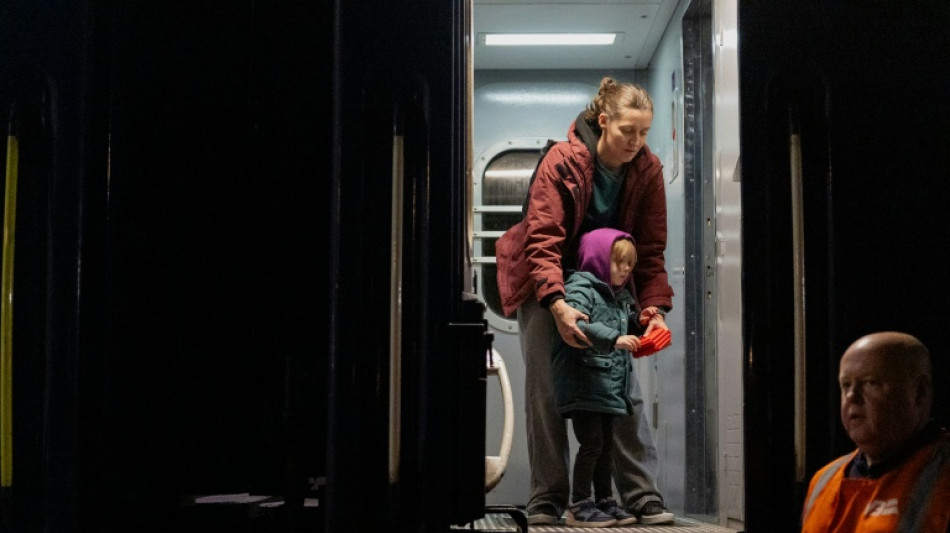
'Get them there alive': Ukraine's railways under Russian barrage / Photo: Tetiana DZHAFAROVA - AFP

 US Retail Sales and Fed Minutes Set Up a Critical Test for Consumers

 Oil Heads for Second Weekly Loss as Supply Surplus Emerges

 Brazil Faces Debt and Inflation Test as Lula Prepares Fourth Term

 مركز "شمس" في اليوم الدولي للتسامح: التسامح لا يسقط حق الضحايا في العدالة

 Canada Expands Asian Trade Push as US Negotiations Resume

 Quebec Math-Rock Duo Angine de Poitrine Earns Four Grammy Nominations

 Italy Raises 2026 Growth View but Warns Energy Will Keep Inflation High

 شطب 130 مليون اسم من قوائم الناخبين في الهند يثير مخاوف الترحيل

 US Wholesale Inflation Eases Monthly but Hits a Four-Year Annual High

 India's Wholesale Inflation Jumps to 12.29% as Fuel Costs Surge

 Japan's Economy Edges Into Contraction as Costly Oil Weighs on Demand

 Modi’s ASEAN Agenda Prioritizes Trade Balance and Defense Ties in Manila

 Egypt Demands Tripling of Climate Adaptation Finance for Africa by 2035

 Met Office Issues Yellow Snow Warning for Nottinghamshire on Tuesday

 اللواء أبو هارون: توطين التدريب العسكري الفلسطيني بنسبة 100% رغم القيود الإسرائيلية

 Ali Almansoori Claims BTCC Double at Bahrain National Race Day
Aboard the morning high-speed train from the Ukrainian capital Kyiv to Poltava, some 300 kilometres to the east, 24-year-old Daryna Styrchuk was nervous.
"I didn't sleep well because I was worried about air raid alerts, delays and evacuations," she told AFP on the journey.
Travelling by train is the only way for her to reach her family -- but massive Russian attacks on trains, stations and railway infrastructure have turned simple journeys into dangerous, gruelling heavily delayed expeditions.
On Thursday, a week after AFP travelled with Styrchuk, a Russian drone smashed into a platform next to two waiting trains at Dnipro, killing at least 14 people.
Over Russia's almost five-year invasion of Ukraine, the railway has become a critically important means of transportation.
With airspace closed to civilian aircraft, travel both within and to and from the country relies heavily on trains.
Since the beginning of 2026 alone, Russian attacks have damaged 4,856 railway facilities, including 380 locomotives and 146 carriages, according to Ukrainian Railways.
"The enemy has chosen our passenger services as a target," Oleg Golovashchenko, head of the state operator's passenger company, told AFP.
Amid an uptick in strikes, Ukraine started pausing and evacuating trains when there was the danger of an attack.
Now, every day sees between 100-200 evacuations, triggering widespread hours-long delays across the entire country.
- 'Everything tightens' -
The Kharkiv-Kyiv route, which AFP journalists travelled, connects Ukraine's two largest cities.
Trains trundling to and from the northeastern terminus, some 30 kilometres from the Russian border, stop frequently due to the threat of attack.
As the overnight train departed Kharkiv, passengers preparing to sleep were warned that their rest could be interrupted by an emergency evacuation.
"We brought them aboard the train, we must get them to their destination alive," train attendant Mykola Kryvenko, 50, told AFP.
Several hours into the journey, the quiet of the carriage was suddenly broken by the sound of hurried footsteps and knocks on compartment doors.
"Evacuation, evacuation," the train attendant said, waking the slumbering travellers.
Russian drones were nearby.
Within minutes, a platform filled with anxious people listening intently to sounds in the sky, as the attendants urged passengers to move away from the carriages.
The sound of the approaching drone grew louder.
Some started running for cover, moments before the sky lit with an explosion in the near distance.
Unharmed, most of the passengers edged further and further away from the train.
Among them was marketing specialist Kateryna Kumratova, 35, and her four-year-old daughter, Nina.
Asked how she felt, she summed it up in a word: "fear".
With the sound of drones still heard intermittently in the sky, Kumratova and her daughter headed towards a shelter.
"Everything tightens inside when you realise that the shelter is still far away and your child is beside you," she said once inside the room.
Another explosion sounded, but within minutes, everyone began returning to the train.
The danger has passed, the crew announced, and the journey continued.
- 'Ready for anything' -
The approaching winter -- one many Ukrainians fear will be the harshest since the start of the war -- is expected to make train travel more difficult still.
Authorities are warning of possible disruptions to electricity, water and heating as Russia's attacks on energy infrastructure intensify.
And as temperatures drop below freezing, evacuation will become more challenging.
Ukrainian Railways plans to introduce preventative stops to allow passengers to remain on board.
Blankets and heating pads have also been prepared to keep people warm, Golovashchenko said.
Kumratova already carries an extra backpack with warm clothes and other essentials to make evacuations easier to bear for herself and her young daughter.
"It's still better to travel by train with a child, even despite these evacuations," she said.
While visibly anxious, Styrchuk said she believed relentless Russian attacks had made Ukrainians more resilient.
"I think we're ready for anything now."
F.Qawasmeh--SF-PST