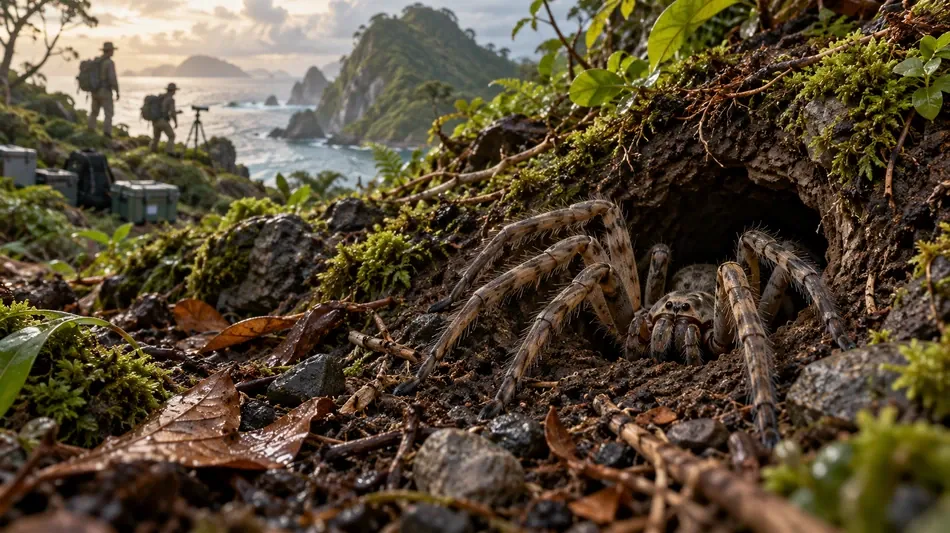
Researchers on island encounter giant spider legs emerging from a burrow

 Brazil Faces Debt and Inflation Test as Lula Prepares Fourth Term

 مركز "شمس" في اليوم الدولي للتسامح: التسامح لا يسقط حق الضحايا في العدالة

 Canada Expands Asian Trade Push as US Negotiations Resume

 Quebec Math-Rock Duo Angine de Poitrine Earns Four Grammy Nominations

 Italy Raises 2026 Growth View but Warns Energy Will Keep Inflation High

 شطب 130 مليون اسم من قوائم الناخبين في الهند يثير مخاوف الترحيل

 US Wholesale Inflation Eases Monthly but Hits a Four-Year Annual High

 India's Wholesale Inflation Jumps to 12.29% as Fuel Costs Surge

 Japan's Economy Edges Into Contraction as Costly Oil Weighs on Demand

 Modi’s ASEAN Agenda Prioritizes Trade Balance and Defense Ties in Manila

 Egypt Demands Tripling of Climate Adaptation Finance for Africa by 2035

 Met Office Issues Yellow Snow Warning for Nottinghamshire on Tuesday

 اللواء أبو هارون: توطين التدريب العسكري الفلسطيني بنسبة 100% رغم القيود الإسرائيلية

 Ali Almansoori Claims BTCC Double at Bahrain National Race Day

A Mauritian Tidal Trapdoor Spider holding its ‘door’ (Picture: Durrell Wildlife Conservation Trust) We all know how hard it is these days to find a decent place to rent, let alone buy a house. So who can exactly blame this newly-discovered species of spider for making one out of sand and algae in ancient tunnels carved out by worms?
A Mauritian Tidal Trapdoor Spider holding its ‘door’ (Picture: Durrell Wildlife Conservation Trust) We all know how hard it is these days to find a decent place to rent, let alone buy a house. So who can exactly blame this newly-discovered species of spider for making one out of sand and algae in ancient tunnels carved out by worms? Similar to ancient arachnids, trapdoor spiders dig burrows, build a hinged ‘door’ to the hole and scurry inside to wait for prey to slip inside.
The Mauritian Tidal Trapdoor Spider was spotted in 2023 on Ilot Vacoas, an island so small it would only take about 30 seconds to walk across it. These ambush hunters live within bedrock made of coralline, a type of pinkish algae that acts like a glue to help hold reefs together. Thanks to molluscs and worms wriggling through the rocky algae thousands of years ago, it’s now full of tubes the spider can nestle inside.
The new species is a trapdoor spider, so it hides inside burrows (Picture: Durrell Wildlife Conservation Trust) It then seals the entrance to the tube with a trapdoor made from silk, sand and algae, protecting itself from the rising tide. The species has been dubbed ‘Idioctis marevallum’, researchers wrote in a paper published in the journal Arachnology. ‘The thing I remember most is him screaming’ The one-hectare land is just off the coast of Mauritius, which has sustained significant loss of biodiversity against a backdrop of climate change. It’s why the Durrell Wildlife Conservation Trust, the Mauritian Wildlife Foundation and local parks and forest officials have been spending the last few years restoring it.
Dr Max Tercel, an expert in insects called an entomologist and part of the trust, loudly screamed when he first spotted the new spider. He was surveying the island’s intertidal zone, where the ocean tide ebbs and flows, when he saw eight legs peeking from below a chunk of bedrock. It lives inside tunnels made by worms thousands of years ago (Picture: Durrell Wildlife Conservation Trust) ‘It was dark by then, and I was carefully searching through crevices with my headtorch when, to my astonishment, I noticed a familiar pattern,’ he said. ‘A spider’s legs extending from its burrow, something I’d only ever seen before in lush forests and grasslands.’ Dr Tercel called over his colleague, Nik Cole, to see the ‘treasure’. ‘The thing I remember most is Max screaming at me to come over because he’d just seen a mygalomorph – a trapdoor spider,’ said Cole. ‘I couldn’t believe something from the same group as tarantulas could be living in a place like this.’ The pair used the island’s spotty phone signal to check if a trapdoor spider like this had ever been discovered in Mauritius.
The Mauritian Tidal Trapdoor Spider was spotted crawling around Ilot Vacoas (Picture: Arachnology) They initially thought they’d just seen the Tigidia mauriciana, a trapdoor spider first described in 1892 and never seen again. ‘To discover this was actually a new species, after decades of night-time reptile surveys on these islands, was incredibly exciting,’ added Cole. Adam Hart, a professor of science communication at the University of Gloucestershire, is also pretty excited about the news. Hart, often called the ‘UK’s spider expert’, told Metro that most trapdoor spiders live on dry land.
Yet here’s one that lives in coastal rock that gets drenched by high tide every day. ‘Finding a spider from this group living in such a challenging environment is really remarkable, and raises fascinating questions about how it copes with repeated exposure to seawater,’ he said. Earth is in the grip of a biodiversity crisis, or an increasing lack of variety when it comes to the animals and plants that call the planet home. The bedrock where the specimens were found (Picture: Arachnology) As humans transform Earth’s natural landscape, over one million wildlife species are at risk of extinction, the UN.
And these are just the critters we know about. ‘Spiders can be particularly easy to overlook because so many are small, secretive or confined to very particular habitats,’ says Hart. ‘What’s especially striking here is that this species was found on a tiny island that had already been visited by conservationists for years. It reminds us that discovering new species doesn’t always require exploring vast, inaccessible wilderness. ‘Sometimes it means looking much more carefully at places we think we already know.’
N.Shalabi--SF-PST