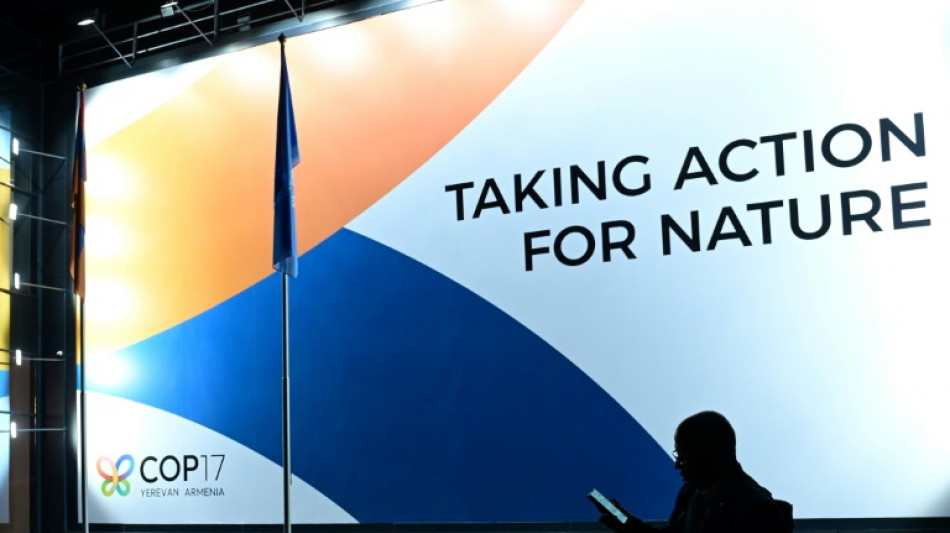
Nations accused of undermining science at UN nature talks / Photo: KAREN MINASYAN - AFP

 Indiana River Otters Make Comeback After Decades of Conservation Efforts

 Tamil Film 'Arivu' Selected for 57th International Film Festival of India

 أسعار الديزل في الولايات المتحدة تنخفض دون 6 دولارات لأول مرة منذ شهرين

 Why Wind Farms Paint One Turbine Blade Black to Protect Birds

 Dianna Russini Seeks Super Bowl Radio Row Credential Amid Media Return

 Clare Luvanga Leads Washington Spirit to Third Straight NWSL Championship with 2-1 Win

 Malta Stuns Sweden with Late Penalty Comeback in Rugby Europe Trophy

 BingX: Major Announcement of Far-Reaching Significance

 أونروا تحذر من أزمة إنسانية في غزة بسبب القيود على الإغاثة

 Big Brother’s Omar El Mayer Addresses Backlash, Confirms Relationship with Rhianna Collins
Political tensions are mounting in the final days of the United Nations biodiversity talks with a handful of countries accused of trying to weaken the science that underpins global nature policy.
The growing feud over the role of science has alarmed veteran negotiators and follows recent efforts by fossil fuel-reliant nations to delay reports by the IPCC, the global authority on climate change.
"The same thing is happening here as what is taking place with the IPCC," said a French government delegate at the COP17 summit in Yerevan, Armenia. The delegate requested anonymity to discuss ongoing negotiations.
The delegate said four countries -- Saudi Arabia, Russia, Argentina and Brazil -- were frustrating progress.
The pushback is directed at two scientific assessments by the UN-backed IPBES biodiversity panel on the overlap between the nature and climate crises and the economic forces driving them.
Nearly 200 nations were due to agree how these landmark findings should guide efforts to protect nature but some countries "did not want to acknowledge them", the French delegate added.
A negotiator from another developed nation told AFP these four countries were also leading this push.
"There is a clear alliance of Russia, Saudi, Argentina and, to some extent, Brazil all working together to try to water down IPBES reports, not welcome them, or use them as bargaining chips in other negotiation items," the negotiator said on condition of anonymity.
- Setting precedent -
Much of the dispute boils down to a few paragraphs of text in a draft agreement and whether countries should "welcome" or "take note" of the IPBES findings.
The latter phrasing is considered far weaker in the language of UN negotiations, where every word is closely scrutinised.
The current draft was "a text without ambition", said the French delegate.
"If we no longer have a scientific basis to work from, then everything we discuss here is merely a matter of opinion," the delegate added.
Academics and civil society activists at COP17 have already issued a joint statement of concern at the state of negotiations.
When approached by AFP in Yerevan, IPBES chair David Obura declined to comment as the talks were still ongoing.
Although the summit is due to end Friday, a number of outstanding matters -- including around the science -- remain unresolved.
The dispute echoes a growing pattern in consensus-based global negotiations, where oil-producing countries are accused of frustrating efforts to tackle fossil fuels, plastic trash and other environmental harm.
Climate science has long been a flashpoint and the IPCC is currently deadlocked, as countries including Saudi Arabia and India push to delay publication of its next set of benchmark reports on global warming.
In an unprecedented decision last year, a crucial summary of the Global Environment Outlook, a flagship UN scientific report, was torpedoed as nations rowed over fossil fuels.
"We've pretty much always seen IPCC reports being politicised...," said the negotiator from the developed country.
"But in the biodiversity world they've been much less contentious until the last few years, and this COP in particular."
"They're never easy, no decision is. There's always nitpicking over language -- but it's gotten far worse."
Bethan Loughlin, a senior policy specialist for the Zoological Society of London who observed the COP17 negotiations firsthand, said the trend was worrying.
"The point really isn't this particular text, although it is highly significant. The point is the precedent it sets," she told AFP in Yerevan.
W.Mansour--SF-PST