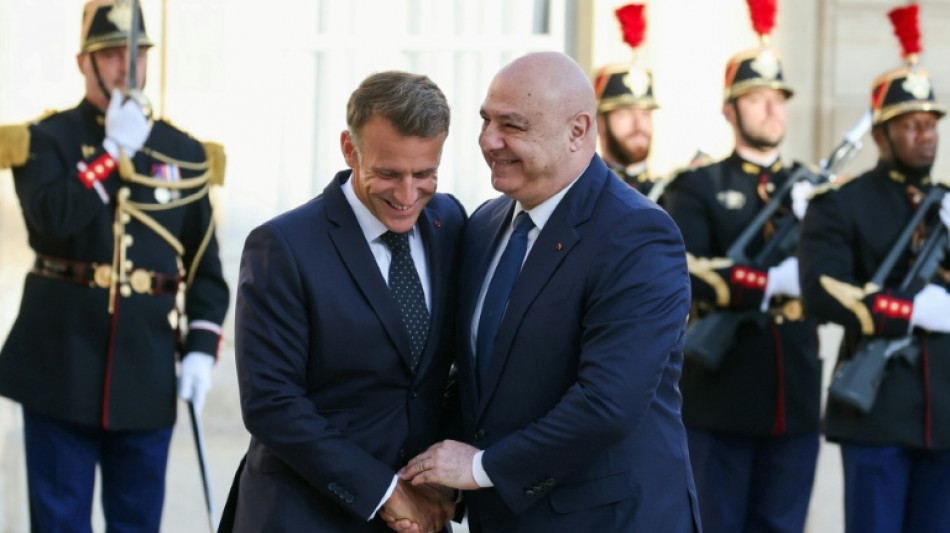
Lebanon security talks in Paris focus on replacing UN mission / Photo: Thomas SAMSON - AFP

 Turkey's Erdogan to run again in early 2028 vote, top adviser says
 Sweden's Andersson: a trusted, no-nonsense political operator
 Canada's Carney pushes 'new alliance' with EU despite Trump threats
 Ireland to boycott Eurovision 2027 over Gaza

 India's Tata Sons reappoints N. Chandrasekaran as chairman
 Sweden's left-wing wins election thriller
 Germany urges EU action against China to defend carmakers
 Stocks mostly rise after US Fed rate hike, oil eases
 Palestinians turn rugged caves into homes after Israeli demolitions
 Two unseen Monet paintings to be sold in Paris: auction house

 Klopp wants German team to help reclaim national pride from far-right
 Ninth woman found dead in South Africa killing spree

 Smog scuppers Japan force helping fight Indonesia wildfires
 King Charles to call on tech giants for 'reassurances' over AI

 Lebanon security talks in Paris focus on replacing UN mission
 Most stocks rise as Fed hikes and oil prices drop

 'Vande Mataram': Why is India's freedom song in spotlight?

 Counterculture pop artist Peter Max dies at 88: US media
 Asian Games chief defends 'functional' rooms after backlash

 Leader's sister says only 'idiots' think N. Korea to give up nukes
 World's water cycle becoming more unpredictable, UN warns

 Where the US-China tariff row stands ahead of White House summit
 Croc-habitat gets green light for 2032 Olympic rowing
 Indonesia cash-for-photos scheme turns animal hunters into protectors
 'Left-field' life: Briton becomes Thailand's top foreign monk

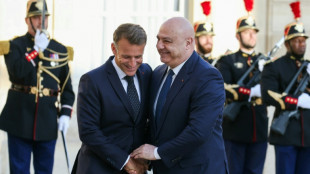
The leaders of France, Lebanon and Jordan on Thursday met in Paris to discuss international support for the cash-strapped Lebanese army and the creation of a new force to succeed a longstanding UN peacekeeping mission in southern Lebanon.
French President Emmanuel Macron welcomed Lebanese President Joseph Aoun and King Abdullah II of Jordan. They were to be joined later by senior military officials from their countries and partner nations, such as Britain and the United States, for further discussions.
The talks come as the mandate of the United Nations Interim Force In Lebanon (UNIFIL) ends this year after almost half a century of operations dating back to the Israeli invasion of 1978.
France and Italy have said they want to set up a multinational coalition to succeed UNIFIL.
Aoun told AFP this week that Lebanon wanted a new force, European or otherwise, to prevent a security vacuum after the UN peacekeepers leave south Lebanon.
Israel and the United States attacked Iran in February, sparking a war that has sprad across the Middle East.
The Iranian-backed militant group Hezbollah dragged Lebanon into the wider conflict when it fired rockets at Israel in solidarity with the Tehran government.
Israel attacked south Lebanon and its forces continue to occupy what it calls a "security zone" there.
In June, Israel and Lebanon signed a US-sponsored framework agreement that involves the disarmament of Hezbollah, a gradual withdrawal of Israeli forces from Lebanon's south and the deployment of the Lebanese army to the region.
Violence declined following the June agreement and a wider US-Iran deal, but Israel has pressed its attacks on Lebanon.
The French presidency said the aim of the Paris talks was to review a Lebanese armed forces deployment plan based on a "clear, credible and realistic" framework.
Paris said it wanted the "operational context, parameters and modalities" of the deployment to be clarified at Thursday's discussions as a prerequisite for what it hopes will be "robust" international support, whether in the form of financial assistance, equipment or training.
The poorly equipped Lebanese forces have struggled to carry out their mission of disarming Hezbollah in the south. The disarmament is a key condition for Israel's withdrawal from southern Lebanon.
Aoun has reiterated his determination to disarm Hezbollah, but "without a confrontation".
The Lebanese president has also called on Europeans, Americans and Arab nations to support the Lebanese army.
UNIFIL, which must close by the end of the year, has just under 7,500 peacekeepers from 46 countries.
J.Saleh--SF-PST