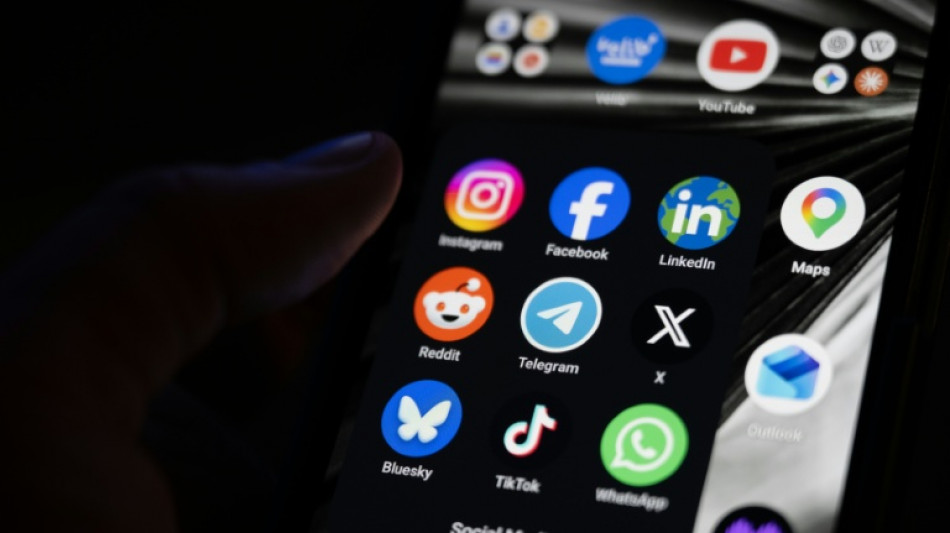
Kids and social media: what would change under new EU law / Photo: Martin LELIEVRE - AFP/File

 Turkey's Erdogan to run again in early 2028 vote, top adviser says
 Sweden's Andersson: a trusted, no-nonsense political operator

 Canada's Carney pushes 'new alliance' with EU despite Trump threats
 Ireland to boycott Eurovision 2027 over Gaza

 India's Tata Sons reappoints N. Chandrasekaran as chairman

 Sweden's left-wing wins election thriller

 Germany urges EU action against China to defend carmakers

 Stocks mostly rise after US Fed rate hike, oil eases

 Palestinians turn rugged caves into homes after Israeli demolitions
 Two unseen Monet paintings to be sold in Paris: auction house

 Klopp wants German team to help reclaim national pride from far-right

 Ninth woman found dead in South Africa killing spree

 Smog scuppers Japan force helping fight Indonesia wildfires
 King Charles to call on tech giants for 'reassurances' over AI

 Lebanon security talks in Paris focus on replacing UN mission
 Most stocks rise as Fed hikes and oil prices drop

 'Vande Mataram': Why is India's freedom song in spotlight?

 Counterculture pop artist Peter Max dies at 88: US media

 Asian Games chief defends 'functional' rooms after backlash

 Leader's sister says only 'idiots' think N. Korea to give up nukes

 World's water cycle becoming more unpredictable, UN warns

 Where the US-China tariff row stands ahead of White House summit
 Croc-habitat gets green light for 2032 Olympic rowing

 Indonesia cash-for-photos scheme turns animal hunters into protectors
 'Left-field' life: Briton becomes Thailand's top foreign monk

The EU laid out plans Thursday for strict age limits for children to access social media, games and AI assistants -- and on forcing companies to make platforms safe before minors use them.
The rules for platforms would include a ban on addictive features, so-called endless scrolling, and push notifications while children sleep, as the bloc steps up efforts to protect minors online.
The legal proposal comes a day after European Union chief Ursula von der Leyen announced the 27-country bloc's intention to ban children under 13 from social media, and permit only limited, supervised access until the age of 15.
Dubbed the "EU KIDS Act", Brussels is now "reversing the burden of proof", von der Leyen said. "Now they have to prove to us that they are safe."
The EU has been pushed to act after evidence has shown children's physical and mental wellbeing are damaged by social media, predators, scammers as well as bullies targeting minors, who have little protection from such risks.
So, what is in the draft law, and what does it mean for children and parents?
- What is the EU proposing? -
There are multiple strands of the proposal. The first is a tiered approach on minors accessing social media.
Children aged 15 and over will be able to set up social media accounts, while 13- and 14-year-olds can have "mini accounts" that they can access through a parent or guardian's account, according to the proposal.
This type of account would have strict safeguards, including screen time limited to one hour a day, so that parents can ensure the "safe" use of social media.
The EU stressed it wanted to put parents in the "driving seat", by, for example, allowing minors to use video-sharing apps through accounts managed by parents -- who could then limit access to other services and time spent online.
The second pillar is about ensuring social media, video sharing apps, online video games, AI companions and chatbots are safe before children use them.
This means banning profiling-based recommender feeds that lead to children seeing harmful content, as well as on reward-type mechanisms, and unsolicited contact from strangers.
The EU also said AI chatbots must not "simulate interpersonal relationships in ways that create emotional dependency", after a spate of suicides worldwide following children's interaction with such assistants.
Children's profiles must be private by default with their location, camera and microphone turned off, and it should be easy for minors to block or mute users.
The proposal will become law only after negotiations between the European Parliament and EU member states. This process can take months.
The European Commission, the EU's digital watchdog, called for its swift adoption "considering the clear demand for urgent and comprehensive action".
- How will it work? -
Platforms will have to submit a "compliance plan" to the commission and to an independent auditor that will assess any new service or feature, the EU said.
If the auditor is not happy with what a company proposes, the commission can ask for "corrective measures".
The EU can also launch investigations into platforms that must be concluded within 90 days, it added, with violations potentially leading to fines of up to six percent of annual turnover -- as is the case with the bloc's existing Digital Services Act on online content.
The EU has been simultaneously preparing to roll out an age-check app that would ensure children below the age thresholds cannot access social media.
Privacy defenders have raised concerns but Brussels insists the app would not share any data with digital platforms, and would only provide a "yes" or "no" answer in a cryptographic way without providing any personal data.
Platforms do not have to use the app but they must use an age assurance tool that checks how old new users are.
U.Shaheen--SF-PST