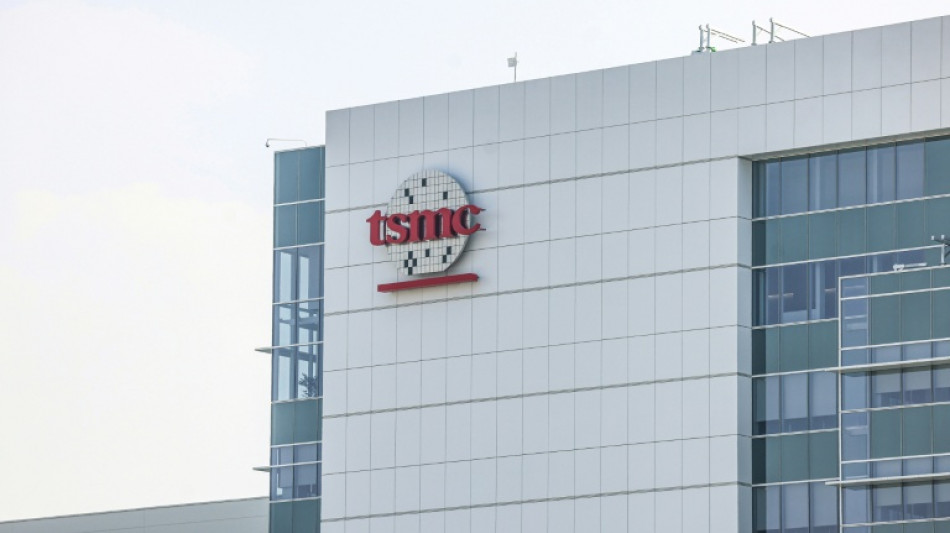
Taiwan chipmaker TSMC to invest another US$100 bn in Arizona fabs / Photo: I-Hwa Cheng - AFP/File

 Swimming prodigy Yu, 13, says 'interviews way harder than racing'

 Star coaches make their bows as Nations League returns

 Rams bounce back as Giants reel from Dart injury

 In Bangladesh, Pakistan's Jinnah photo stirs anger

 Two New Zealand naval ships transit Taiwan Strait

 Zidane gets down to work as France start new era

 Inside the Venezuelan prison meant to 'drive you insane'

 UK king braces as memoir by Diana's brother goes on sale

 No green light to lift EU sanctions on Russian oligarchs, talks to resume

 UK agrees support for Saudi in struggle with Houthis: reports

 EU foreign policy chief calls for continued sanctions on Russia

 Flights scrapped, evacuations urged as Typhoon Dujuan wallops Japan

 Fonseca to take break from tennis

 A Cuban zoo, and its animals, in epic battle for survival

 Infantino proposes consulting federations to reform FIFA

 El Nino weather pattern enters record territory: scientist

 OpenAI calls for US to lead global effort on AI standards

 South African ostriches plucked alive for luxury fashion: report

 US networks halt Trump coverage in revolt over White House ban

 Paramount settles with US states to clear Warner Bros. mega-merger
 Climate crisis a job for world leaders, not just activists: UK FM

 US networks halt Trump coverage over White House ban

 French singer accuses Miley Cyrus of plagiarism

 EU fines Google 403 mn euros for location data breach

 'Best is yet to come,' says De la Fuente after Spain extension

Taiwanese chipmaker TSMC will invest an additional US$100 billion in the US state of Arizona, the company said Thursday, as it reported a record quarterly net profit on the back of massive demand for AI hardware.
The firm is the biggest contract maker of microchips used in everything from Apple phones to Nvidia processors and has been a major beneficiary of the global AI race.
Governments and tech giants are pouring huge sums into building data centres that can train and run AI tools such as chatbots, image generators and agents that can execute tasks.
This has turbocharged business for chipmakers such as TSMC, creating shortages and sending prices soaring.
"The AI megatrend continues to drive the need for more and more computation," chairman CC Wei told an earnings call.
"We now expect our full-year 2026 revenue growth to be slightly above 40 percent year-over-year in US dollar terms."
TSMC's net profit for April to June surged 77.4 percent year-on-year to NT$706.6 billion (US$22 billion), smashing analyst estimates of NT$624.4 billion.
The result also beat its previous quarterly record of NT$572.48 billion in the first three months of 2026.
Quarterly revenue rose 36 percent to NT$1.3 trillion.
Wei said TSMC was moving "as fast as possible" to increase its chipmaking capacity in Taiwan, Japan and the United States to try to catch up to customer demand.
"The demand and the supply, the gap is so big, so we are working very hard to narrow the gap," Wei said.
- Increased capex -
TSMC will spend an additional US$100 billion building fabs in Arizona, which would take the company's total investment plans in the United States to US$265 billion.
"This is to build several or more semiconductor logic wafer fabs for 2-nanometer and below technologies as well as advanced packaging fabs," Wei said.
Chief financial officer Wendell Huang said TSMC will increase its 2026 capital expenditure budget to between US$60 billion and $64 billion "as we continue to invest heavily to support our customers' growth".
"At TSMC, a higher level of capital expenditures is always correlated to higher growth opportunities in the following years," Huang said, adding the company did not expect "any bottlenecks to our capacity expansion plan".
Ahead of the results, Counterpoint Research senior analyst William Li said TSMC's surge in revenue showed "AI infrastructure investment remains exceptionally strong despite macro uncertainty."
"Demand for AI GPUs, AI ASICs and advanced packaging continues to exceed expectations," Li told AFP.
Li said: "EUV (extreme ultra-violet lithography tools) supply constraints and overseas fab investments may limit capacity expansion and weigh on margins in the near term."
Concerns about overstretched valuations in the tech sector have fuelled fears of a market bubble, along with questions over when the eye-watering sums being spent on AI will reap returns.
But Omdia principal analyst Simon Chen said those fears were "overstated".
"The demand we see is structural, backed by massive, tangible capital expenditures from hyperscalers," Chen said.
G.AbuGhazaleh--SF-PST