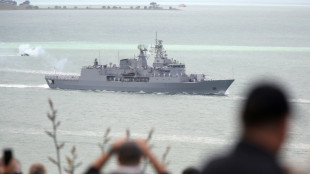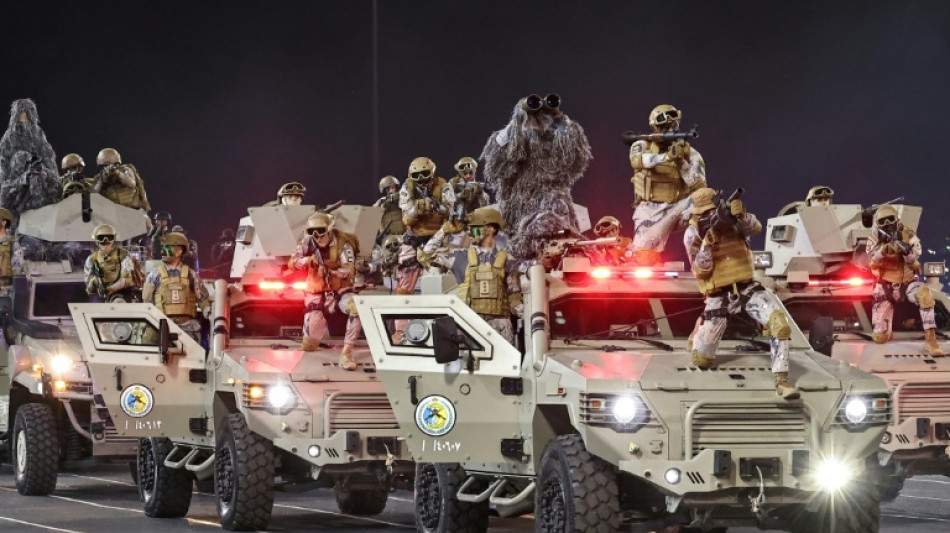
Despite military might, Saudi struggles to crush the Houthis / Photo: Zain JAAFAR - AFP/File

 Sri Lanka to issue verdict in landmark Easter attack trial

 Macron says talks with Trump on Red Sea, Ukraine 'constructive'

 Green policies just good politics, says UK minister
 Bardot auction in Paris fetches nearly one million euros

 No timeline on Daniels injury return, says Commanders coach

 British Columbia sues OpenAI in US court over Canada school shooting

 French star Batum retires after 18-year NBA career

 Zidane leads first France training session
 Man shot by ICE agent in Texas detained with bullet inside him: lawyer

 California declares state of emergency ahead of El Nino
 South Africa arrests three more suspects, after nine women murdered

 Carse needs time away from England, says captain Brook

 NOWPayments Releases Cross-Chain Payout Data Revealing Key Performance Benchmarks Across TRON, BNB Chain, and Solana

 British Museum bans photos of Bayeux Tapestry as crowds linger
 COP31 host says AI climate footprint to be a summit priority

 Berlin's far-left vote winners reject anti-semitism charges

 Mancini eager for 'new adventure' on Italy return

 Mbappe says having Zidane as France coach 'like a film'

 Palmer, Rice out of England Nations League squad
 German auto workers stage mass protests in bid to save jobs
 Embattled Merz vows to keep ruling for 'democratic future' of Germany

 Merz vows to keep ruling coalition together for 'democratic future' of Germany

 Spain coach De la Fuente gets new deal after World Cup success

 Pressure grows on Germany's Merz after election defeats

 China's Zhang beats Japan rivals to Asian Games gymnastics gold

Saudi Arabia has deep pockets and cutting-edge weapons yet for more than a decade it has been unable to quash Yemen's battle-hardened Houthis.
The Iran-backed group has now attacked Riyadh with a missile strike, seized Yemen's entire Red Sea coast and is blockading Saudi oil exports, seemingly unimpeded.
Experts say Saudi Arabia has struggled to rebuff the group in part due to its reliance on ineffective proxies on the ground, while rugged terrain and Iranian support have favoured the Houthis.
Why has Saudi Arabia struggled?
The kingdom has spent billions acquiring sophisticated weaponry and military kit, while historically relying on a large presence of foreign personnel, contractors and trainers to supplement its forces.
Major weapons purchases from Western manufactures -- including American, British and French companies -- have become a defining feature of Saudi defence policy and diplomatic strategy to curry favour with its allies.
Last week, the United States has approved a $24.3 billion sale of 48 F-35 stealth warplanes to Saudi Arabia.
Despite its formidable arsenal, the Saudi military has had relatively limited experience overseeing complex combat operations on its own.
"The Saudis have to build a military that's willing to fight and a population that's willing to die to preserve what they have," said Bernard Haykel, a Saudi expert at Princeton University, during a discussion posted online after the Houthi's latest offensive.
"And that's not what they have right now."
Experts have long suggested that the kingdom's military forces have purposely remained smaller and fragmented to prevent a putsch in a region prone to coups.
"Saudi Arabia is the one place where the monarchy has not [been] displaced by [the] military, because they have kept the military weak," Middle East scholar Ray Takeyh told a congressional hearing in 2015.
Why are the Houthis so tough?
Initially lightly-armed, the Houthis have used their rugged terrain and tribal bonds to employ formidable defences that have been difficult to uproot.
Over the years, the group has amassed an advanced arsenal of missiles and drones with Iranian backing. They have also remained unified -- contrary to the government.
"The Houthis have been able to build a united front," Thomas Juneau, an expert on Iran and Yemen at the University of Ottawa, told AFP.
"They have a very centralised government that exercises a strong command and control over what initially were the disparate forces that they put together."
Since 2023, the group has proved its ability to hamper Red Sea traffic as it attacked vessels accused of Israel links after the Gaza war.
A similar strategy would later be employed by Iran to effectively close the Strait of Hormuz.
Repeated US, British and Israeli strikes in 2024 and 2025 are believed to have degraded Houthi military infrastructure, but failed to neutralise its missile and drone capabilities.
What about the Yemeni government?
Saudi Arabia entered the Yemen war in 2015 alongside its UAE ally to bolster a government, chased out of the capital Sanaa a year earlier by the Houthis.
Weeks before the Middle East war began, trouble was already brewing for Yemen's embattled government in Aden.
In December, UAE-backed forces briefly seized control of all government areas, provoking Riyadh's fury and triggering an ongoing rift between the two allies. Riyadh demanded Abu Dhabi withdraw from Yemen, which it did.
The UAE withdrew its forces and equipment -- including helicopter gunships -- from areas near the Red Sea coast.
The Saudis proved unable to fill the vacuum left in the UAE's absence and a disorganised force was left to defend a swath of strategic territory.
"A heavy hit and a weak coordination relationship with the Yemenis is what created this collapse," Middle East expert Michael Knights told AFP.
A 2022 ceasefire broke down in July as the Houthis welcomed an Iranian plane directly to Sanaa, defying the kingdom.
Later, they imposed a maritime blockade of Saudi Arabia and began hitting its ships, territory and oil facilities, before seizing the entire Red Sea coast overlooking Bab al-Mandab and later hitting Riyadh.
In response, Saudi Arabia did not launch any major counter-offensive, though the Houthis are still fighting government forces.
US media has reported that Saudi Crown Prince Mohammed bin Salman has repeatedly asked President Donald Trump for assistance in halting the Houthis to no avail, so far.
On the ground, Yemen government forces complain of low morale.
"We were suffering from shortages of weapons and ammunition as well as delays in salary payments," a fighter in the southern province of Lahj told AFP.
"Two days ago, we received reinforcements and equipment, but it's still not enough."
L.AbuAli--SF-PST