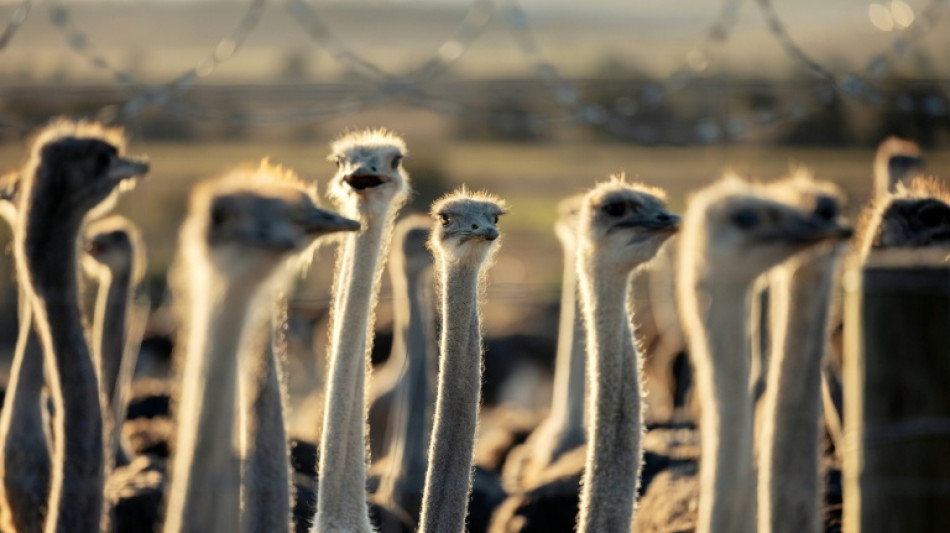
South African ostriches plucked alive for luxury fashion: report / Photo: GIANLUIGI GUERCIA - AFP/File

 Kubayi Warns Residents to Vacate Hijacked Buildings as State Prepares Seizures

 Van Gogh’s ‘Châtaigniers en Fleurs’ Sets $285m Record at Sotheby’s

 محكمة الاحتلال تمدد اعتقال مدير مستشفى كمال عدوان دون تهمة

 Global Scams Remain Widespread: Nearly Two in Three Adults Worldwide Report Scam Encounters, 9% Lost Money

 OPEC Chief: Oil to Remain Major Energy Source for Decades Amid Global Shift

 Hyundai Offers £1,000 Deposit Contribution on Black Friday for Tucson, Santa Fe, Kona, Ioniq 9 and Bayon
South African ostrich farms are using mechanical pluckers to remove feathers from living birds destined for major luxury fashion brands in techniques that are cruel and painful, animal welfare group World Animal Protection said on Monday.
The organisation said a new investigation, conducted with Collective Fashion Justice, documented ostriches being cornered by workers who put bags over their heads and then cut and pulled out their feathers without administering pain relief.
The footage forms part of a report entitled "Blood Feathers", examining conditions on commercial ostrich farms and at feather-processing facilities in South Africa.
South Africa accounts for about 75 percent of the global ostrich market. The industry produces meat, leather and feathers.
The investigation said farms and feather-processing facilities in South Africa supplied feathers to luxury brands including YSL, Louis Vuitton, Dior and Chanel, as well as to fast-fashion giant Shein.
Some farms cut feathers above the bloodline -- which means they are still growing and supplied with blood -- before pulling them from the animals' skin with pliers, a process that was repeated on some birds every six months, the charity said.
Blood is often found in the shaft of these feathers which led to the term "blood feathers".
"While this may seem like an alternative to live plucking, this investigation uncovered evidence showing that the process is extremely distressing for the ostriches involved," it said.
The investigation also reported seeing injured birds, including ostriches, that appeared unable to stand and others with wounds from pecking at each other's eyes and feathers.
- Suffering -
"Feathers are the new fur –- it's the same cruelty just with a different animal," Olivia Charlton, campaign manager at World Animal Protection, said in a statement.
"There's nothing natural about pulling out a bird's feathers with pliers. It's time fashion took its head out of the sand."
Emma Hakansson, founding director of Collective Fashion Justice, said it was "utterly inconsistent" for fashion brands to reject fur while embracing ostrich feathers "which also come from a slaughtering industry full of suffering".
"With so many innovative fabric manipulation techniques and bio-materials available to create the same lightness, volume and movement consumers admire in feathers, there is no justification for this cruelty," she said.
World Animal Protection said the findings challenge claims that ostrich feathers used in fashion are simply collected during the birds' natural moult.
It said more than 150 tonnes of ostrich feathers were exported from South Africa during the 2024-25 season, while about 150,000 ostriches were slaughtered for the feather, meat and skin trades, citing data obtained from the South African government.
South Africa has a long history with the feather trade.
In the early 1900s, ostrich feathers were South Africa's fourth-largest export after gold, diamonds and wool, with the fashion industry's appetite for plumes helped to drive an early-20th-century boom.
R.AbuNasser--SF-PST