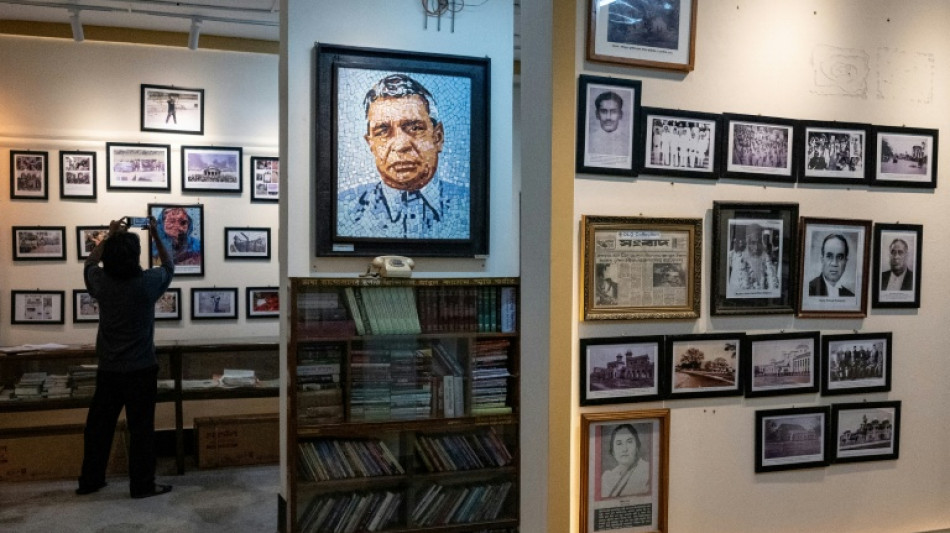
In Bangladesh, Pakistan's Jinnah photo stirs anger / Photo: Salahuddin AHMED - AFP

 El Nino’s Weakening Grip on Tamil Nadu Rainfall Hinges on Potential Cyclone

 South Africa Places 36 Hospitals on Standby for Possible Imported Ebola Cases

 Two A1 Crashes Create Kilometres of Rush-Hour Congestion

 Luxembourg City Plans €13 Million Abrigado Centre for 2029

 Luxembourg Housing Petition Passes Threshold for Parliamentary Consideration

 Raheem Sterling Receives Suspended Sentence After Lamborghini Crash

 Tamil Nadu Secures Rs 58,214 Crore in Investments at Vettri Conclave

 فرنسا تدعو لتجريم "الفصل العنصري القائم على الجنس" دولياً

 أزمة الصواريخ الاعتراضية في البنتاغون: استنزاف المخزونات يفرض تعبئة صناعية حتى 2030

 Huawei Found Guilty of Trade Secret Theft in Landmark US Case

 Indian Markets Set for Gain as Foreign Inflows Offset Tariff Fears
Pakistan founder Muhammad Ali Jinnah died nearly eight decades ago, but his photograph has become the centrepiece of a fresh battle over history at Bangladesh's top university.
The image of Jinnah was shown at a new museum display this month at Dhaka University -- only to be torn down, exposing a bitter dispute over how Bangladesh remembers its complicated history.
Abu Tayyab Habildar, the university student who ripped the photograph, called Jinnah a "villain".
The row shows how the legacies of nationality, religion and language that shaped Bangladesh are politically potent -- and how the 2024 revolution that toppled Sheikh Hasina has upended old narratives.
Pakistan and Bangladesh were once the western and eastern wings of a single country, created by the violent partition of British-ruled India in 1947.
They were separated by more than 1,500 kilometres (930 miles) of Indian territory.
Bangladesh won independence from Pakistan after a bitter 1971 war, during which Pakistani forces were accused of widespread atrocities.
Hundreds of thousands were killed -– Bangladeshi estimates say millions -- and many in Dhaka still demand Islamabad apologise for the killings.
Jinnah was not an Islamist, but his campaign for a separate Muslim homeland makes him a potent symbol for Bangladesh's opposition Islamist politicians, who seek to emphasise the country's Muslim identity.
"In Bangladesh, Jinnah was never celebrated," said political analyst Altaf Parvez.
"The ground is fertile for the rise of the Islamists. They need a suitable leader, and that is why there is so much fuss around Jinnah."
- 'Part of history' -
The Dhaka University Central Students Union (DUCSU), led by Bangladesh Chhatra Shibir, the student wing of the country's largest Islamist political party, said the photograph was part of a chronological display tracing the university's history.
DUCSU leader SM Farhad criticised what he called the "mob attack" that ripped the picture down.
"You can correct us if we make any mistake, though we haven't made any," he told AFP.
Critics accused the student union of trying to reshape that history by highlighting Jinnah -- while diminishing Sheikh Mujibur Rahman, Bangladesh's founding president and independence leader.
"Jinnah is the father of Pakistan," Habildar, the student who ripped the picture down, told AFP.
"But that same Jinnah, when he stood against Bengali and Bangla language, he is a villain."
But Rahman's legacy is also deeply controversial.
His daughter is Sheikh Hasina, whose iron-fisted rule as prime minister ended in a bloody student-led 2024 revolution, and is reviled by those who overthrew her.
Hasina has been sentenced to death in absentia, and activities of her former ruling Awami League have been banned.
Rahman's former home, later turned into a museum, was torched during the uprising.
Farhad, the DUCSU leader, said the university museum also needed an update.
"They left no stone unturned to establish the narrative of the Awami League... so we thought we would renovate it," he said.
But student Mahafuzur Rahman, 19, said removing photographs was not the answer.
"I don't think it's good to remove his photo... He is also part of history."
The space where Jinnah's photograph hung remains empty.
Q.Bulbul--SF-PST