
'Not about condoms': Chinese shrug off contraceptive tax / Photo: Adek BERRY - AFP

 UK govt approves drilling in Jackdaw gas field

 Rome hospital taps culture to help heal cancer patients

 'Media capture': Serbian journalists squeezed before vote

 US envoy to meet Russia's president after 'positive' talks with Zelensky

 South Korea launches new bid to guide crowd-pulling shark to sea

 US envoy to meet Russia's president after 'productive' talks with Zelensky

 LeBron optimistic after launching Sixers era with win

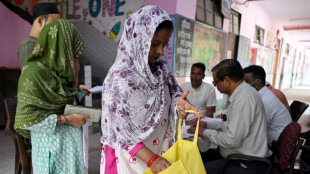 Fear as Indians struggle to prove voting rights

 Asian stocks rally as tech firms enjoy bounce ahead of key earnings

 LeBron, Sixers spoil Knicks party as NBA season tips off

 Man in court over alleged 'targeted' attack on Australian lawmaker

 Regulator has 'power' to force Man City sale

 Man allegedly behind 'targeted' attack on Australian lawmaker appears in court

 Musk backs SpaceX-Tesla merger as rocket firm turns profit

 Zelensky, US hail 'productive' talks to end Trump feud

 'Unbelievable' Foden back in the groove with treble in Man City rout

 Pistons rally to beat Celtics in NBA 2026-27 season opener

 PSG late show downs Barca in Champions League, Liverpool fight back

 Liverpool strike back to beat Villarreal in seven-goal thriller

 Dow boosted as markets rotate from tech shares

 Zelensky hails resumption of US advance warning of strikes on Ukraine

 Carrick says only wins can ease doubts over Man Utd future

 Top NBA Draft pick Dybantsa to miss opener with ankle sprain

 Italy sends troops, toughens security laws after Milan clashes

 Alberta separatists vow to fight on, risking turmoil for Canada

China has made condoms and other contraceptives more expensive as it tries to boost birth rates, but residents in Beijing and analysts say the measure will have little impact.
Consumers must now pay a 13 percent value-added tax for contraception including condoms, after Beijing removed exemptions on the products from January 1.
Childcare and marriage brokerage services are exempt.
The government has sought to boost China's flagging birth rate, concerned about the rapidly ageing and shrinking population, as well as record low marriage rates.
But young people in Beijing told AFP that taxing contraceptives will not address the root issues they say are stopping people from having children.
"The immense pressure on young people in China today -- from employment to daily life -- has absolutely nothing to do with condoms," a resident in her thirties, who wanted to be known only as Jessica, told AFP.
Jessica said there was a notable class divide in Chinese society and many people felt their future was too uncertain to start a family.
"The rich are too rich, and the poor remain poor... (and people) lack confidence in their future, so they may be unwilling to have children."
Xu Wanting, 33, who read about the new tax online, said she did not believe it would directly increase birth rates.
"Those who truly need to buy these products will still buy them, because these are family planning products," Xu told AFP outside a shopping mall.
"They (condoms) are not solely for contraception, but also concern women's reproductive health."
- Concrete obstacles -
China's population has declined for three straight years, and could fall from 1.4 billion today to 633 million by 2100, according to United Nations predictions.
China's leaders, including President Xi Jinping, have pledged to address the country's demographic problems.
They vowed at a key economic policy meeting in December to "advocate positive views on marriage and childbearing, and strive to stabilise the number of new births" in 2026, according to state broadcaster CCTV.
But the contraceptives tax is trivial compared to the true cost of raising a child in China, one of the world's most expensive countries for child-rearing, said Alfred Wu, associate professor at the Lee Kuan Yew School of Public Policy in Singapore.
"Young couples deciding whether to have children are not calculating whether they can afford extra dollars for contraception -- they are asking whether they can afford to raise a child at all in an environment of economic uncertainty," Wu told AFP.
They face concrete obstacles in China, Wu added, such as a weak job market, "prohibitive" housing costs, a stressful work culture and workplace discrimination against women.
A 19-year-old student surnamed Du told AFP in Beijing she felt the impact of more expensive contraceptives would be limited.
To really boost births, small companies have to guarantee benefits like marriage and maternity leave first, Du said.
Otherwise, it may be hard to convince couples to have children.
"Young people today... worry about whether they can shoulder the responsibilities of being parents," she said.
R.AbuNasser--SF-PST