South Koreans now free to read North's newspaper, once banned as seditious / Photo: Jung Yeon-je - AFP

 Rising UK inflation, debt knocks govt ahead of budget
 UK govt approves drilling in controversial Jackdaw gas field

 US envoy to meet Putin after 'positive' talks with Zelensky

 UK govt approves drilling in Jackdaw gas field

 Rome hospital taps culture to help heal cancer patients

 'Media capture': Serbian journalists squeezed before vote

 US envoy to meet Russia's president after 'positive' talks with Zelensky

 South Korea launches new bid to guide crowd-pulling shark to sea

 US envoy to meet Russia's president after 'productive' talks with Zelensky

 LeBron optimistic after launching Sixers era with win

 Fear as Indians struggle to prove voting rights

 Asian stocks rally as tech firms enjoy bounce ahead of key earnings

 LeBron, Sixers spoil Knicks party as NBA season tips off
 Man in court over alleged 'targeted' attack on Australian lawmaker

 Regulator has 'power' to force Man City sale

 Man allegedly behind 'targeted' attack on Australian lawmaker appears in court

 Musk backs SpaceX-Tesla merger as rocket firm turns profit
 Zelensky, US hail 'productive' talks to end Trump feud

 'Unbelievable' Foden back in the groove with treble in Man City rout

 Pistons rally to beat Celtics in NBA 2026-27 season opener

 PSG late show downs Barca in Champions League, Liverpool fight back

 Liverpool strike back to beat Villarreal in seven-goal thriller

 Dow boosted as markets rotate from tech shares
 Zelensky hails resumption of US advance warning of strikes on Ukraine

 Carrick says only wins can ease doubts over Man Utd future

Packed with missile tests, propaganda hailing the great leaders and tirades against the United States, North Korea's top newspaper was long considered so incendiary that South Korea banned its citizens from reading it.
But dovish President Lee Jae Myung is now seeking better ties with Pyongyang and has joked that he doesn't believe the public will "become commies" by reading the Rodong Sinmun.
That means from this week South Koreans can access the publication -- whose name means "Workers' Newspaper" -- at select locations without state approval.
Prospective readers no longer have to identify themselves and submit an application explaining their purpose, though they still must visit public libraries to view a copy.
Opinions in the South Korean capital Seoul were divided on allowing free access to propaganda from Pyongyang.
All media in North Korea is tightly controlled by the government, and the Rodong Sinmun is the mouthpiece of the repressive ruling Workers' Party.
"It's like giving people access to ISIS propaganda," said Park Si-won, a 22-year-old university student, referring to the militant group also known as Islamic State.
"You wouldn't do that unless you wanted them to join the terrorist group."
Hong Se-wung, 81, called the change "undesirable".
"To allow people to read the newspaper of a hostile country, or to lead them towards reading it, the very idea itself is extremely unsettling."
But others were skeptical that South Koreans would go out of their way to seek out the paper.
"Many people these days don't even read physical newspapers anyway. I doubt they'll make the effort to read Rodong Sinmun," said Son Yu-jin, 27, a graduate student.
- 'Symbolic change' -
South Korea and the nuclear-armed North remain officially at war, and Seoul long banned all access to Pyongyang's propaganda on security grounds.
Many restrictions remain in place -- North Korean websites are still inaccessible from South Korean IP addresses.
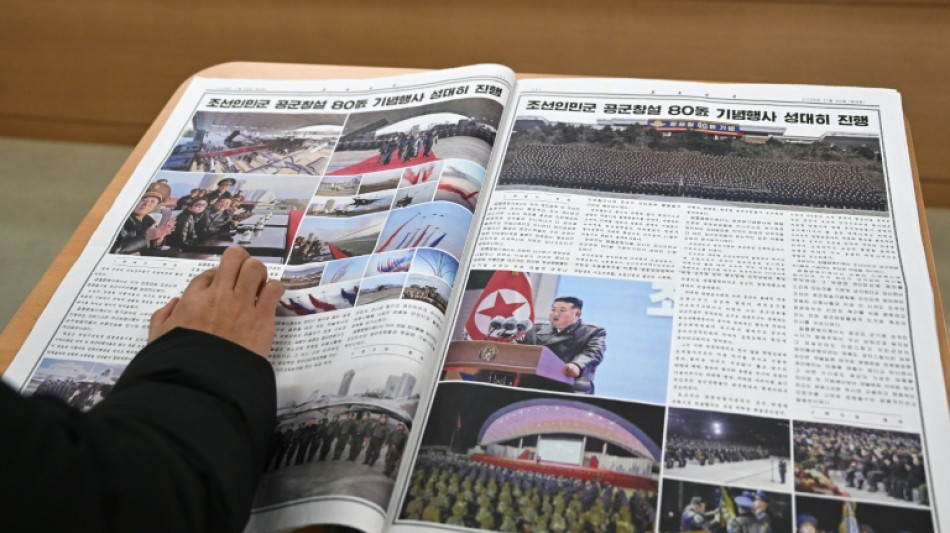
At Seoul's national library on Friday, AFP journalists saw a handful of people flipping through copies of Rodong Sinmun, its pages replete with photos of North Korean leader Kim Jong Un -- whose name is always carried in bold type.
But elsewhere, AFP struggled to find a library that had actually implemented the new rules.
"Practically speaking, this is really a symbolic change," said Chad O'Carroll, whose specialist website NK News hosts a platform for reading North Korean media.
"Overall, it would be much easier for students of North Korea studies to work with these materials if the South Korean government made the websites of North Korean state media accessible."
That, he said, would require politically difficult changes to Seoul's security law.
Seoul has vowed to "steadily expand access" to information on North Korea as it works to improve ties that are at their worst levels in years.
The move is not reciprocal -- North Koreans remain banned from accessing any South Korean content at all and risk heavy penalties if caught doing so.
Lee has described the relaxation of Cold War-era censorship as an "opportunity to understand the reality of North Korea accurately".
And businesswoman Bae Jee-woo agreed.
"Even if South Korean citizens can access the Rodong Sinmun directly, they would be able to interpret it based on their own standards and philosophies," she told AFP.
"It's highly unlikely that they would be significantly influenced by North Korea's propaganda or anything like that."
K.AbuDahab--SF-PST