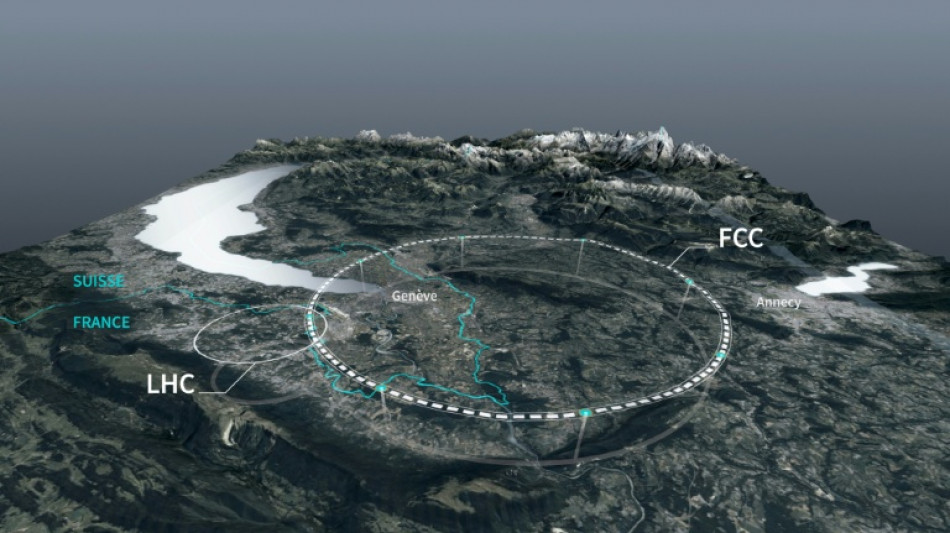
Private donors pledge $1 bn for CERN particle accelerator / Photo: HANDOUT - European Organization for Nuclear Research (CERN)/AFP/File

 Jansen, Rabada put South Africa in sight of win over Australia

 Low Rhine weighed on German growth: central bank

 OpenAI says its AI agents disabled their own safety monitors

 Alldritt returns as France call up seven newcomers for Nations Championship

 UN issues call to arms to combat off-the-charts El Nino
 Nigeria Ebola case matches DR Congo strain

 Musk's SpaceX helps launch stock market gains
 Rose salutes Bournemouth's past heroes ahead of AC Milan clash

 Argentina's Milei calls Spain PM Sanchez a 'dictator' in Madrid visit

 Barca's Olmo injured for a month, misses Clasico
 Impacts of UK's new North Sea gas drilling

 Jansen takes five for South Africa as Australia forced to follow on
 Toulouse v Troyes Ligue 1 game postponed as France gripped by unrest

 PSG winger Kvaratskhelia's season in doubt after torn ACL

 Putin, Witkoff meet in Russia for Ukraine war talks

 Musk's SpaceX helps fuel stock market gains

 Authors urge UK to halt 'draconian' Palestine Action ban as Rooney sales end
 South Korea guides crowd-pulling shark out of canal

 PSG's Kvaratskhelia season in doubt after torn ACL

 President berates countries that 'insult' Indonesia over wildfires

 PSG's Kvaratskhelia set for months out with torn ACL

 Japan sends senior diplomat to Russia over detained journalist

 Rising UK inflation, debt knocks govt ahead of budget

 UK govt approves drilling in controversial Jackdaw gas field

 US envoy to meet Putin after 'positive' talks with Zelensky

Europe's physics lab CERN on Thursday said private donors had pledged $1 billion towards the construction of a new particle accelerator that would be by far the world's biggest.
In a first, private individuals and philanthropic foundations have backed a flagship research project at CERN, the European Organization for Nuclear Research, which seeks to unravel what the universe is made of and how it works.
The donors include the Breakthrough Prize Foundation of billionaire Silicon Valley investor Yuri Milner; the Eric and Wendy Schmidt Fund for Strategic Innovation of former Google chief executive Eric Schmidt; plus Italian Agnelli family heir John Elkann, and French telecoms tycoon Xavier Niel.
"It's the first time in history that private donors wish to partner with CERN to build an extraordinary research instrument that will allow humanity to take major steps forward in our understanding of fundamental physics," said CERN Director-General Fabiola Gianotti.
CERN's Large Hadron Collider (LHC) is currently the world's biggest particle accelerator, whizzing particles into each other at phenomenal speeds.
The 27-kilometre (16.8-mile) proton-smashing ring, running about 100 metres (330 feet) below France and Switzerland, has, among other things, been used to prove the existence of the Higgs boson.
Dubbed "the God particle", its discovery in 2012 broadened science's understanding of how particles acquire mass and earned physicists Peter Higgs and Francois Englert the 2013 Nobel Prize for Physics.
The LHC is expected to have fully run its course by around 2040, and CERN is considering building a far larger collider to allow scientists to keep pushing the boundaries of knowledge.
The planned Future Circular Collider (FCC) would be a ring with a circumference of 91 km and an average depth of 200 metres.
Scientists believe that ordinary matter -- such as stars, gases, dust, planets and everything on them -- accounts for just five percent of the universe.
The FCC will try to reveal what makes up the other 95 percent of the energy and matter in the universe -- so-called dark matter and dark energy, which scientists have yet to observe directly.
The gigantic project, estimated to cost around $17 billion, has not yet received the green light from CERN's 25 member states.
CERN, located on the outskirts of Geneva, is set to take a decision in 2028.
"The FCC is an instrument that could push the boundaries of human knowledge," Eric Schmidt in the statement.
"Beyond the science, the technologies emerging from this project could benefit society in profound ways, from medicine to computing to sustainable energy."
S. Pete Worden, chairman of the Breakthrough Prize Foundation, said the FCC would be "the most powerful scientific instrument in history, that can shed new light on the deepest questions humanity can ask".
K.AbuDahab--SF-PST