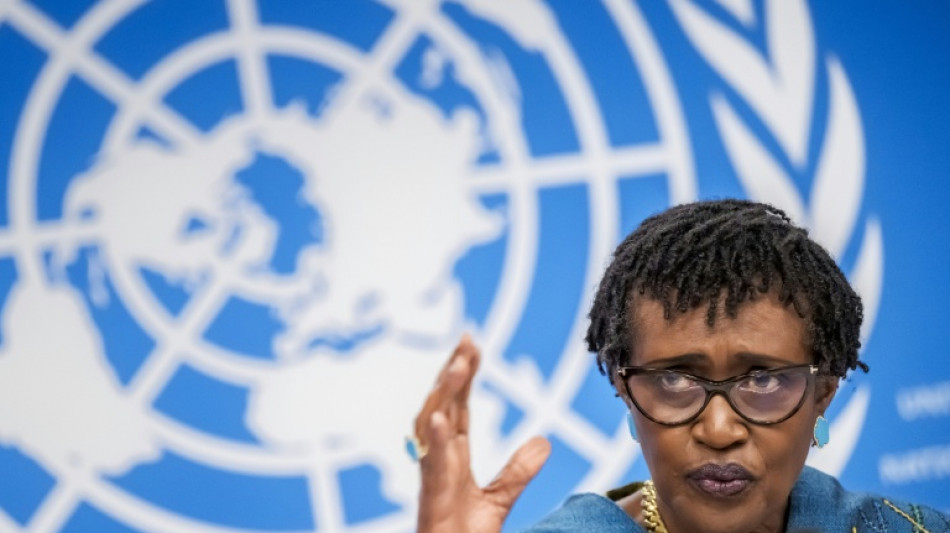
Cuts to HIV funding 'most significant setback in decades': UN / Photo: Fabrice COFFRINI - AFP

 Trump slams NBA's LeBron James for national anthem actions

 Australia sanctions North Koreans over 'fraudulent' IT work, cybercrime
 UK singer-songwriter Raye wins Mercury Prize for second album

 Antonelli needs ‘perfect weekend’ to realise title dream

 Reclaiming the walls in a former Salvadoran gang hotspot

 Musk wants to merge SpaceX and Tesla: Here's what to know

 Musk's wants to merge SpaceX and Tesla: Here's what to know

 Hashimoto sweeps to gymnastics world all-around title

 Super Bowl MVP Walker returns to Seattle with unbeaten Chiefs

 Red Bull advisor Marko slams Horner memoir as 'collection of untruths'

 France reports first human Shamonda virus case, says no health risk

 Rekindled Gucci desirability fails to light flame under Kering sales

 Thousands rally as Serbia heads to pivotal poll

 Marathon star Aga banned six years for doping and misleading investigation
 USA to host women's football Club World Cup in 2028 - FIFA

 Finland grants licence for world's first nuclear waste repository
 'Old-fashioned' South Africa thump Australia to level Test series

 No more taking out the trash at your Airbnb

 Swiss supreme court upholds Guatemala ex-police chief sentence

 UN climate disaster fund moves to provide $20 mn aid for Nepal

 Africa faces 'complex' Ebola outbreak after spread to Nigeria: WHO

 American detained in Russia arrives in US: lawyer
 Pentagon, Lockheed announce deal for 850 F-35 jets over 10 years

 French authorities seek to ban or curb fresh protests
 Nearly all coral reefs risk collapse in 50 years: IUCN

Dramatic international funding cuts have thrown the global HIV response into turmoil, the United Nations said Tuesday, warning that new infections could surge.
The UNAIDS agency cautioned that, since the United States and others abruptly slashed funding this year, the ecosystem sustaining HIV treatment and prevention in dozens of countries has been "shaken to its core".
"Clinics closed without warning, thousands of health workers faced job losses or lost salaries and life saving, testing, treatment and prevention services experienced widespread and continuing disruption," UNAIDS executive director Winnie Byanyima told reporters in Geneva.
Presenting a new report, she described it as the "most significant setback in decades".
Byanyima pointed to "the abrupt pause by the United States" -- previously the biggest funder of the global HIV response -- after US President Donald Trump returned to the White House at the start of the year.
But she highlighted that other major donors had also significantly cut their foreign aid spending.
"The cuts are dramatic across the board," she lamented, warning of "devastating consequences".
- 630,000 AIDS-related deaths -
In its report, UNAIDS said that in 2024 around 1.3 million people contracted the disease.
That was 40 percent lower than in 2010, but remained more than three times higher than needed to reach the UN's goal of ending AIDS as a public health threat by 2030.
Around 630,000 people died from AIDS-related illnesses last year, down 54 percent since 2010, and 15 percent since 2020, the report said ahead of World AIDS Day next Monday.
But Byanyima warned Tuesday that the deep funding crisis had "exposed the fragility of the progress we fought so hard to achieve".
Even before the crisis, the global AIDS response was severely underfunded, with access to $18.7 billion in 2024 -- 17 percent below what was needed, Byanyima said.
Already last year, some 9.2 million of the over 40 million people living with HIV around the world were not receiving treatment, Tuesday's report showed.
And Byanyima said that in 13 countries, the number of people starting on treatment had actually declined compared to last year.
She stressed though that a lot of effort had gone into ensuring that those living with HIV could continue accessing their treatment, and that such services now were "somewhat stabilised".
But she voiced deep concern about a "collapse" in HIV prevention services, which were already under strain.
If left unaddressed, this risked resulting in "3.3 million additional new infections" by 2030, she warned.
UNAIDS warned that the funding crisis was unfolding amid a deteriorating global human rights environment, with particularly severe consequences for marginalised populations.
With more countries criminalising same-sex relations, transgender expression and sex work, testing needed to detect an HIV infection could drop.
Byanyima said it was too soon to know if the current crisis would result in more deaths, since it "takes time before (HIV) weakens the body and somebody dies".
"This is the moment to choose," she said.
"We can allow these shocks to undo decades of hard won gains, or we can unite behind the shared vision of ending AIDS.
"Millions of lives depend on the choices we make now."
K.AbuDahab--SF-PST