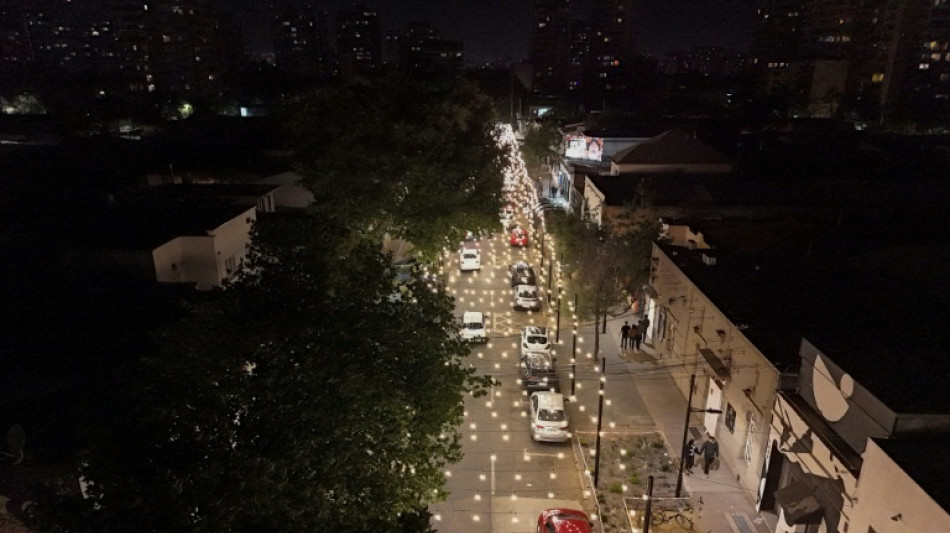
Pining for Pinochet: how crime fanned nostalgia for Chile's dictator / Photo: Raul BRAVO - AFP

 Waze rejects Malaysia's data security claims after civil servant ban

 'Call of Duty' seeks to win back fans with warfare spectacle

 Volvo Cars shares plunge on losses, job cuts
 France braces for new protests as Macron seeks to restore order

 Kering shares tumble as Gucci fails to reassure investors

 West Bank attack wounds 5 as Israel PM cancels events
 Ahead of APEC summit, Trump comes knocking on Kim's door
 Emergency nurseries rescue DR Congo's Ebola orphans

 Bezzecchi tops Australian MotoGP practice as wallaby hops onto track

 Under-threat Ospreys bet on new ground and Australian 'stardust'

 India stirs up its gastronomy with French cooking schools

 Williams, Santos lead Bears over Patriots

 China's first AI film hits cinemas but ticket sales lag
 Barcelona aiming to put Real Madrid out of sight in Clasico

 Taiwan shuts down as Typhoon Champi approaches

 370 books in 20 months: S.African author defends her use of AI
 76ers rally to stun Cavs in James's first home game for Philadelphia
 How are Ukraine strikes, Mideast war driving US fuel prices?
 Colombia's Indigenous Guard up in arms over new president's agenda

 From tech giants to anonymous nonprofits, the biggest donors in US midterms
 Israel's far-right Ben Gvir seeks new ground in election

 Trump slams NBA's LeBron James for national anthem actions

 Australia sanctions North Koreans over 'fraudulent' IT work, cybercrime

 UK singer-songwriter Raye wins Mercury Prize for second album

 Antonelli needs ‘perfect weekend’ to realise title dream

One Saturday morning in September, four men burst into Miguel Angel Bravo's home in a quiet, middle-class neighborhood of Chile's capital Santiago.
The 61-year-old accountant, who lives with his wife and daughter, had activated an alarm and put a padlock on the gate the night before.
But four armed attackers easily overcame those defenses to burst into his bedroom, beat him with an iron bar, steal his wallet and phone and make their getaway in his car.
Such attacks were almost unheard of in Chile a decade ago.
But the past decade has brought a surge in armed robberies, kidnappings and murders, turning security into a national obsession that is driving voters to the right ahead of presidential elections on November 16.
After nearly four years of center-left rule, polls show Chileans clamoring for order and authoritarianism, with growing numbers openly expressing nostalgia for the 1973-1990 dictatorship of late general Augusto Pinochet.
The election frontrunner, far-right candidate Jose Antonio Kast, is an ardent defender of the general who overthrew socialist president Salvador Allende in 1973.
"If he (Pinochet) were alive, he would vote for me," Kast has boasted.
Kast is polling second, behind left-wing candidate Jeannette Jara of the Communist Party, in the first round of the presidential election.
But all polls show Jara losing to Kast or any other right-wing rival if, as expected, the election goes to a second round on December 14.
- Seeking 'peace of mind' -
Chile is one of the South America's safest countries, but murders and kidnappings have more than doubled in the past decade, causing deep disquiet in a nation with a reputation for stability.
Bravo, who still has a scar on his forehead from the attack at his home, echoes the sentiments of many Chileans who feel their country is being lost to crime.
"They take away your peace of mind," he said, referring to criminal gangs.
The situation has been widely blamed on transnational crime gangs from countries such as Venezuela, Peru and Bolivia, whose arrival in Chile has coincided with an unprecedented migration wave, particularly from Venezuela.
From left-wing candidate Jeannette Jara, a communist, to far-right frontrunner Jose Antonio Kast, all eight presidential hopefuls have promised to crack down on crime.
Kast has also vowed mass deportations of undocumented migrants.
Bravo, who plans to move out of his home into a secure apartment complex, sees such promises as pure electioneering.
But on social media and among Chilean youth, calls for a return to the iron-fisted policies of the past have grown louder.
Messages declaring "we need another one like him" abound on the "Don_Pinochet1973" TikTok account, which has nearly 10,000 followers.
Some of Pinochet's fans weren't born when he and other generals ordered warplanes to bomb the presidential palace on September 11, 1973 and had thousands of opponents rounded up and murdered or disappeared.
"I didn't live through that time, but we need someone who takes a firm hand like he did," Vicente Sepulveda, a 20-year-old engineering student, told AFP.
Sociologist Matias Rodríguez, a lecturer at the Academy of Christian Humanism University in Santiago, attributed Pinochet's popularity among younger Chileans to a lack of awareness about the gravity of his crimes.
In schools, the dictatorship "is studied without an explicit condemnation of human rights violations," he noted.
- The Bukele model -
Pinochet died in 2006 without being convicted of any crime.
A survey of the country's most admired figures conducted by Cadem pollsters in September placed him tied for second with former right-wing president Sebastian Pinera, behind 19th century naval hero Arturo Prat and Nobel Literature laureate Gabriela Mistral, tied in first.
Antonio Vasquez, a 51-year-old computer programmer who heads a residents' crime-watch association in Bravo's neighborhood of Penalolen, said he would vote for Kast so that people could "rest easy" again, as they did "during the dictatorship" and in the first years after Chile's return to democracy.
Kast, meanwhile, is looking to the Central American country of El Salvador for inspiration on crushing criminal gangs.
El Salvador's President Nayib Bukele, a hero of US leader Donald Trump, has locked up tens of thousands of suspected gang members without charge in a brutal mega-jail cut off from the outside world.
On a visit to El Salvador last year, Kast praised Bukele for helping millions of Salvadorans "regain their freedom" from gangs.
D.Khalil--SF-PST