African armies turn to drones with devastating civilian impact / Photo: Thomas SAMSON - AFP

 Monaco hold Lille as both move to top of Ligue 1

 Isak extends hot streak as Liverpool sink Brighton

 Brazil chooses between Lula and Bolsonaro in nail-biter vote

 Doha opens ninth World Investment Forum focused on future investment

 Kuwait public works minister and UK ambassador discuss closer cooperation

 Historic Ramallah olive press joins modern production with local tradition

 Hebron operation forces 373 Palestinian families from their homes

 Chicago Fire rally past Atlanta United 3-2 to hold fourth place

 Credit-card shortcuts can turn impulse spending into lasting debt

 Insurance deductibles and no-claim bonuses require a careful claims decision

 Poland’s WB Group plans $100 million India investment for drone production

 John Catlin wins Hong Kong Open and secures first Masters invitation

 KIB Group nine-month profit rises 30% to KD 26.6 million

 شركات عائلية من دبي تدرس تجارب هونغ كونغ في الحوكمة وانتقال الثروة

 تحالف إماراتي أفريقي يدرس مشاريع الطاقة والتعدين والبنية التحتية

 كأس الإمارات للناشئين يعزز مسار اكتشاف مواهب الغولف

 نازحو مخيم الإسراء في غزة يواجهون نقص الغذاء وتراجع المساعدات

 فيديو انتخابي لبن غفير من سجن عوفر يثير انتقادات

 هيئة حقوقية تحذر من تهجير وهدم واسع في الخليل

 الأمير علي ينتقد دعم الاتحاد الآسيوي لإنفانتينو ويطالب بالشفافية

 أربع ملفات قد تتغير إذا سيطر الديمقراطيون على الكونغرس الأميركي

 حرية التنقل تعيد ملف علاقة بريطانيا بالاتحاد الأوروبي إلى الواجهة

 Pinheiro Braathen wins Soelden giant slalom

 Man Utd's Fernandes dropped by Carrick after Como outburst
 التفكجي: قيود الترخيص والهدم تضغط على الوجود الفلسطيني في القدس

The Easter period usually offers a rare respite in Gedeb, in Ethiopia's deeply troubled north, but on April 17 death rained from the skies in this sleepy town caught up in a war between rebels and the army.
On this important holiday for Ethiopian Orthodox and Protestant Christians, many families had gathered in the morning to repair the local primary school.
But out of the blue, shortly before 11:00 am (1400 GMT), "a drone fired on the crowd and pulverised many people right in front of my eyes", a resident told AFP.
Ethiopia and many other African nations are increasingly turning to drones as a low-cost means of waging war, often with mixed military results but devastating consequences for civilian populations.
Last year, Ethiopia carried out a total of 54 drone strikes, compared to 62 attacks in Mali, 82 in Burkina Faso and 266 in Sudan, according to data collected by the Armed Conflict Location & Event Data Project (ACLED), a US-based monitor.
According to one of two Gedeb residents contacted by AFP, the strike killed "at least" 50 people, and according to the second, more than 100 -- a figure corroborated by several local media outlets.
It is one of the deadliest in a series of drone attacks since the conflict began in August 2023, pitting the Ethiopian army against the Fano, the traditional "self-defence" militias of the Amhara ethnic group.
A shoe seller at the scene, whose nephew was killed instantly, also blamed an armed drone that continued to "hover in the air" some 20 minutes after the strike.
"The sight was horrific: there were heads, torsos and limbs flying everywhere and seriously injured people screaming in pain," he recalled.
Ethiopian authorities have not released any information about this attack in Amhara, where the security situation makes some areas very difficult to access and communications are subject to significant restrictions.
The Ethiopian army's use of drones, which began during the bloody Tigray War (2020-2022), has since spread to the Amhara and Oromia regions amid multiple insurgencies.
In the Amhara region alone, now the hardest-hit, at least 669 people have been killed in more than 70 drone strikes since 2023, according to ACLED data analysed by AFP.
- Low-cost -
Remotely piloted aircraft used for reconnaissance and strikes -- low-cost technologies now ubiquitous in current conflicts and particularly in Ukraine -- are generating massive interest in Africa.
Some 30 African governments have acquired drones, according to data cross-referenced by AFP from the International Institute for Strategic Studies (IISS) "Military Balance" and the Center for a New American Security's Drone Proliferation Dataset.
For decades, wars in Africa had been fought on land, conducted primarily by light and mobile infantry units.
"Drones offer sub-Saharan African militaries more affordable and flexible access to air power, which has been out of reach until now due to its cost and operational complexity," said Djenabou Cisse, a west African security specialist at the Foundation for Strategic Research.
Countries like China, Turkey and Iran have the advantage of selling drones "without attaching any political conditionality related to respect for human rights", she added.
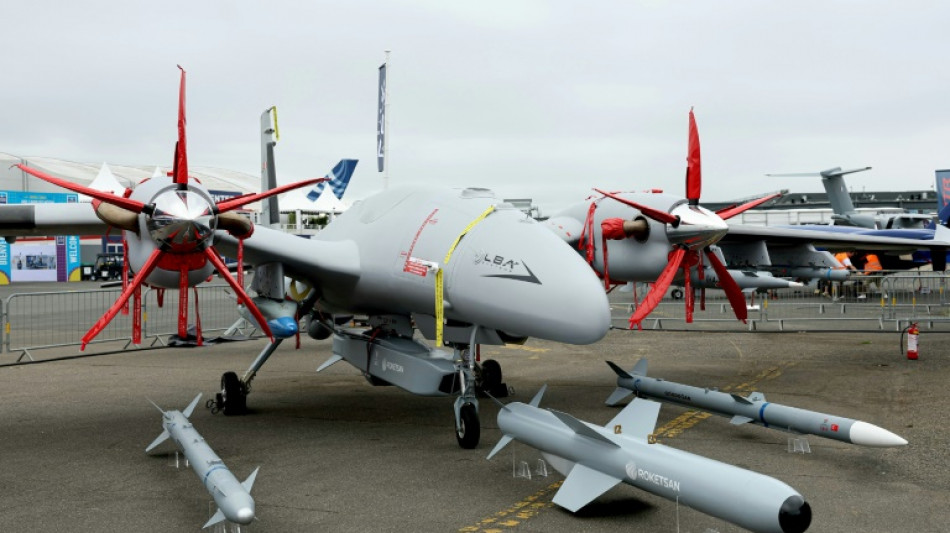
Among African military commands, the most popular is undoubtedly the Turkish Bayraktar TB2 drone, which, along with its big brother, the Akinci, has dethroned the Chinese Wing Loong in recent years.
The TB2 made a notable appearance in 2019 in Libya, the first African theatre of drone warfare, between the Ankara-backed Government of National Accord and its eastern rival, Marshal Haftar, equipped with Chinese weapons supplied by the United Arab Emirates.
The following year, its deployment in the Karabakh region during the conflict between Armenia and Azerbaijan, and then in Ukraine starting in 2022, boosted its popularity.
Orders soared and waiting lists grew. While contract details are kept secret, experts consulted by AFP estimate that a "system" of three drones costs nearly $6 million -- significantly less than the several tens of millions for a fighter jet or combat helicopter.
This offsets its rather average performance, with a range limited to 150 kilometres (75 miles).
The TB2 is produced by private company Baykar, headed by the son-in-law of Turkish President Recep Tayyip Erdogan.
It "is now an integral part of Turkey's foreign policy, whose strategy is to export its military products worldwide," said Batu Coskun, a researcher at the Sediq Institute in Tripoli.
The growing footprint of Turkish drones in Africa is partly due to the fact that unlike the West, Ankara is free from the cumbersome export control procedures for military equipment.
"It's essentially at the president's discretion," he said.
- Turkish military cooperation -
After severing ties with former colonial ruler France, the military regimes of Mali, Burkina Faso and Niger have turned to Turkish drones to attack jihadist fighters as well as separatists.
In December last year, the Malian army eliminated a leader and several members of the Azawad Liberation Front (FLA), a pro-independence coalition, in a drone attack.
In November 2023, drones played a decisive role in the recapture of the northern Malian city of Kidal from predominantly Tuareg rebels.
A senior Malian officer praised the "discretion" of Turkish military cooperation.
"When you pay for military equipment in the West, it has to go through political agreements, negotiations," he said, speaking on condition of anonymity.
"With Turkey, we have a speed that we don't have elsewhere, not even in Russia or China," two countries that also supply military equipment, he added.
According to a young Malian surveillance drone pilot, who also wished to remain anonymous, the Turkish aircraft "are easy to pilot, which means we don't need a long training period".
In Chad, four Turkish drones have replaced French fighter jets at the forward bases they occupied until N'Djamena ended its military cooperation agreements with France at the end of 2024.
The latter had repeatedly provided air support to help the Chadian government halt the advance of rebels threatening the capital.
The capital N'Djamena is equipped with only five Russian Sukhoi aircraft and as many ageing Mi-24 helicopters.
Contrary to Franco-Chadian relations, "there is no military cooperation agreement (between N'Djamena and Ankara) but a trade agreement that allows us to acquire military equipment", a Chadian officer told AFP.
Turks are present to provide technical assistance and the former French bases are "entirely in the hands of the Chadian military", the same source added.
This flexible cooperation on drones clearly illustrates the desire of some African leaders to "assert their sovereignty and greater strategic autonomy". said researcher Djenabou Cisse.
- 'Extreme fear' -
On the ground, however, the tactical and strategic gains from the use of drones do not always materialise, several experts said.
"Drones alone cannot defeat an adversary," Cisse said, adding: "We saw this in Libya, where both sides had sophisticated drones, and more recently in Sudan, where each side uses drones, but with very unequal capabilities."
"Not only have these countries failed to fully stabilise but conflicts have often become entrenched or even escalated," the researcher added.
Drones are proving especially decisive in open terrain, when the enemy is unable to disperse and hide as is the case with jihadists in the Sahel, according to a detailed study by the German Institute for International and Security Affairs (SWP).
In Ethiopia, they helped turn the tide of the conflict in Tigray at a key moment, giving a decisive advantage to federal forces without, however, securing a definitive victory.
In the summer of 2021, a large column of Tigray rebel forces, which reached within 200 kilometres of Addis Ababa and threatened to seize the capital, was stopped by the arsenal of drones deployed by the government.
Analysis of satellite images by Dutch peace organisation PAX at several Ethiopian air bases confirmed the presence of TB2s and, more recently, the Akinci, as well as Chinese Wing Loongs and Iranian Mohajer-6s.
These drones have "significantly increased the Ethiopian army's intelligence, surveillance and reconnaissance capabilities, as they can prowl for nearly 24 hours, track enemy movements, identify their positions, provide targeting information or directly strike targets," Wim Zwijnenburg, a drone specialist for PAX, told AFP.
While the fighting subsequently focused primarily on Tigray, it continued into 2022 and high tensions remain in the region despite the conclusion of a fragile peace agreement, while other hotbeds of violent insurrection have spread to Amhara and Oromia.
Ethiopian Prime Minister Abiy Ahmed, winner of the 2019 Nobel Peace Prize for his peace efforts with neighbouring Eritrea, is now regularly accused of indiscriminate abuses against the population.
"The drones continued to target civilians despite the presence of sophisticated sensor systems, high-definition cameras and night vision," supposedly allowing for better threat identification, said Zwijnenburg, deploring "a lack of operator training or, in the worst case, a deliberate decision".
In Gedeb, the small Amhara town targeted during Passover, residents contacted by AFP said there had been no fighting in the area in the run-up to the attack.
They live in constant fear now.
"We are ready to flee to the bush at any moment in the event of a sudden drone strike," said one of them. "We live in extreme fear."
burs-cl-mra/dab/sva/ach/cw/djt
R.Halabi--SF-PST