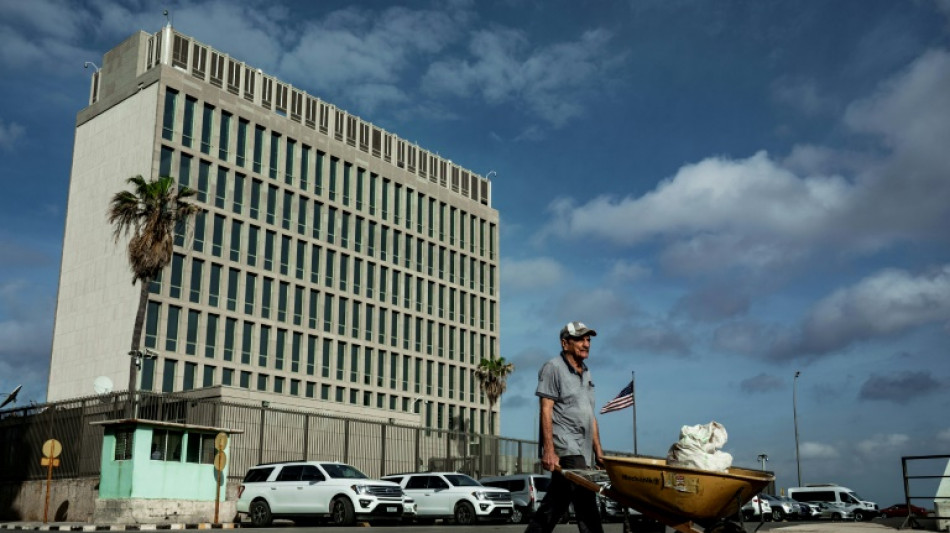
New research deepens Havana Syndrome mystery / Photo: YAMIL LAGE - AFP

 Stocks move lower despite oil prices dropping

 AI driving up innovation investment: UN

 UN Security Council extends Haiti mission by 6 months

 Man Utd do not deserve medals if Man City stripped of titles: Rooney

 Vana Completes Expanded Staking as Part of the Vega Upgrade, Publishes Expanded VANA Token Economics

 Spain to cap gas price hikes, extend fuel discounts

 'We just need rain': Germany's Rhine river hits new low

 Yemen health system at 'breaking point': WHO

 Ireland undecided on second Israel match: coach

 France's Le Pen defiant after top ally hit by antisemitism claims

 Tom Cruise trades stunts for satire as toxic tycoon 'Digger'

 MEXC Unveils "WE SEE YOU" Brand Visual Refresh, Putting People Behind Every Trade in Focus

 Thai capital cleans up after deadly floods

 NATO, EU allies rally to Estonia after 'sabotage' blamed on Russia

 Families demand justice for Cameroon's 'nightmare' wave of murdered women

 Tebas says Man City should face 'most severe' sanctions if guilty of rule breaches

 Pochettino calls Man City success 'a period of deception'

 Settler attack on West Bank village injures Israeli forces, drawing rare rebuke

 Mystery over UK airbase scare after reports no explosives found

 Spanish govt races to adopt housing law under protest pressure

 Estonia slams Russian 'sabotage' after arson attack on defence company

 Slovenia sees surge in '.si' sites after Trump hypes 'super intelligence'
 'Like a dream' for An as Games organisers 'sorry' for latest mix-up
 Tokyo suffers longest streak of rainy days on record

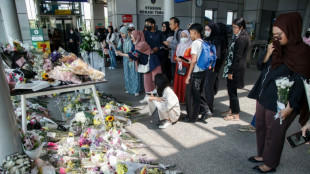 Indonesia charges train driver over crash that killed 16 women
The mystery of so-called Havana Syndrome, which struck down dozens of US diplomats, deepened Monday as new research found no tangible evidence of brain injury in those affected.
Researchers at the National Institutes of Health (NIH) acknowledged that ongoing symptoms including migraines, chronic dizziness, and depression are still very much real -- even if they cannot yet be explained.
Havana Syndrome first baffled officials in 2016 when US diplomats in Cuba's capital reported falling ill and hearing piercing sounds at night, sparking speculation of an attack by a foreign enemy using an unspecified sonar weapon.
Similar reports of the illness later emerged from embassy staff in China, Europe and US capital Washington.
Yet despite the "disabling" symptoms, people with Havana Syndrome -- formally referred to as anomalous health incidents (AHIs) -- show no clinical differences, according to two new papers published Monday in peer-reviewed journal JAMA.
Leighton Chan, lead author of one of the papers, said "it's important to acknowledge that these symptoms are very real, cause significant disruption in the lives of those affected and can be quite prolonged, disabling and difficult to treat."
In this study, researchers assessed more than 80 US government officials and their family members using MRI brain scans and other blood, visual and auditory tests. They were compared with a control group of overseas US officials who had similar work assignments but were unaffected by the symptoms.
It found those with AHIs self-reported increased symptoms of fatigue, post-traumatic stress and depression.
- 'Genuine, distressing' -
Forty one percent of those with AHIs met the criteria for "functional neurological disorder" -- problems with the way the brain sends and receives information from the rest of the body, and as a result nearly all with this dysfunction could be diagnosed with a chronic form of dizziness.
"These individuals have symptoms that are genuine, distressing, and can be quite prolonged, disabling, and difficult to treat," said the researchers.
In the second paper, participants underwent MRI scans to examine their brain size, structure, and function. These were carried out on average 80 days after symptom onset and revealed no imaging abnormalities differentiating the group with AHIs.
But this "does not exclude that an adverse event impacting the brain occurred at the time of the AHI," said Carlo Pierpaoli, who led the study.
The US State Department was reviewing the research, a spokesperson said Monday, adding its "top priority remains the health, safety, and security of the Department’s personnel and family members."
US intelligence had said in 2022 that intense directed energy from an external source could have caused some cases of Havana Syndrome, officially known as anomalous health incidents (AHIs).
But in March 2023 intelligence agencies concluded that "there is no credible evidence that a foreign adversary has a weapon or collection device that is causing AHIs."
They reported the symptoms were probably the result of preexisting conditions, conventional illnesses and environmental factors.
David Relman of Stanford University, who has led previous research into Havana, said the new study was flawed as not all brain injuries were detectable with the tests used.
In an editorial also published in JAMA, Relman cited two previous studies he contributed to which found the cases "to be unlike any disorder reported in the neurological or general medical literature, and potentially caused by an external mechanism."
Q.Najjar--SF-PST