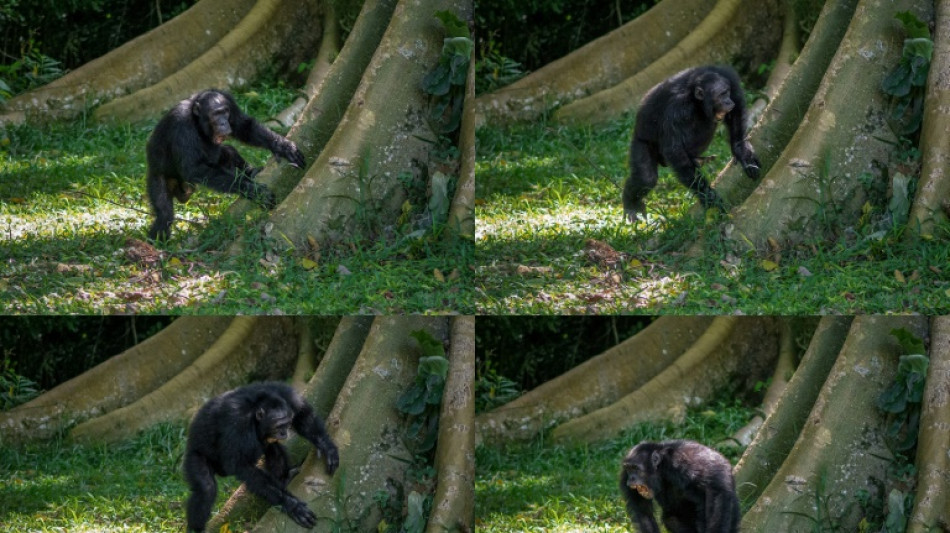
Jungle music: Chimp drumming reveals building blocks of human rhythm / Photo: Adrian Soldati - University of St Andrews/AFP/File

 Rose, Scott among 2027 World Golf Hall of Fame finalists

 Brunson says NBA champion Knicks can't get satisfaction

 France puts out largest wildfire since 1949

 Real Madrid's Perez summoned over Barcelona referee payments comments

 Oil takes off again, Wall Street dips after Trump rejects Iran truce offer

 AlgoQuant Asset Management Selects Liquid Mercury to Enhance Digital Asset Trading Infrastructure

 UK to reopen refugee resettlement scheme to push 'safe' migration

 Pope urges Europe to help combat 'lies and deceit' in world affairs

 Iranian lawyer Nasrin Sotoudeh wins Council of Europe's rights prize

 French far-right's Bardella denies alleged 2013 antisemitic comments

 Oil up, Wall Street dips after Trump rejects Iran truce offer

 Gakpo withdraws from Netherlands squad

 SpaceX puts Starship megarocket in orbit for first time

 Iran denies link to suspected bomb plot at UK airbase used by US

 Ex-boss Mancini says City charges 'not my concern'

 Berlin Marathon winner Assefa finished race with torn Achilles

 Comedian convicted for Erdogan 'insult' but freed pending appeal

 French prosecutors seek two-year sentence for ex-minister Dati in graft case

 Eala makes fast start as weather and transport woes hit Asian Games

 Hurricane Polo approaches Mexico, threatens severe damage

 Energy markets rally after Trump rejects Iran truce offer

 Japanese convenience store enlists Lady Gaga to bolster recruitment

 Seoul summons Ukraine envoy in row over North Korean POWs

 Ireland 'raised awareness worldwide' in Israel game: Hallgrimsson

 Colombian police capture wife, daughter of Ecuador drug lord

Out west, they groove with fast, evenly spaced beats. In the east, it's more free-form and fluid.
Like humans, chimpanzees drum with distinct rhythms -- and two subspecies living on opposite sides of Africa have their own signature styles, according to a study published Friday in Current Biology.
The idea that ape drumming might hold clues to the origins of human musicality has long fascinated scientists, but collecting enough clean data amid the cacophony of the jungle had, until now, proven elusive.
"Finally we've been able to quantify that chimps drum rhythmically -- they don't just randomly drum," lead author Vesta Eleuteri of the University of Vienna told AFP.
The findings lend fresh weight to the theory that the raw ingredients of human music were present before our evolutionary split from chimpanzees six million years ago.
Previous work showed chimpanzees pound the huge flared buttress roots of rainforest trees to broadcast low‑frequency booms through dense foliage. Scientists believe these rhythmic signals help transmit information across both short and long distances.
For the new study, Eleuteri and colleagues -- including senior authors Catherine Hobaiter of the University of St. Andrews in the UK and Andrea Ravignani of Sapienza University in Rome -- compiled more than a century's worth of observational data.
After cutting through the noise, the team focused on 371 high-quality drumming bouts recorded from 11 chimpanzee communities across six populations living in both rainforest and savannah-woodland habitats across eastern and western Africa.
Their analysis showed that chimpanzees drum with definitive rhythmic intent -- the timing of their strikes is not random.
Distinct differences also emerged between subspecies: western chimpanzees tended to produce more evenly timed beats, while eastern chimpanzees more frequently alternated between shorter and longer intervals.
Western chimps also drummed more frequently, kept a quicker tempo, and began drumming earlier in their signature chimp calls, made up of rapid pants and hoots.
The researchers do not yet know what is driving the differences -- but they propose that it might signify differences in social dynamics.
The western chimps' faster, predictable pulse might promote or be evidence of greater social cohesion, the authors argue, noting that western groups are generally less aggressive toward outsiders.
By contrast, the eastern apes' variable rhythms could carry extra nuance -- handy for locating or signalling companions when their parties are more widely dispersed.
Next, Hobaiter says she would like to study the data further to understand whether there are intergenerational differences between rhythms within the same groups.
"Music is not only a difference between different musical styles, but a musical style like rock or jazz, is itself going to evolve over time," she said.
"We're actually going to have to find a way to tease apart group and intergenerational differences to get at that question of whether or not it is socially learned," she said.
"Do you have one guy that comes in with a new style and the next generation picks it up?"
N.Shalabi--SF-PST