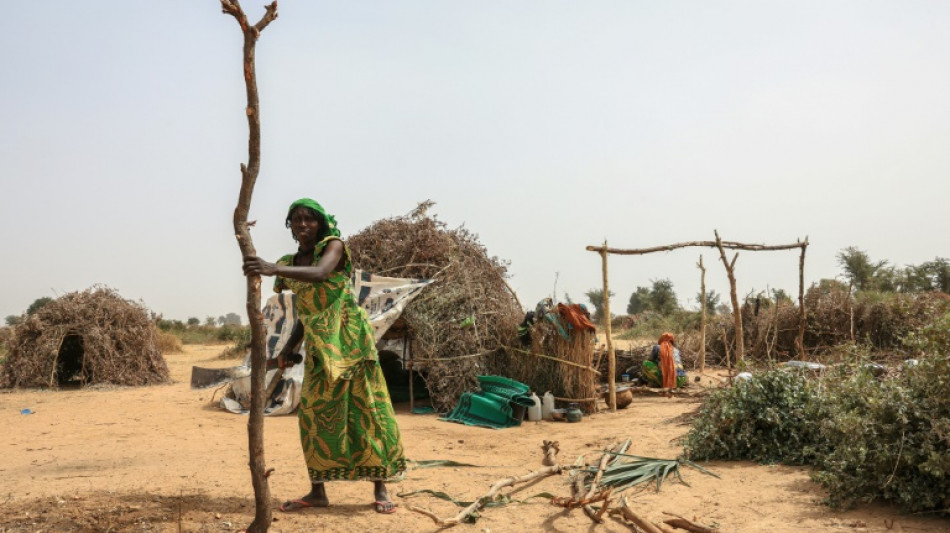
Climate crisis worsening already 'hellish' refugee situation: UN / Photo: Daniel Beloumou Olomo - AFP/File

 OpenAI cancels release of newest model due to safety concerns

 AI bosses head to White House as safety pressure builds
 Batista sacked as Costa Rica coach after six months
 Flooding, power cuts and evacuations as Hurricane Polo slams Mexico

 Dodgers eye three-peat, Red Sox face Yankees as MLB playoffs begin
 Certification of Boeing 737 MAX delayed by software bug

 Celine Dion wows Paris Fashion Week with surprise gig
 AMD buys firm founded by AI 'godmother' Fei-Fei Li

 Italy rebound in Turkey as France win late in Belgium

 Pope says concerns about AI 'should be taken seriously'

 Hurricanes to hoist title banner as NHL season begins

 Justice Alito steps aside from major US climate case

 Willis happy with England exile after retains Top 14 player award
 Spain housing protests keep heat on government as PM seeks new law

 Wissa spoils Zimbabwe homecoming as DR Congo win AFCON qualifier

 UK police release on bail five men held over airbase incident

 Ex-All Black Plummer 'sure' New Zealand will find Super Rugby solution

 Shein sees 1% revenue growth in first half of 2026
 Netherlands regrets Israel retaliation in settlements row

 Moscow seizes Russian assets of German food retailer Metro

 Bulgarian spirits inflamed by new rakia rules

 Documentary turns camera on architect Peter Zumthor
 UK police say releasing on bail five men held over airbase incident
 Trump admin finalizes reversal of US fuel economy standards

 US says no China arms sale plans after envoy cites Trump offer

Climate change is contributing to record numbers of people being uprooted from their homes globally, while worsening the often already "hellish" conditions of displacement, the United Nations said Tuesday.
With international climate talks under way in Baku, the UN refugee agency highlighted how soaring global temperatures and extreme weather events are impacting displacement numbers and conditions, as it called for more and better investment in mitigating the risks.
In a fresh report, UNHCR pointed to how climate shocks in places like Sudan, Somalia and Myanmar were interacting with conflict to push those already in danger into even more dire situations.
"Across our warming world, drought, floods, life-threatening heat and other extreme weather events are creating emergencies with alarming frequency," UNHCR chief Filippo Grandi said in the foreword to the report.
"People forced to flee their homes are on the front lines of this crisis," he said, pointing out that 75 percent of displaced people live in countries with high-to-extreme exposure to climate-related hazards.
"As the speed and scale of climate change increase, this figure will only continue to rise."
- 120 million displaced -
A record 120 million people already live forcibly displaced by war, violence and persecution -- most of them inside their own countries, UNHCR figures from June showed.
"Globally, the number of people that have been displaced by conflict has doubled over the last 10 years," Andrew Harper, UNHCR's special advisor on climate action, pointed out to AFP.
At the same time, UNHCR pointed to recent data from the Internal Displacement Monitoring Centre indicating that weather-related disasters have displaced some 220 million people inside their countries over the past decade alone -- equivalent to approximately 60,000 displacements per day.
"We're just seeing more and more and more people being displaced," Harper said, lamenting a dire lack of the funds needed to support those who flee and the communities that host them.
"We are seeing across the board, a hellish situation become even tougher."
Most refugee settlement areas, he pointed out, are found in lower-income countries, frequently "in the desert, in areas which are prone to flooding, in places without necessary infrastructure to deal with the increasing impacts of climate change".
This is set to get worse. By 2040, the number of countries in the world facing extreme climate-related hazards is expected to rise from three to 65, UNHCR said, with the vast majority of them hosting displaced populations.
- Dangerous heat -
And by 2050, most refugee settlements and camps are projected to experience twice as many days of dangerous heat as they do today, the report cautioned.
That could not only be uncomfortable and a health hazard to the people living there, but could also lead to crop failures and livestock dying off, Harper warned.
"We're seeing increasing loss of arable land in places exposed to climate extremes, like Niger, Burkina Faso, Sudan, Afghanistan, but at the same time we've got the massive increase in populations," he said.
UNHCR is urging decision-makers gathered for the COP29 in Baku to ensure that far more of international climate financing reaches refugees and host communities most in need.
Currently, UNHCR pointed out, extremely fragile states receive only around $2 per person in annual adaptation funding, compared to $161 per person in non-fragile states.
Without more investment in building climate resilience and adaptation in such communities, more displacement towards countries less impacted by climate change will be inevitable, Harper said.
"If we don't invest in peace, if we don't invest in climate adaptation in these areas, then people will move," he said.
"It's illogical to expect them to do anything different."
U.Shaheen--SF-PST